You’re writing a sentence. Maybe it’s “she was completely _____ in the novel,” or maybe you’re staring at a plant listing that says “emersed grown” and have no idea what that means for your fish tank. Either way, you’ve landed on one of English’s sneakier near-twins: immersed and emersed.
They differ by a single letter. They sound almost identical out loud. And they mean, in a very real sense, opposite things.
The short answer: Immersed means something is fully in or covered by something else — physically or figuratively.
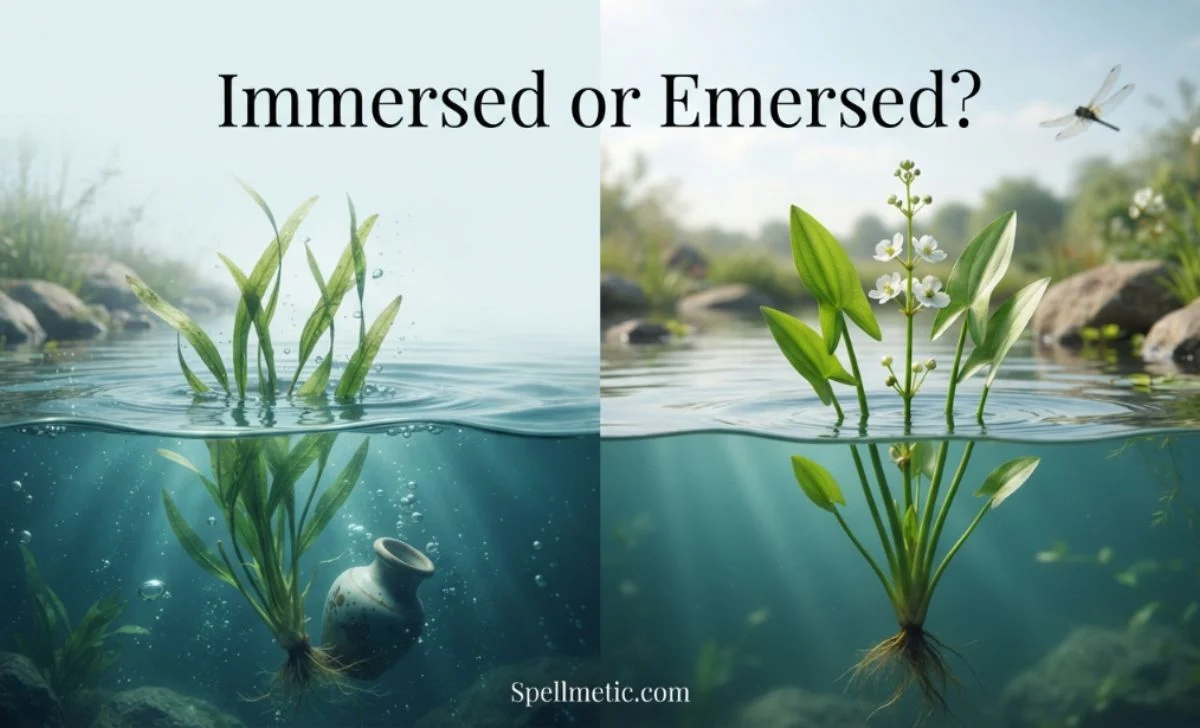
Emersed means something has come out of or risen above a surface, usually water. If you’re describing deep focus, being underwater, or being covered in something, you want immersed. If you’re describing a plant, object, or celestial body that’s emerging above a surface, you want emersed.
That covers the basic rule. But if you’ve ended up here, you’re probably dealing with one of two very different situations — a writing/grammar question, or an aquarium/botany question — and most explanations online only answer one of them well. This one covers both.
Immersed vs. Emersed: The Core Difference
Both words trace back to the same Latin verb, mergere, meaning “to dip” or “to plunge.” The prefixes are what send them in opposite directions:
- Im- (a form of in-) means “into.” Immersus, the Latin root of immersed, literally means “plunged into.”
- E- (a form of ex-) means “out of.” Emersus, the root of emersed, means “risen out of.”
So the direction of the prefix is the meaning. Immersion goes in. Emersion comes out. Merriam-Webster defines “immerse” as to plunge or dip into a fluid, and separately to become deeply involved — while its entry for “emerge” (the more common cousin of “emerse”) centers on coming into view or rising up out of something.
Once you anchor the two words to that in/out logic, the confusion mostly disappears.
Immersed: Meaning and Everyday Use
Immersed does double duty in English — a literal, physical sense and a figurative, mental one.
Literal: something is physically submerged in liquid.
- The thermometer needs to stay immersed in the water for two minutes.
- Keep the vegetables immersed in brine overnight.
Figurative: someone is deeply absorbed, involved, or surrounded by something non-physical — a task, an emotion, a culture, a situation.
- She was so immersed in the case file she didn’t hear the phone ring.
- Living abroad for a year got him immersed in the language faster than any class could.
- The company found itself immersed in a lawsuit it hadn’t planned for.
This figurative sense is where most of the modern life of the word “immersed” actually happens, and it’s spawned a whole family of related terms worth knowing:
- Immersive — technology or experiences (VR, theater, exhibits) designed to surround you completely.
- Immersion therapy — a psychological treatment where a person is gradually exposed to a feared stimulus.
- Immersion blender — a hand blender you submerge directly into a pot or bowl.
- Language immersion — learning a language by being surrounded by it constantly, rather than studying it in isolation.
None of these use “emersed” — and that’s a useful gut check. If the sentence is about focus, involvement, exposure, or being surrounded, the word is almost certainly “immersed.”
Immersed in Culture: What Does It Mean?
Immersed in culture means becoming deeply involved in the customs, language, traditions, values, and everyday life of a particular culture.
For example:
After moving to Spain, she became immersed in the local culture.
Here, immersed is figurative. It does not mean physically placed underwater. It means the person is surrounded by and actively experiencing the culture.
You can also say:
- immersed in American culture
- immersed in a new culture
- immersed in local traditions
- immersed in another language and culture
Emersed does not normally work in this meaning. In standard usage, immersed in culture is the natural expression.
Emersed: Meaning and Where You’ll Actually See It
Emersed is far less common in everyday writing, which is exactly why it trips people up — most readers only half-remember it, if at all. It means something has risen out of, or exists above, a surrounding medium, almost always water.
You’ll run into “emersed” in three fairly specific fields, and knowing them helps the word actually stick.
1. Botany and aquascaping
This is where “emersed” earns its keep. In aquatic plant care, emersed growth describes a plant grown with its roots in water (or wet soil) but its leaves and stems in the air, above the waterline. Submersed growth (or “submerged”) describes the same plant grown fully underwater.
This isn’t a minor technicality — it changes how a plant looks and behaves. Nurseries commonly grow aquarium plants like Cryptocoryne, Anubias, and Amazon Sword emersed, above water, because it’s faster, cheaper, and produces hardier, algae-free, pest-free stock than growing them fully submerged.
The catch: an emersed-grown plant often looks noticeably different from its submersed form — different leaf shape, thickness, even color — and it needs a transition period after planting, during which the old emersed leaves die back and new, thinner submersed leaves take over.
If you’ve ever bought an aquarium plant online and had it arrive looking nothing like the photo, this is almost always why.
- The Cryptocoryne was grown emersed, so expect some leaf melt in the first few weeks underwater.
- Emersed plants ship better because their leaves are thicker and more rigid.
2. Astronomy
In astronomy, emersion refers to the moment a celestial body reappears after being hidden — for example, when a star or planet re-emerges from behind the moon during an occultation, or when the sun reappears at the end of a solar eclipse.
It’s the direct counterpart to “immersion,” which in this context describes the moment the body disappears from view.
- Astronomers timed the emersion of the star to the second.
3. Marine and wetland contexts
More broadly, “emersed” describes anything that has risen above a water level that once covered it — a rock exposed at low tide, land that appears as floodwaters recede, or a ship’s hull rising above the waterline.
Emersed vs. Emerged vs. Emergent: The Third Confusable Word
Just when “immersed vs. emersed” seems settled, a third word wanders in: emerged. These are not interchangeable, even though they look related and sometimes get swapped in casual writing.
- Emerged is the everyday, general-purpose word for something coming into view, becoming known, or appearing — a trend emerged, a leader emerged, the truth emerged. It’s not tied to water or a specific field.
- Emersed is the specialized, mostly scientific adjective, almost always describing something physically rising above a liquid surface — a plant, a rock, a celestial body.
- Emergent, used heavily in ecology, describes plants that are rooted underwater but grow up through the surface — cattails and reeds are classic emergent (or emersed) vegetation.
A simple test: if you could just as easily say “appeared” or “came to light,” you want emerged. If you’re specifically talking about something rising above a water line in a scientific or technical sense, emersed (or emergent) is the more precise, field-appropriate word.
Immersed or Emersed Examples
The difference becomes easier to understand when you see the words in real sentences.
Examples with immersed:
- She was completely immersed in the novel.
- The roots were immersed in water.
- He became immersed in his studies before the exam.
- The child was fully immersed in the new culture.
Examples with emersed:
- The aquarium plant was grown emersed above the water.
- The plant developed different leaves when grown emersed.
- Several leaves remained emersed while the roots stayed underwater.
Use immersed for something that is fully under a liquid or deeply involved in an activity, subject, or experience. Use emersed mainly for something, especially a plant or plant part, that rises above water.
Immersed vs. Submersed vs. Submerged: A Related Mix-Up
Here’s something almost no general grammar resource mentions, and it’s exactly the kind of detail that trips up aquarium hobbyists: in plant and aquarium contexts, immersed, submersed, and submerged are all used to mean essentially the same thing — fully underwater.
Meanwhile, emersed and emergent cover the same “above water” territory. So a plant listing might describe the exact same growth state as “submerged,” “submersed,” or “immersed” depending on which supplier or forum you’re reading, and it isn’t a mistake — it’s just inconsistent terminology within the hobby itself.
If you’re shopping for aquarium plants, the distinction that actually matters isn’t which of those three synonyms a seller used — it’s whether the plant was grown emersed (out of water, and will need to transition) or submersed/submerged/immersed (already grown underwater, ready to plant as-is).
Word Forms at a Glance
| Verb | Adjective (past participle) | Noun | |
|---|---|---|---|
| In (submerge/involve) | immerse | immersed | immersion |
| Out (rise above) | emerse (rare, mostly technical) | emersed | emersion |
Note that “emerse” as a standalone verb is technically valid but rarely used in modern writing — most people reach for “emerge” instead, and reserve “emersed” specifically as the adjective for the botanical/astronomical/technical sense described above.
Immersed Synonym: What Words Can You Use?
The best immersed synonym depends on the context.
For physical situations, useful alternatives include submerged, underwater, and covered.
For figurative use, alternatives include:
- absorbed
- engrossed
- involved
- engaged
- focused
- wrapped up
For example:
She was immersed in her work.
You could also say:
She was absorbed in her work.
However, these words are not interchangeable in every sentence. Submerged usually describes something physically below water, while absorbed and engrossed describe deep mental involvement.
Real Example Sentences by Field
General writing:
He remained immersed in his work long after everyone else had gone home.
Psychology:
Immersion therapy gradually exposes patients to the source of their fear in a controlled setting.
Astronomy:
The eclipse’s emersion phase began just after 9:14 p.m., as sunlight reappeared along the moon’s edge.
Aquascaping:
Because the Bucephalandra was shipped emersed, keep it slightly above the substrate until new submersed leaves appear.
Wetland ecology:
Emergent, or emersed, vegetation like cattails plays a major role in filtering runoff before it reaches open water.
Immersed in Psychology: What Does It Mean?
In psychology and everyday descriptions of mental experience, immersed can describe a state of deep attention, involvement, or absorption.
Someone may become immersed in a task, story, game, conversation, or experience when their attention is strongly focused on it.
For example:
She became completely immersed in the game and lost track of time.
This idea is related to absorption, focused attention, engagement, and deep involvement.
The word emersed does not normally describe this psychological state. If you are talking about a person’s thoughts, attention, emotions, or experiences, immerse
Immersed Antonyms: What Is the Opposite?
Common immersed antonyms depend on the meaning.
For physical immersion, possible opposites include above, out of, dry, or exposed.
For figurative immersion, useful opposites include detached, uninvolved, distracted, and disengaged.
For example:
- Immersed in work → disengaged from work
- Immersed in water → out of the water
- Immersed in a culture → detached from the culture
The exact antonym depends on what immersed means in the sentence.
A Simple Way to Remember It
Match the prefix to the direction: Im- goes in. E- goes out. Immersed things are in — underwater, or absorbed in an activity. Emersed things are out — risen above the surface, back into view.
Common Mistakes
The overwhelming majority of real-world mix-ups go one direction: people write or say “emersed” when they mean “immersed” (as in “I was totally emersed in the movie”), simply because “immersed” is the far more common word and “emersed” sounds like it could be a fancier variant.
It isn’t — it’s a different word with a specific, mostly technical meaning. If you’re describing focus, emotion, or being covered in something, “emersed” is virtually never correct.
The reverse mistake — using “immersed” when you mean the botanical or astronomical “emersed” — is rarer, but it does show up in casual aquarium-forum posts where people default to the more familiar word without realizing a plant description needs the more precise term.
FAQ
Is “emersed” a real word?
Yes. Emersed is a real English word used mainly in botany, aquascaping, and astronomy to describe something that rises above a water surface. It is much less common than immersed.
What’s the difference between emersed and submersed aquarium plants?
Emersed plants grow with their leaves above the water, while submersed plants grow completely underwater. Many aquarium plants are sold emersed and later adapt to underwater conditions.
Is “immersed” or “emersed” correct for describing being absorbed in a book, culture, or activity?
Use immersed when talking about being deeply involved in a book, culture, or activity. Emersed is only used in scientific contexts and not for figurative meanings.
What does emersion mean in astronomy?
In astronomy, emersion is the moment a celestial object reappears after being hidden. It is the opposite of immersion, which describes the object disappearing from view.
Are “emersed” and “emerged” the same word?
No. Emerged means something has come into view or become known, while emersed is a scientific term for something that rises above a water surface.
Is “emersed” British or American English?
Neither. Emersed is used the same way in both British and American English, but it is a specialized scientific term rather than a regional spelling.
Why do my aquarium plants look different from the picture when they arrive?
Many aquarium plants are grown emersed for easier shipping. After being placed underwater, they often grow new leaves adapted to their submersed environment.
Key Takeaways
- Immersed = in, covered, or deeply involved (physically or figuratively).
- Emersed = out, risen above a surface — almost always used in botany, aquascaping, or astronomy.
- Emerged is the general-purpose word for “came into view”; emersed is the technical, water-specific term.
- In aquarium contexts, “immersed,” “submersed,” and “submerged” are used interchangeably for “underwater,” while “emersed” and “emergent” both mean “above water.”
- When in doubt, match the prefix: im- in, e- out.
Related Blogs:
- Neither or Nither: Which One Should You Use In English?
- Laptop or Labtop: What’s the Difference between Both Words
- Compair or Compare? Which Spelling Is Correct?