Many English users stop mid-sentence and hesitate when writing “coming or comming”. It looks like a small spelling issue, but in reality, it creates confusion in exams, emails, blogs, and professional communication.
The mistake usually comes from pronunciation habits, typing speed, and the assumption that English words always follow a simple double-letter pattern. Because of this, thousands of people search daily to confirm which spelling is correct.
This guide removes that confusion completely. You will learn the correct spelling, pronunciation, grammar rules, real-life usage, and memory tricks that make the difference unforgettable.
We will also break down why “comming” feels right but is actually wrong, and how English spelling rules work in words ending with “-ing”.
By the end of this article, you will confidently use “coming” in every context—formal, informal, academic, and professional, without ever second-guessing yourself again.
Quick Answer
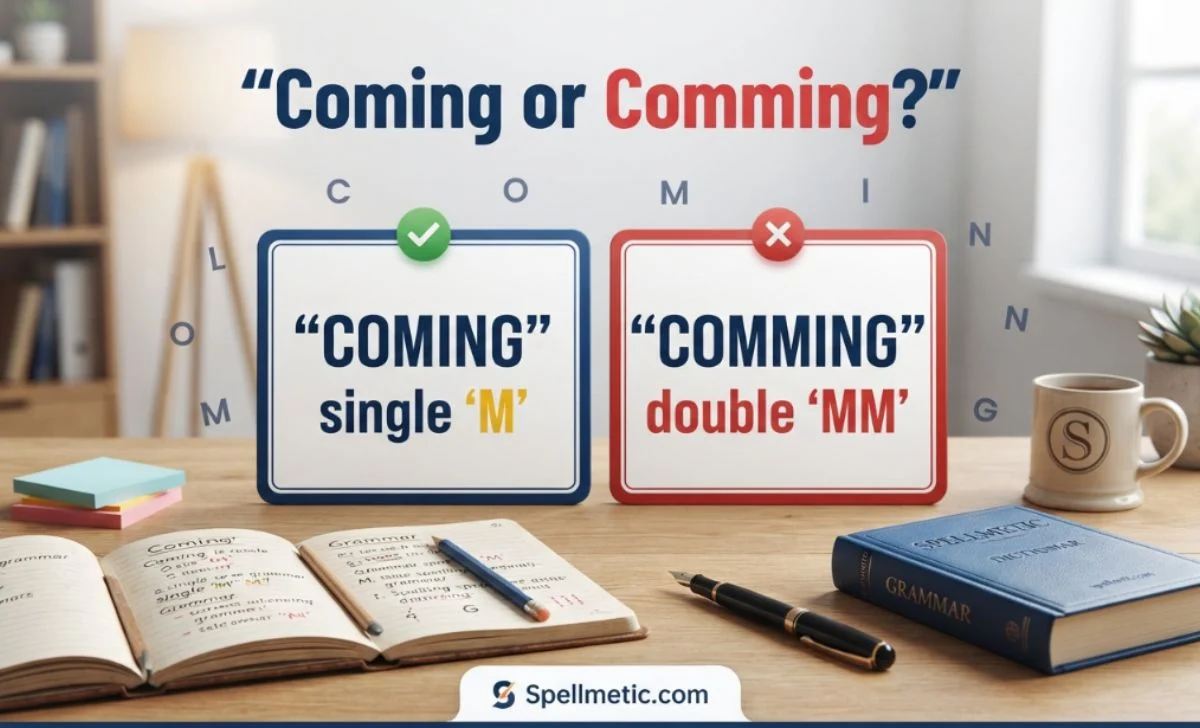
The correct spelling is coming.
The spelling comming is incorrect in all forms of English.
Examples:
- I am coming to the meeting. ✅
- She is coming home tomorrow. ✅
- He is comming late tonight. ❌
The word “coming” is the present participle of the verb “come”, widely used in continuous tenses in English Grammar.
It follows a simple rule:
- come → remove “e” → add “ing” = coming
There is no rule in English spelling that doubles the “m” in this word.
Comming has no standard English meaning because it is a misspelling. If you mean the act of arriving, approaching, or moving toward something, the correct word is coming.
How Do You Spell Coming?
The correct spelling is coming: C-O-M-I-N-G. The spelling comming is incorrect. When the verb come takes -ing, the final silent e is removed, giving coming.
Example:
She is comming home. ❌
She is coming home. ✅
Pronunciation of Coming (and Why It Confuses Writers)
Pronunciation: /ˈkʌmɪŋ/ (kum-ing)
- It sounds like “kumming”
- The “m” sound may feel slightly stretched in fast speech
- But spelling does NOT double the consonant
According to English Phonology, pronunciation and spelling often diverge in English, which is why learners write “comming” incorrectly.
Dictionaries like Cambridge Dictionary clearly list only “coming” as the correct form.
Why People Confuse Coming or Comming
The confusion is not random—it comes from multiple linguistic and cognitive reasons:
1. Sound-to-spelling mismatch
People hear a slightly heavier “m” sound and assume doubling.
2. Overgeneralization of grammar rules
Words like:
- running
- sitting
- planning
all use double letters, so learners incorrectly apply the same rule to “coming”.
3. Typing + memory interference
Fast typing often produces “comming” due to finger repetition.
4. English spelling complexity
English orthography in English Orthography is not fully phonetic.
Easy Trick to Remember Coming
Use this simple rule:
👉 “Come never doubles M in -ing form”
Or even easier:
- come → coming (just add -ing)
Memory hack:
Think:
“Running has double N, but coming stays single M.”
This contrast helps your brain lock the correct pattern.
Word History and Development (Etymology)
The word “come” originates from Old English “cuman”, meaning “to move toward, arrive, or approach”.
Evolution:
- Old English: cuman
- Middle English: comen
- Modern English: come → coming
The structure follows standard verb inflection rules in English Grammar.
The incorrect form “comming” has no historical linguistic root and does not appear in authoritative sources like the Oxford English Dictionary.
British vs American English Usage (Spelling Consistency)
Unlike many words in English, “coming” is identical in both British and American English.
| Region | Correct Form | Incorrect Form |
|---|---|---|
| British English | coming | comming |
| American English | coming | comming |
| Australian English | coming | comming |
| Canadian English | coming | comming |
There is no variation like color/colour or organize/organise. The spelling rule is globally fixed.
Which Form Should You Use in Writing?
Always use coming in:
- Academic writing
- Emails
- Business communication
- Social media
- Exams
- Formal reports
“Comming” is always marked as an error in grammar systems and spell check tools.
For global English communication, consistency matters. Standard English in English Language only accepts “coming”.
Common Mistakes with Coming or Comming
Here are real-world errors users make:
❌ Double “m” error
- I am comming home ❌
- I am coming home ✅
❌ Missing “g”
- I am comin ❌
- I am coming ✅
❌ Mixing verb forms
- becomeing ❌
- becoming ✅
❌ False analogy with “running”
People wrongly assume all -ing verbs double letters.
Comeing or Coming?
Comeing is incorrect. When come changes to its -ing form, the final silent e is removed before adding -ing.
- come → coming ✅
- come → comeing ❌
- come → comming ❌
Coming in Everyday English Usage
Emails:
- I am coming to the office at 9 AM.
- The manager is coming tomorrow.
News:
- Relief teams are coming to the affected area.
- Storm is coming toward the coast.
Social media:
- Weekend is coming 😎
- Summer is coming soon ☀️
Formal writing:
- The report is coming next week.
- The results are coming after review.
In all contexts, “coming” remains the only correct spelling.
Is “I Am Coming” Grammatically Correct?
Yes, “I am coming” is grammatically correct. It uses the present continuous form of come:
I + am + coming
It can describe movement happening now:
I am coming to your house.
It can also refer to a future arrangement when the context makes the meaning clear:
I am coming to the meeting tomorrow.
The spelling remains coming, never comming.
Can Coming Refer to the Future?
Yes. Coming can refer to something that is approaching in time or expected to happen soon. It is common with words such as week, month, year, season, event, and holiday.
Examples:
- The coming week will be busy.
- We are preparing for the coming year.
- The coming election will receive a lot of attention.
Here, coming means upcoming or approaching, not necessarily physical movement.
Coming vs Upcoming: What Is the Difference?
Coming and upcoming can both describe something that will happen soon, but they are not always interchangeable.
Coming is broader and can describe movement, arrival, or something approaching in time.
- The bus is coming.
- The coming weeks will be busy.
Upcoming mainly describes an event or something scheduled to happen soon.
- The upcoming meeting is important.
- We are preparing for an upcoming exam.
So, use coming for both movement and future time, while upcoming is especially common for future events.
Coming or Comming – Google Trends & Search Behavior
Search data shows:
- “coming meaning” → very high global volume
- “coming or comming” → learner confusion query
- “why is coming not comming” → grammar curiosity searches
Top countries:
- Pakistan
- India
- Philippines
- USA
- Nigeria
This shows the keyword is mostly searched for learning correction and spelling confirmation, not alternative usage.
Comparison Table: Coming vs Comming
| Feature | Coming | Comming |
|---|---|---|
| Correct spelling | Yes | No |
| Used in exams | Yes | No |
| Dictionary approved | Yes | No |
| Grammar valid | Yes | No |
| Professional use | Yes | No |
Only one form is valid in all English systems: coming.
Why “Comming” Feels Correct (Psychology + Language Insight)
Many learners feel “comming” is correct because:
- Brain expects symmetry in spelling
- Double letters appear “visually balanced”
- Similar sounding words reinforce wrong memory
This is a known cognitive issue in language learning where pattern recognition overrides grammar accuracy.
Verb Form Breakdown (Grammar Layer)
Base verb: come
Present participle: coming
Past tense: came
Past participle: come
There is no grammatical stage where “comming” appears in Verb Forms.
What Is the Difference Between Come and Coming?
Come is the base form of the verb, while coming is its present participle and gerund form.
- Come: Please come here.
- Coming: She is coming here.
The form coming is created by removing the silent e from come and adding -ing.
Why Might Spellcheck Fail to Fix “Comming”?
A spellchecker may not always correct comming immediately. Spellcheck systems can depend on the software, dictionary, language settings, and the surrounding text.
If comming is not flagged, that does not make it a correct English spelling. For standard English writing, the correct form is still coming.
Real-Life Correction Examples
Incorrect → Correct
- I am comming late → I am coming late
- She is comming tomorrow → She is coming tomorrow
- They are comming now → They are coming now
Even small spelling errors can affect professionalism in writing.
FAQs
1. What is correct: coming or comming?
“Coming” is correct. “Comming” is always wrong.
2. Why do people write comming?
Because of pronunciation confusion and wrong grammar assumptions.
3. Is comming ever accepted?
No, not in any English variant.
4. Why is coming not double m?
Because the base verb “come” has only one “m”.
5. Is coming same in UK and US English?
Yes, spelling is identical worldwide.
6. How do I remember the spelling?
Come → coming (just add -ing).
7. Is coming used in formal writing?
Yes, it is standard in all formal and informal contexts.
Conclusion
The confusion between “coming or comming” is common but easy to fix once you understand the rule. The correct spelling is always “coming” in every form of English – British, American, academic, and professional.
The incorrect form “comming” appears only due to pronunciation influence and overgeneralization of spelling patterns.
By understanding verb structure, phonology, and grammar rules in English Language, you can avoid this mistake permanently. Whether you are writing emails, academic papers, or social media posts, using “coming” ensures clarity and professionalism.
English spelling is not always phonetic, so rely on rules, not sound. Once you master this, you eliminate one of the most common spelling errors in English writing.
Related Posts:
- Licensed or Licenced – UK vs US Spelling Difference Explained
- Sentence or Sentance: Correct Spelling Explained with Examples
- Coaches or Coachs: Which One Is Correct and Why It Matters in 2026