The confusion between seel or seal is common among English learners, writers, and ESL students because both words sound similar but have very different meanings.
Many people search this keyword to understand whether “seel” is a correct spelling or just a mistake for “seal.” This confusion often appears in grammar writing, vocabulary learning, and spelling correction tools.
The word “seal” is widely used in multiple contexts such as an animal, a closure, or an official stamp, while “seel” is rarely used in modern English and is considered archaic.
Understanding this difference is important for accurate writing, better communication, and avoiding spelling errors in academic, professional, and everyday usage.
In this guide, we will explain meanings, grammar rules, examples, and correct usage in detail.
Quick Answer
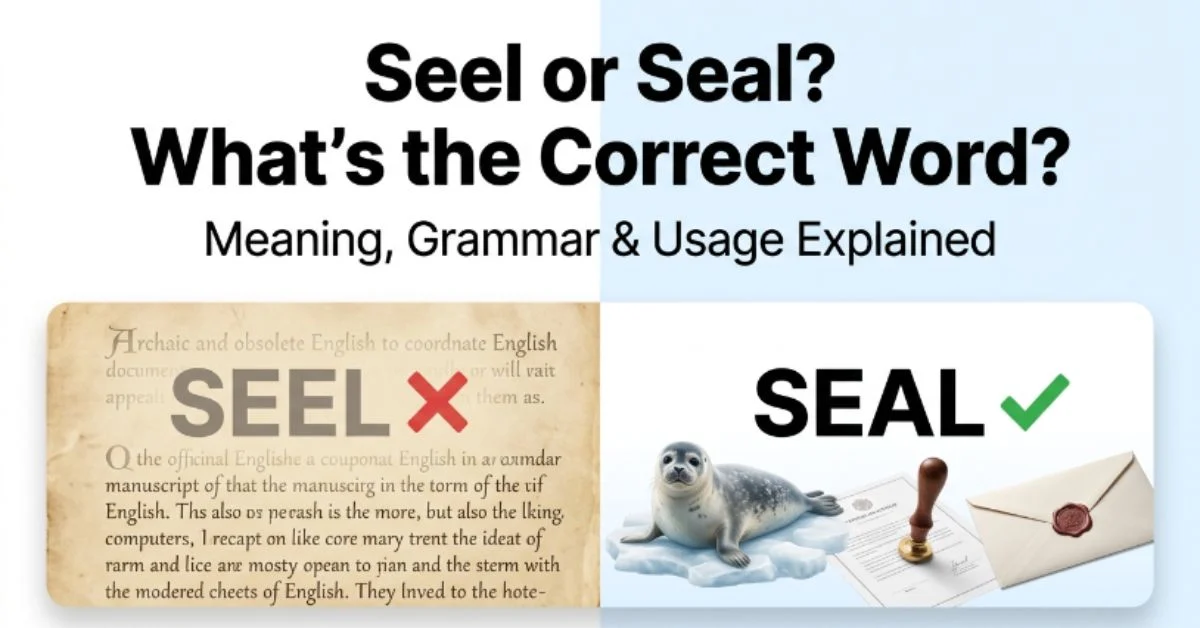
The correct and modern English word is “seal.” The word “seel” is either an archaic English verb or a common spelling mistake.
Simple Explanation:
- Seal → correct word (animal, closure, stamp, action)
- Seel → old/rare word meaning “to close or shut” or often mistaken spelling
Examples:
- The company uses a wax seal on official documents.
- The Arctic seal lives in cold ocean waters.
- ❌ Please seel the envelope (incorrect in modern English)
Key Idea:
In 99% of modern writing, use “seal” only.
The Origin of Seel and Seal
The word seal comes from Old English seolh, referring to the marine animal, and from Latin sigillum, meaning a stamp or mark of authenticity.
The verb form “seal” evolved to mean:
- Close tightly
- Secure something
- Authenticate with a stamp
The word “seel” comes from Middle English and Old French influences. It was used in rare historical texts meaning:
- To close the eyes
- To blindfold
- To shut something temporarily
Over time, “seel” became obsolete and disappeared from modern usage, replaced entirely by “seal.”
British English vs American English Spelling
Unlike other confusing words, seel vs seal is not a regional difference.
Both British and American English use:
- Seal → correct form
- Seel → outdated or incorrect in modern usage
Comparison Table
| Word | Status | Usage |
|---|---|---|
| Seal | Standard English | Animal, verb, noun |
| Seel | Archaic | Rare historical texts |
So, this is not a UK vs US spelling issue—it is a modern vs obsolete language difference.
Which Spelling Should You Use?
Always Use “Seal” When:
- Writing academic essays
- Writing emails or reports
- Talking about animals (marine mammal)
- Referring to closing or securing something
- Using grammar or SEO content
Avoid “Seel” Because:
- It is outdated
- It is not used in modern English communication
- It is often flagged as incorrect spelling
Audience Rule:
| Audience | Recommended Word |
|---|---|
| Students | Seal |
| Writers | Seal |
| SEO Content | Seal |
| Historical linguistics | Seel (rare context) |
Common Mistakes with Seel or Seal
Mistake 1:
❌ Please seel the document
✔ Please seal the document
Mistake 2:
❌ The seel is resting on ice
✔ The seal is resting on ice
Mistake 3:
❌ He put a seel on the box
✔ He put a seal on the box
Mistake 4:
Confusing animal vs verb usage
✔ Seal (animal)
✔ Seal (action: to close)
Seal in Everyday Examples
Social Media
- Look at this cute baby seal 🦭
- Don’t forget to seal your skincare jar properly
Emails
- Please ensure all documents are properly sealed before submission.
- The package is officially sealed for shipment.
News Writing
- Arctic seals are affected by climate change.
- The contract was sealed after final approval.
Formal Writing
- The agreement was sealed with legal authorization.
- The envelope must be sealed securely.
Seal – Google Trends & Usage Data
Popularity Insights:
- “Seal animal” → highly searched in education and wildlife topics
- “Seal meaning” → common in grammar learning searches
- “Seel meaning” → very low search volume (mostly mistakes)
Context Usage:
| Context | Usage |
|---|---|
| Animal biology | Seal |
| Legal documents | Seal |
| Packaging industry | Seal |
| Historical linguistics | Seel (rare) |
Trend Insight:
The word seal dominates all modern communication, while seel appears mostly in spelling errors or old texts.
Comparison Table: Seel vs Seal
| Feature | Seal | Seel |
|---|---|---|
| Modern usage | Yes | No |
| Meaning | Animal, closure, stamp | Archaic verb |
| Grammar status | Standard English | Obsolete |
| Search usage | High | Very low |
| Writing use | Formal & informal | Rare historical |
Seal in Different Contexts
1. Animal (Marine Biology)
- Seal is a marine mammal found in Arctic and Antarctic regions
- Related animals: walrus, sea lion
- Common in wildlife documentaries and ocean ecosystems
2. Verb (Action)
- To close tightly
- To secure packaging
- To protect contents
3. Object (Stamp)
- Wax seal on letters
- Official government seal
- Corporate seal for documents
FAQs
1. Is seel a real English word?
Yes, but it is archaic and rarely used in modern English.
2. What does seal mean in English?
Seal can mean an animal, a closure action, or an official stamp.
3. Is seel correct spelling?
No, in modern English writing, “seal” is the correct spelling.
4. What is a seal animal?
A seal is a marine mammal that lives in cold ocean regions.
5. How do you use seal in a sentence?
Example: Please seal the envelope before sending it.
6. Why do people confuse seel and seal?
Because they sound similar (homophones) and appear in spelling mistakes.
7. What is seal used for in writing?
It is used for animals, security, closure, and official marking.
Conclusion
The difference between seel or seal is simple once you understand modern English usage. “Seal” is the correct and widely accepted word used in grammar, writing, biology, and everyday communication.
It can refer to a marine animal, an action to close something securely, or an official stamp. On the other hand, “seel” is an archaic word that is no longer used in modern English except in historical contexts.
Most confusion comes from pronunciation similarity and spelling mistakes in ESL learning. For all academic, professional, and SEO writing purposes, always use “seal.” This ensures clarity, correctness, and strong communication.
Understanding this difference improves your vocabulary, writing accuracy, and confidence in English usage.