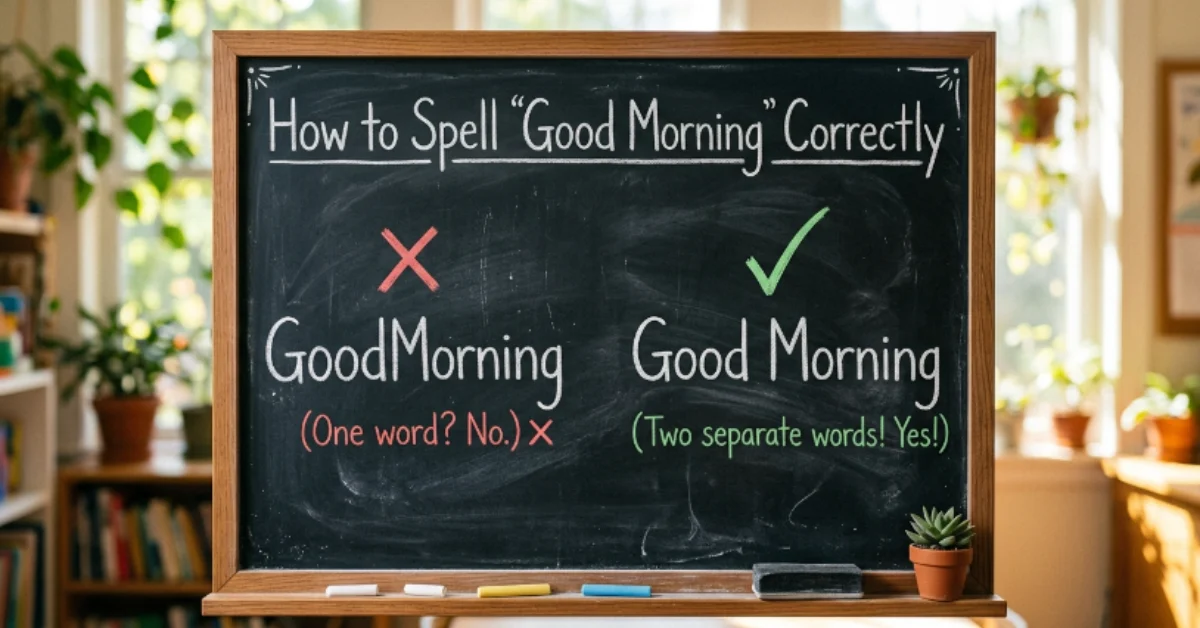
Good morning is the correct spelling in standard English, while goodmorning is generally considered incorrect. The confusion happens because many English compound words have become one word over time, leading some people to assume the same rule applies here.
This guide explains the correct spelling, grammar rule, dictionary usage, capitalization, examples, and when to use good morning with confidence.
Quick Answer
| Form | Is It Correct? | Usage |
|---|---|---|
| Good morning | ✅ Yes | The standard English greeting used in speech and writing. |
| Goodmorning | ❌ No | A common spelling mistake in standard English. |
If you’re wondering whether to write goodmorning or good morning, always choose good morning. Major dictionaries, including Merriam-Webster, Cambridge Dictionary, Oxford English Dictionary, and Collins Dictionary, recognize good morning as the correct spelling.
It is the preferred form in professional emails, business communication, academic writing, formal letters, and everyday conversation.
The Rule Explained
Good morning is an open compound, meaning it is made up of two separate words that work together as a greeting or salutation.
Unlike closed compounds such as goodbye, the expression good morning has remained two words in modern English. Standard dictionaries and English style guides continue to treat it as a phrase rather than a single word.
The first word, good, is an adjective expressing goodwill or politeness.
The second word, morning, is a noun referring to the early part of the day.
Together, they form one of the most common English greetings used in both spoken and written communication.
Examples:
- Good morning, everyone!
- Good morning, Professor Smith.
- Good morning! I hope you’re having a wonderful day.
Because it functions as a greeting, the words stay separate in standard English spelling.
Why “Good Morning” Is Two Words
Many people wonder why good morning is written as two words while expressions like goodbye are written as one.
The answer lies in how English compound expressions evolve.
Some expressions gradually change from an open compound (two words) to a closed compound (one word). Others never make that transition because they continue to function as fixed greetings rather than independent vocabulary words.
For example:
- Good morning ✅
- Good afternoon ✅
- Good evening ✅
- Good night ✅
All of these remain two-word greetings in standard English.
By comparison:
- Goodbye ✅
Originally written as good bye, it gradually became a closed compound through centuries of everyday use.
Today, good morning has not undergone that change. According to the Cambridge Dictionary and the Oxford English Dictionary, it remains the standard spelling in both British English and American English.
You may occasionally see goodmorning used in usernames, hashtags, brand names, domain names, or creative titles. However, these are stylistic choices rather than examples of standard English usage.
Memory Trick
Remember this simple rule:
If you’re greeting someone, write “good morning” as two words.
Think of the other daily greetings:
- Good afternoon
- Good evening
- Good night
Since all of them are written as two separate words, good morning follows the same pattern.
Whenever you’re writing an email, letter, text message, presentation, or social media post, using good morning will ensure your English grammar, word spacing, and professional communication are correct.
What the Dictionaries and Style Guides Say
Leading dictionaries and writing authorities agree that good morning is the correct spelling in standard English.
| Style Guide / Dictionary | Preferred Form | Notes |
|---|---|---|
| Merriam-Webster | Good morning | Listed as a greeting and salutation. |
| Cambridge Dictionary | Good morning | Used when greeting someone in the morning. |
| Oxford English Dictionary | Good morning | Recognized as a two-word expression. |
| Collins Dictionary | Good morning | Standard spelling in both speech and writing. |
These references consistently treat good morning as an open compound rather than a single word. If you’re writing for school, work, publishing, or professional communication, following these standard references is the safest choice.
How Usage Has Changed Over Time
English is full of compound words that have changed over the centuries.
Some expressions begin as two separate words, later become hyphenated, and eventually turn into one word.
For example:
- Web site → Website
- Good bye → Goodbye
- On line → Online
However, not every compound follows this pattern.
Greetings such as good morning, good afternoon, good evening, and good night have remained open compounds because they function as polite greetings rather than standalone vocabulary words.
Although you’ll occasionally find goodmorning in hashtags, usernames, product names, mobile apps, or website domains, these are branding or stylistic choices—not examples of standard English spelling.
Which Should You Use?
Your choice is simple.
- If you’re writing emails, reports, essays, or professional documents → Use “good morning.”
- If you’re texting friends or posting on social media → “Good morning” is still the correct spelling.
- If you see “goodmorning” in a brand name, hashtag, username, or website → Treat it as a creative style, not a grammar rule.
Using good morning demonstrates accurate English spelling, proper word spacing, and professional writing skills.
Common Mistakes People Make
Here are some of the most common errors involving goodmorning or good morning.
❌ Goodmorning, everyone!
✅ Good morning, everyone!
The greeting should always be written as two separate words.
❌ I sent her a Goodmorning message.
✅ I sent her a good morning message.
Even when used before another noun, good morning remains two words.
❌ Goodmorning Professor Jones.
✅ Good morning, Professor Jones.
When directly addressing someone, place a comma after the greeting.
❌ I always say goodmorning to my neighbors.
✅ I always say good morning to my neighbors.
The spacing does not change in everyday writing.
❌ Have a goodmorning!
✅ Have a good morning!
This phrase also remains an open compound.
Example Sentences
Professional Emails
- Good morning, Sarah. Thank you for your prompt response.
- Good morning, everyone. Today’s meeting will begin at 9:00 a.m.
Business Communication
- The manager opened the presentation with a warm good morning.
- We start every customer meeting by saying good morning.
Academic Writing
- The students greeted their teacher with Good morning, Professor Ahmed.
- The textbook explains that good morning is a standard English greeting.
Everyday Conversation
- Good morning! Did you sleep well?
- I say good morning to my neighbors every day.
Text Messages and Social Media
- Good morning! Hope you have an amazing day.
- Wishing everyone a happy and productive good morning.
Capitalization Rules
Many people also wonder whether good morning should be capitalized.
The answer depends on where it appears.
| Situation | Correct Form |
|---|---|
| Beginning of a sentence | Good morning! |
| Email greeting | Good morning, Emma, |
| Normal sentence | I said good morning to everyone. |
| Article or headline title | Good Morning Messages for Friends |
In normal sentences, write good morning in lowercase unless it starts the sentence or is part of a title. Proper capitalization helps make your writing look polished and professional.
FAQs
Is goodmorning one word or two?
The correct form is good morning, written as two separate words. It is the standard spelling recognized by Merriam-Webster, Cambridge Dictionary, Oxford English Dictionary, and Collins Dictionary. The one-word form goodmorning is generally considered a spelling mistake.
Is good morning the correct spelling?
Yes. Good morning is the correct spelling in both American English and British English. It is the standard greeting used in emails, letters, meetings, classrooms, workplaces, and everyday conversations.
Why is good morning written as two words?
Good morning is an open compound. It functions as a greeting rather than a single vocabulary word, so English spelling conventions keep the adjective good and the noun morning separate.
Can you write goodmorning as one word?
In standard English, no. You may see goodmorning used in brand names, usernames, hashtags, website domains, or creative titles, but these are stylistic choices rather than correct grammar.
How do you write good morning correctly?
Write it as two words:
Good morning
Examples:
- Good morning, David.
- Good morning! How are you today?
Never combine the words into goodmorning in formal or everyday writing.
Should good morning be capitalized?
It depends on where it appears.
- Good morning! (Beginning of a sentence)
- Good morning, Mrs. Wilson, (Email greeting)
- I said good morning to everyone. (Middle of a sentence)
Capitalize it only when normal capitalization rules require it.
Is good morning formal or informal?
Good morning works in both formal and informal situations. It is appropriate for business emails, customer service, academic writing, workplace communication, classrooms, and casual conversations with friends and family.
What is the difference between goodmorning and good morning?
The difference is simple.
- Good morning ✅ Standard English greeting.
- Goodmorning ❌ Incorrect spelling in standard English.
Always use good morning unless you’re referring to a brand or another creative name.
Can I use good morning in an email?
Yes. Good morning is one of the most common and professional email greetings. It is suitable for colleagues, clients, teachers, managers, and customers.
Example:
Good morning, Mr. Ahmed,
Thank you for your email.
Is good morning a greeting?
Yes. Good morning is one of the most common English greetings and salutations. It is used to politely greet someone during the morning hours in both spoken and written communication.
Final Thoughts
When choosing between goodmorning or good morning, the correct answer is always good morning. It is the standard English spelling used in professional emails, business communication, academic writing, and everyday conversation.
Remember that good morning is an open compound, so the two words should always remain separate. Following this simple rule will improve your English grammar, word spacing, proofreading, and overall writing quality.
Related Blogs: