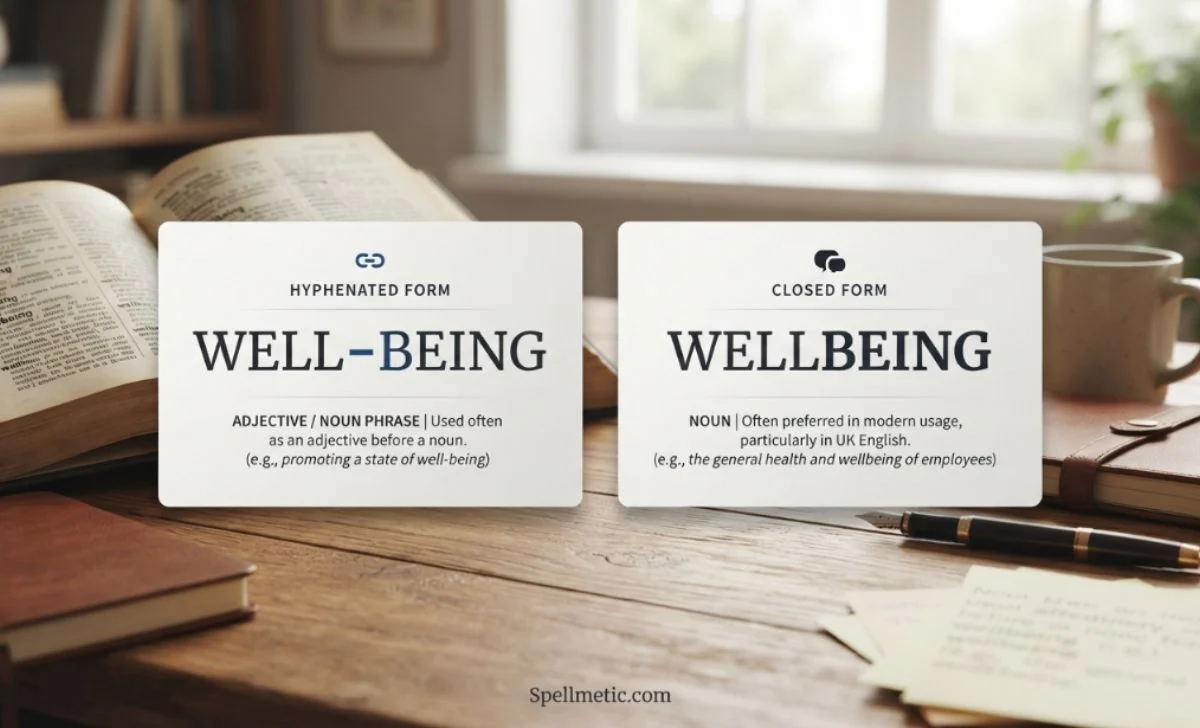
Both well-being and wellbeing are correct — well-being with a hyphen is the standard in American English, while wellbeing as one word is widely accepted in British English.
The confusion exists because English compound nouns naturally evolve over time, moving from hyphenated forms toward single closed words.
In this post, you will learn exactly which spelling to use, what the major style guides say, how usage differs by region, and why “well being” as two separate words is almost always wrong.
Quick Answer
Well-being (hyphenated) is the correct form in American English and is endorsed by Merriam-Webster, the AP Stylebook, and Garner’s Modern English Usage.
Wellbeing (one word) is the accepted British English spelling, used widely in UK government documents, academic journals, and major publications.
Well being as two unhyphenated words is nonstandard in both regions and should be avoided.
| Form | Status | Preferred In |
|---|---|---|
| well-being | Correct | American English, formal global writing |
| wellbeing | Correct | British English, modern casual writing |
| well being | Incorrect | Neither — avoid always |
The Rule Explained
Well-being is a compound noun, a single concept formed from two words. Merriam-Webster has listed it as well-being since its earliest editions, with the hyphen treated as non-negotiable in standard American English.
The AP Stylebook and Garner’s Modern English Usage both confirm this explicitly: well-being is hyphenated, full stop, for American writers. There is no editorial debate in American publishing on this point.
British English follows a different path. The Oxford English Dictionary recognizes wellbeing as an accepted one-word form, reflecting how British English tends to drop hyphens faster as compound nouns become standard vocabulary.
The UK Department of Health, for instance, uses wellbeing throughout its official publications without a hyphen.
The key rule: the hyphen exists because well (an adverb) and being (a noun) are different parts of speech being joined. In American English, that grammatical join always requires the hyphen. In British English, familiarity with the term has made the hyphen optional.
Memory trick: If you’re writing for an American audience, picture the hyphen as a bridge connecting two words that can’t stand alone as a noun without it. No bridge, no noun.
What Are Some Synonyms for Well-Being?
Common synonyms for well-being include wellness, welfare, health, happiness, quality of life, prosperity, and flourishing. The best choice depends on the context.
- Wellness usually refers to overall healthy living and good habits.
- Welfare often describes a person’s health, safety, or general condition.
- Health focuses more directly on physical or mental condition.
- Happiness emphasizes positive feelings and life satisfaction.
- Quality of life refers to how comfortable, healthy, and satisfying someone’s life is.
- Flourishing suggests positive personal growth and thriving.
For example, “employee well-being” could sometimes be expressed as “employee wellness” or “employee welfare,” but these words are not always exact substitutes.
How Compound Words Evolve — Why This Debate Exists
Most compound nouns in English follow a predictable three-stage journey. They begin as two open words (well being), move to a hyphenated form (well-being), and eventually close into one word (wellbeing).
Words like football, backyard, and roommate all completed that journey. Well-being is mid-journey, fully hyphenated in American English, already closed in British English.
This is why the debate exists and why both sides feel they are correct. They are just in different regions at different points in the same evolution.
Google Books Ngram data confirms this: “well-being” dominates in American corpus texts throughout the 20th century and into the present, while “wellbeing” shows sharp growth in British English corpus data from the 1980s onward, aligning with the rise of workplace wellness and mental health discourse in the UK.
American English vs British English
In American English, well-being with a hyphen is the only accepted standard. Every major American authority agrees — Merriam-Webster lists only the hyphenated form, the AP Stylebook enforces it for journalism, and Chicago Manual of Style treats it as a fixed compound noun requiring the hyphen.
In British English, wellbeing as one word has become the dominant form in everyday, professional, and even academic writing.
The UK’s National Health Service, government health departments, and leading universities consistently use wellbeing without a hyphen in their publications.
| Features | American English | British English |
|---|---|---|
| Preferred spelling | well-being | wellbeing |
| Dictionary authority | Merriam-Webster | Oxford English Dictionary / Collins |
| Style guide | AP Stylebook, Garner’s | Oxford Style Guide |
| Example | “Employee well-being improved after the policy change.” | “The NHS focuses on patient wellbeing above all else.” |
Is Well-Being Hyphenated in British English?
In modern British English, wellbeing is widely used as one word, especially in professional, academic, health, and government writing. The hyphenated form well-being is also seen, so the choice can depend on the dictionary, publication, or style guide being followed.
If you are writing specifically for a British audience, wellbeing is generally the more common modern form. For American English, well-being remains the standard spelling.
The important point is to choose one form that matches your target variety of English and use it consistently throughout the same document.
What the Style Guides Say
| Style Guide | Preferred Form | Notes |
|---|---|---|
| AP Stylebook | well-being | Hyphenated. No exceptions for American journalism. |
| Garner’s Modern English Usage | well-being | Explicitly listed as the correct form. |
| Merriam-Webster | well-being | Only form listed. Wellbeing not recognized. |
| Oxford English Dictionary | wellbeing | One-word form listed as standard British English. |
| Collins Dictionary | wellbeing | Confirms British English preference. |
| Chicago Manual of Style | well-being | Follows Merriam-Webster as its dictionary authority. |
Which Should You Use?
- If your audience is American → use well-being with a hyphen, every time, in all writing contexts
- If your audience is British, Australian, or Commonwealth → wellbeing as one word is correct and preferred
- If writing for a global audience or formal international context → default to well-being with the hyphen, as it is the more universally recognized formal standard.
What Does Well-Being Mean in Psychology?
In psychology, well-being refers to a person’s overall positive functioning and quality of life. It can include emotional health, life satisfaction, positive relationships, a sense of purpose, and the ability to function well in everyday life.
Psychological well-being is broader than simply feeling happy. A person may experience difficult emotions while still having a strong sense of purpose, supportive relationships, and satisfaction with important areas of life.
For example, a psychology study might examine emotional well-being, social well-being, or psychological well-being to understand different aspects of a person’s overall quality of life.
Common Mistakes People Make
❌ Writing “well being” as two separate words
“The company cares about employee well being.” → Correct: well-being
Two separate unhyphenated words creates a grammatical error.
Well and being carry different meanings when split “well being” reads like the adverb well modifying the verb being, not as the compound noun for health and happiness.
❌ Mixing both spellings in the same document
Using well-being in one paragraph and wellbeing three paragraphs later destroys consistency. Pick one form and maintain it throughout your entire document.
❌ Using wellbeing in formal American English contexts
“Our study examined student wellbeing across five campuses.” (submitted to a US academic journal) → Correct: well-being
US academic editors will flag this as a spelling error.
❌ Assuming wellbeing is always wrong
Many writers familiar only with American English assume wellbeing is a misspelling everywhere. It is not — it is standard and correct in British English.
Example Sentences
Casual / Everyday Writing
She started journaling every morning to protect her mental well-being.
The yoga retreat was designed entirely around personal wellbeing and rest.
Formal / Professional Writing
The board approved a new employee well-being initiative covering mental health support and flexible scheduling.
Our HR team has developed a comprehensive wellbeing framework aligned with NHS guidelines.
Academic Writing
Researchers found a statistically significant correlation between social connection and long-term well-being in adults over 60.
The study examined subjective wellbeing among university students during exam periods.
Social Media
Taking care of your well-being isn’t selfish — it’s necessary. 🌿
Small daily habits make the biggest difference to your wellbeing. What’s yours?
Which Form Should You Use in an Essay?
When writing an essay, use the spelling that matches your chosen variety of English or the requirements of your school, university, publisher, or style guide.
For American English, use well-being:
Good mental well-being can help students manage academic pressure and maintain healthy relationships.
For British English, wellbeing is widely used:
Student wellbeing is an important part of a supportive learning environment.
Whichever form you choose, keep the spelling consistent throughout the essay. Avoid switching between well-being and wellbeing unless you are discussing the spelling difference itself.
FAQs
Is wellbeing or well-being correct?
Both are correct. Well-being is the standard American English spelling, while wellbeing is the preferred British English form.
Is wellbeing one word or two?
In British English, wellbeing is one word. In American English, well-being is hyphenated, while well being (two words) is generally incorrect as a noun.
What does well-being mean?
Well-being means a person’s overall health, happiness, and quality of life, including physical, mental, and emotional wellness.
Which spelling does the AP Stylebook use?
The AP Stylebook uses well-being with a hyphen in all contexts.
Is wellbeing correct in academic writing?
Yes. Wellbeing is standard in British academic writing, while well-being is preferred in American academic publications.
Why do some people write “well being” as two words?
Usually by mistake. As a noun, the correct forms are well-being (US) or wellbeing (UK), not well being.
Is wellbeing the same as wellness?
Not exactly. Wellness focuses on healthy habits, while well-being refers to overall physical, mental, and emotional health.
Which is more common—well-being or wellbeing?
Well-being is more common in American English, while wellbeing is increasingly common in British English.
Can I use wellbeing in a formal letter?
Yes, if you’re writing in British English. For American English, use well-being instead.
Is “well-being” hyphenated after a verb?
Yes. Well-being keeps its hyphen wherever it appears because it’s a fixed compound noun.
Conclusion
Well-being with a hyphen is the correct form in American English, while wellbeing as one word is accepted and standard in British English. The safest rule: match your spelling to your audience’s region and stick to it consistently throughout your document.
Never write it as two unhyphenated words — “well being” — that is nonstandard in every variety of English.
If you found this helpful, you might also want to read our guide on healthcare or health care, another hyphenation debate where style guides disagree.
Related Blogs: