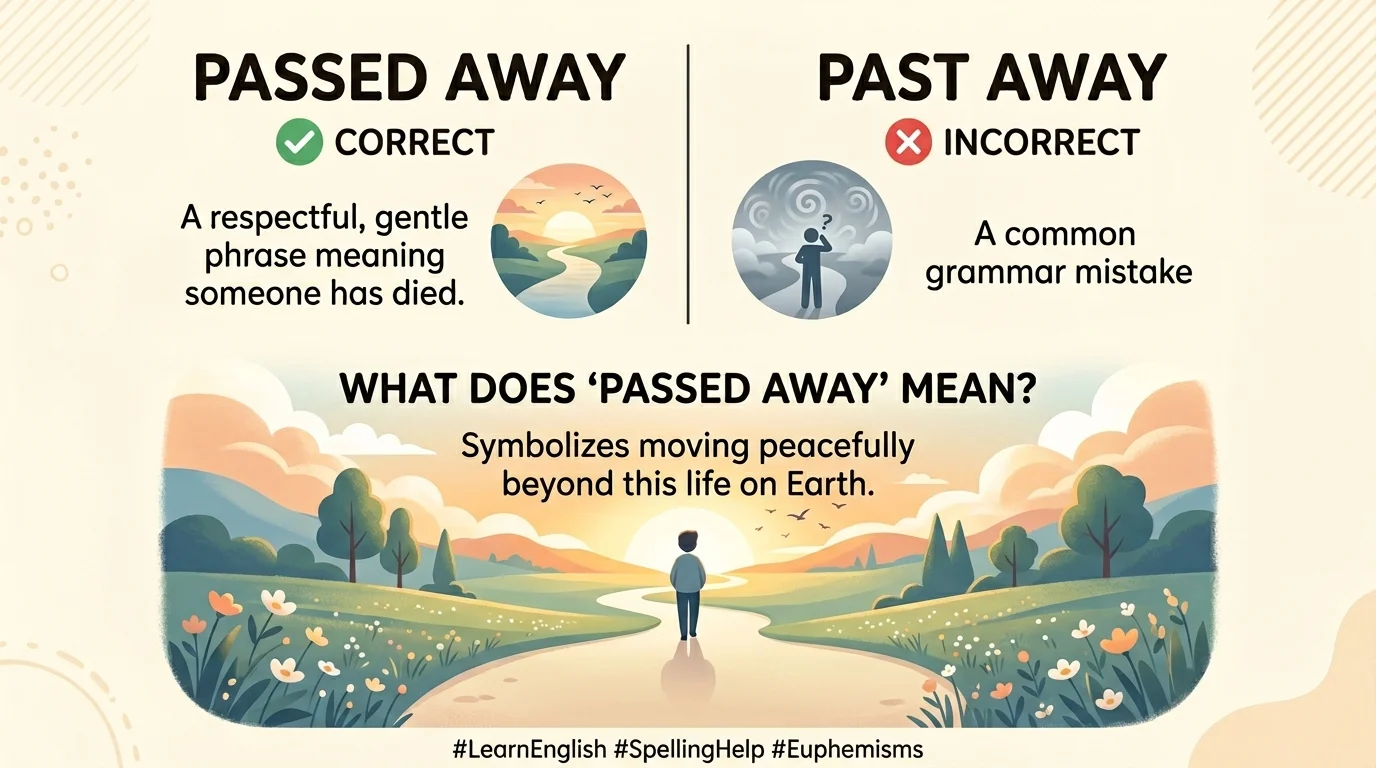
If you’ve ever wondered whether the correct phrase is passed away or past away, you’re not alone. Because passed and past sound very similar, many people accidentally use the wrong spelling when writing about someone’s death. This confusion is common among English learners, students, and even native speakers.
The good news is that the answer is simple: passed away is the correct phrase, while past away is considered a grammatical error. Understanding why can help you avoid a common writing mistake and improve your English grammar skills.
In this guide, you’ll learn the meaning of passed away, why past away is incorrect, the grammatical difference between passed and past, the history of the expression, and when it is appropriate to use it in formal and informal situations.
Quick Answer
The correct phrase is passed away.
Passed away is a common English expression that means someone has died. It is often used as a polite and respectful alternative to the word died.
Past away is incorrect because past is not the past-tense form of the verb pass.
Examples
✅ My grandfather passed away last year.
✅ The famous actor passed away peacefully.
❌ My grandfather past away last year.
❌ The famous actor past away peacefully.
Whenever you are referring to someone’s death, always use passed away.
Passed Away vs Past Away at a Glance
| Feature | Passed Away | Past Away |
|---|---|---|
| Correct English | Yes | No |
| Meaning | To die | No accepted meaning |
| Grammar | Correct verb phrase | Incorrect phrase |
| Used in Obituaries | Yes | No |
| Used in News Reports | Yes | No |
| Used in Everyday English | Yes | No |
What Does Passed Away Mean?
Passed away is a respectful expression used to say that someone has died. It is one of the most common euphemisms in the English language and is frequently used when discussing death in a sensitive manner.
Definition
Passed away means to die or cease living.
Why It Is a Euphemism
A euphemism is a mild or indirect expression used in place of one that may seem harsh or unpleasant.
Many people consider the word died direct and factual. By contrast, passed away sounds softer and more compassionate.
For this reason, the phrase is commonly used in:
- Obituaries
- Funeral announcements
- Sympathy messages
- Memorial services
- News reports
Examples
- Her grandmother passed away peacefully at home.
- We were saddened to hear that our neighbor passed away.
- The celebrated author passed away at the age of 88.
Is Past Away Correct?
No, past away is not correct English.
The mistake occurs because past and passed are pronounced similarly in many accents. However, they have different meanings and grammatical functions.
Incorrect
❌ She past away during the night.
❌ Our teacher past away last month.
Correct
✅ She passed away during the night.
✅ Our teacher passed away last month.
If you’re referring to death, passed away is always the correct phrase.
Why Is Passed Away Correct?
The phrase passed away comes from the verb pass away.
Because it is a verb phrase, it must use the correct past-tense verb form.
Pass as a Verb
The verb pass can mean:
- To move beyond something
- To go by
- To transfer something
- To die (when used as pass away)
Passed as the Past Tense
The past tense of pass is passed.
Examples
- He passed the examination.
- She passed the ball.
- Their grandfather passed away peacefully.
Why Past Is Incorrect
The word past is not a verb. It usually functions as:
- A noun
- An adjective
- An adverb
- A preposition
Because past is not the past-tense form of pass, it cannot replace passed in the phrase passed away.
Passed vs Past: Understanding the Difference
One of the easiest ways to avoid this mistake is to understand the difference between the words themselves.
| Word | Part of Speech | Meaning |
|---|---|---|
| Passed | Verb | Past tense of pass |
| Past | Noun, adjective, adverb, or preposition | Refers to a previous time or position |
Passed Examples
- She passed the test.
- He passed the driving exam.
- Their father passed away last year.
Past Examples
- Let’s move past the issue.
- We cannot change the past.
- The store is just past the bridge.
A simple rule is:
If an action is involved, you probably need passed.
Why Do People Say “Passed Away” Instead of “Died”?
Many people prefer passed away because it sounds more considerate and respectful.
Respectful Language
Death can be an emotional topic. Euphemisms help soften the impact of difficult news.
Compare:
- He died yesterday.
- He passed away yesterday.
Both sentences are correct, but many readers perceive the second as gentler.
Cultural Influences
Many cultures use indirect language when discussing death out of respect for the deceased and their family.
Religious Influences
Some religious traditions view death as a transition rather than an ending. Expressions such as passed away reflect this perspective by suggesting a passage from one state of existence to another.
The History and Origin of “Passed Away”
The phrase passed away has been used in English for centuries.
Early Usage
Historically, writers used forms of the verb pass to describe someone departing from this life.
Evolution of the Phrase
Over time, passed away became a standard euphemism for death in literature, religious texts, and everyday speech.
Modern Usage
Today, the expression remains one of the most widely accepted and recognized ways to discuss death respectfully.
Is “Passed Away” Formal or Informal?
One reason the phrase is so popular is its versatility.
Passed away works in both formal and informal settings.
Formal Usage
- Obituaries
- Funeral notices
- Official announcements
- News reports
Informal Usage
- Conversations with friends
- Family discussions
- Sympathy messages
Because it balances respect and clarity, it is appropriate in most situations.
When Is It Appropriate to Use “Passed Away”?
In Obituaries
The phrase is extremely common in obituary writing.
Example:
The family regrets to announce that John Smith passed away peacefully on June 12.
In Sympathy Messages
Many people use the expression when offering condolences.
Example:
I am deeply sorry to hear that your mother passed away.
In Professional Announcements
Organizations often use the phrase when announcing the death of a colleague, employee, or public figure.
In Everyday Conversations
People frequently use passed away when discussing the loss of friends, relatives, neighbors, or pets.
Can “Past Away” Ever Be Correct?
No.
There is no standard English context in which past away is considered correct.
Although people occasionally write it by mistake, dictionaries, style guides, teachers, and editors recognize passed away as the proper expression.
Quick Answer
✅ Passed away = Correct
❌ Past away = Incorrect
Alternative Expressions for Passed Away
English offers several alternatives depending on the situation.
Formal Alternatives
- Deceased
- Departed
- No longer living
Informal Alternatives
- Passed on
- Gone
- Left us
Context-Specific Alternatives
- Lost their life
- Succumbed
- Died
Each expression carries a slightly different tone, so choose the one that best suits your audience.
Example Sentences
Personal Situations
- My aunt passed away peacefully last spring.
- His grandfather passed away after a long illness.
News Reports
- The award-winning actor passed away at age 91.
- The former president passed away surrounded by family.
Sympathy Messages
- I am sorry to hear that your father passed away.
- Our thoughts are with you after your loss.
Historical References
- The scientist passed away shortly after completing his research.
- The famous composer passed away in the nineteenth century.
Common Mistakes to Avoid
Writing Past Away Instead of Passed Away
Incorrect:
❌ My uncle past away last year.
Correct:
✅ My uncle passed away last year.
Confusing Passed and Past
Although they sound alike, they perform different grammatical functions.
Assuming Pronunciation Determines Spelling
Many English words sound similar but have different spellings and meanings. Always choose the word that matches the grammar of the sentence.
Easy Memory Trick
Remember this simple rule:
Pass → Passed → Passed Away
Because pass away is a verb phrase, it needs the verb form passed.
If the sentence describes an action, passed is usually the correct choice.
FAQS
Is it passed away or past away?
Passed away is correct. Past away is incorrect.
Why is past away wrong?
Because past is not the past tense of the verb pass.
What does passed away mean?
It means someone has died and is commonly used as a respectful euphemism.
Is passed away formal English?
Yes. It is appropriate in both formal and informal contexts.
Can I use passed away in an obituary?
Absolutely. It is one of the most common expressions used in obituaries.
Is past away ever correct?
No. Standard English does not recognize past away as a correct phrase.
What is the difference between passed and past?
Passed is a verb, while past usually refers to time, position, or direction.
Do Americans and British people both use passed away?
Yes. The phrase is widely used in both American and British English.
Final Verdict
When choosing between passed away and past away, the correct phrase is always passed away. It is a standard English expression used to describe someone’s death in a respectful and compassionate way. The phrase comes from the verb pass away, so the past-tense form must be passed, not past.
Although the words sound similar, they have completely different grammatical functions. Passed is a verb, while past relates to time or position. Understanding this distinction will help you avoid a common writing mistake and communicate more clearly.
Whenever you are writing about someone’s death, whether in an obituary, sympathy message, news article, or everyday conversation: use passed away with confidence and avoid past away, which is grammatically incorrect.
Related Blogs:
- Disorganized or Unorganized – Which One Should You Use in 2026
- Indure vs Endure – What’s the Difference? (2026 Guide)