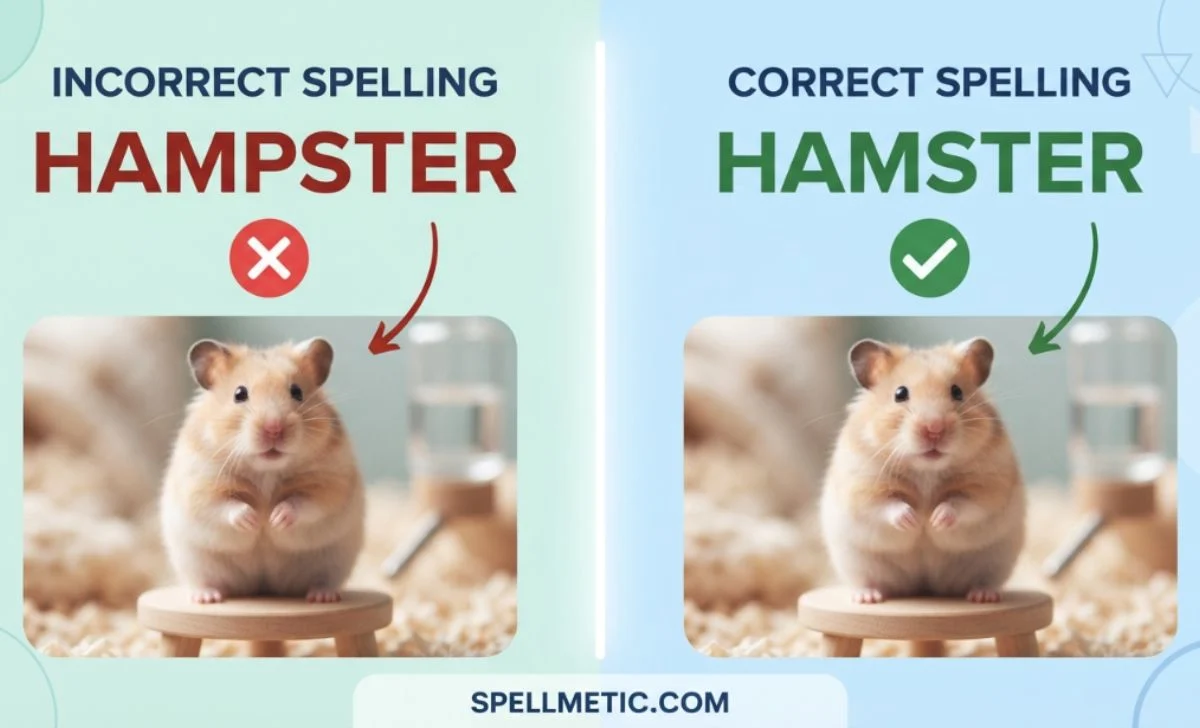
Hampster or hamster is a common spelling question, and the correct answer is simple: hamster is the only correct spelling in standard English.
Although many people accidentally write hampster, trusted dictionaries such as Merriam-Webster, Oxford Dictionary, Cambridge Dictionary, and Collins Dictionary recognize only hamster.
The confusion usually happens because some speakers naturally pronounce a slight “p” sound between the m and s sounds.
As a result, they type the word exactly as they hear it. However, that pronunciation does not change the spelling.
Throughout this guide, you’ll learn the meaning of hamster, how to pronounce it correctly, why the misspelling occurs, and how to avoid this common writing mistake with practical examples and easy-to-remember tips.
Quick Answer
The correct spelling is hamster.
Hampster is a common misspelling and is not accepted in standard English. Whenever you refer to the small pet rodent, always write hamster.
Correct Examples
- My hamster loves running on its exercise wheel.
- We adopted a friendly hamster from a local pet store.
- Every hamster needs a clean cage and fresh water.
- Her hamster hides food inside its cheek pouches.
- The children enjoy playing with their hamster every evening.
Incorrect Examples
| Incorrect | Correct |
|---|---|
| I bought a hampster yesterday. | I bought a hamster yesterday. |
| My hampster is sleeping. | My hamster is sleeping. |
| She cleaned the hampster cage. | She cleaned the hamster cage. |
| Our hampster loves sunflower seeds. | Our hamster loves sunflower seeds. |
| The hampster escaped last night. | The hamster escaped last night. |
The incorrect spelling appears because many people type the word the way they pronounce it. In standard English, however, only hamster is correct.
What Does “Hamster” Mean?
A hamster is a small rodent belonging to the Cricetidae family. It is one of the world’s most popular household pets because it is small, gentle, and relatively easy to care for.
Most hamsters are known for storing food in their cheek pouches and spending time running on exercise wheels or exploring tunnels.
The word hamster is commonly used in pet care guides, educational books, scientific articles, and everyday conversation.
Whether you’re talking about a Syrian hamster, a dwarf hamster, or another species, the spelling never changes.
In contrast, hampster has no definition in standard English. It is simply a spelling mistake that developed from pronunciation and typing habits rather than an actual English word.
Is Hamster a Countable or Uncountable Noun?
Hamster is a countable noun because you can count individual hamsters. Use “a hamster” when talking about one animal and “hamsters” when referring to more than one.
Examples:
- I bought a hamster.
- We have three hamsters.
- The children watched two hamsters playing.
The word hamster can be used in both singular and plural forms, depending on the number of animals.
What Is the Plural of Hamster?
The plural of hamster is hamsters. When you talk about more than one hamster, simply add -s to the singular form.
Examples:
- I have one hamster.
- She owns two hamsters.
- The pet store has several hamsters.
Using the plural form correctly helps you write clearly when discussing multiple animals.
Common Uses of “Hamster”
| Context | Example |
|---|---|
| Pet care | A hamster needs fresh food, clean water, and a safe cage. |
| Education | Students learned how a hamster stores food in its cheek pouches. |
| Everyday conversation | My hamster sleeps during the day and becomes active at night. |
These examples show that hamster has the same meaning in every context. Whether you’re writing about pets, science, or daily life, hamster is always the correct and accepted spelling.
How to Spell and Pronounce “Hamster”
The correct spelling is hamster. Although some people write hampster, that version is not accepted in standard English.
If you’re writing an email, school assignment, blog post, or pet care guide, always use hamster.
Pronunciation
| English Variety | IPA | Simple Guide |
|---|---|---|
| American English | /ˈhæm.stɚ/ | HAM-ster |
| British English | /ˈhæm.stə/ | HAM-stuh |
The spelling stays the same in both American and British English. Only the ending of the pronunciation changes slightly.
Many English speakers naturally pronounce a faint “p” sound between m and s. However, that extra sound is not part of the word’s spelling, so it should never appear in writing.
Is Hamster Spelled With a P?
No, the correct spelling is hamster, without the letter p. Some people add a “p” because of the way they hear the word when it is spoken. However, the standard spelling is hamster.
For example:
- Correct: My hamster is sleeping.
- Incorrect: My hampster is sleeping.
Remember ham + ster to avoid this common spelling mistake.
Why Do People Confuse “Hampster” and “Hamster”?
The confusion between hampster and hamster comes from the way the word sounds when spoken.
Because the letters m and s appear together, some speakers insert a light “p” sound without realizing it. As a result, they often spell the word as hampster.
Several factors also contribute to this mistake:
- People spell the word the way they hear it.
- Fast typing can lead to an extra letter.
- Children often learn the pronunciation before the spelling.
- Social media and online comments sometimes repeat the misspelling.
- Some writers never verify the word in a dictionary.
Although this mistake is common, hamster remains the only correct spelling in standard English.
Is “Hampster” a Real Word?
No. Hampster is not a real English word.
Trusted references such as Merriam-Webster, Oxford Dictionary, Cambridge Dictionary, and Collins Dictionary recognize hamster as the standard spelling.
None of these dictionaries include hampster as an accepted alternative.
If you use hampster in formal writing, spell-check tools and editors will usually mark it as a spelling mistake. For that reason, it is best to use hamster in every type of communication.
What Is the Difference Between Hamster and Hampster?
Hamster is the correct standard English spelling for the small rodent, while hampster is a common misspelling. The extra letter p is not part of the standard spelling.
Although some people pronounce the word with an extra sound, the correct written form remains hamster.
| Correct | Incorrect |
|---|---|
| My hamster is cute. | My hampster is cute. |
| I feed my hamster daily. | I feed my hampster daily. |
Always use hamster in school assignments, emails, and other standard English writing.
Word Origin (Etymology)
The word hamster entered English from the German word Hamster, which has been used for centuries to describe this small burrowing rodent.
Linguists believe the German term has even older Slavic roots, reflecting the animal’s habit of collecting and storing food.
As the word became part of the English language, its spelling remained hamster. Even though some speakers added an extra sound while pronouncing it, the written form never changed.
That is why modern dictionaries, textbooks, and scientific publications all use the same spelling today.
Understanding the word’s history also explains why hampster never became a standard English word.
Dictionary Evidence
Leading English dictionaries consistently recognize hamster as the correct spelling.
| Dictionary | Hamster | Hampster |
|---|---|---|
| Merriam-Webster | Recognized | Not recognized |
| Oxford Dictionary | Recognized | Not recognized |
| Cambridge Dictionary | Recognized | Not recognized |
| Collins Dictionary | Recognized | Not recognized |
All four dictionaries agree that hamster is the standard English spelling for the small pet rodent.
Since hampster does not appear as an accepted entry, writers should avoid using it in academic, professional, or everyday writing.
British English vs American English
The spelling of hamster is identical in both American English and British English. Unlike some English words that have regional spelling differences, this animal’s name remains the same everywhere. Whether you’re reading a pet care guide, a science book, or a dictionary, you’ll always see hamster.
| Feature | British English | American English |
|---|---|---|
| Correct spelling | Hamster | Hamster |
| Incorrect spelling | Hampster | Hampster |
| Dictionary spelling | Hamster | Hamster |
| IPA pronunciation | /ˈhæm.stə/ | /ˈhæm.stɚ/ |
| Standard usage | Yes | Yes |
The table shows that only the pronunciation changes slightly between the two varieties of English. The spelling remains hamster in every case.
Which Spelling Should You Use?
American English
Use hamster in emails, school assignments, business documents, websites, and everyday writing. American dictionaries recognize only this spelling.
British English
British English follows the same rule. Hamster is the accepted spelling, while hampster is treated as a spelling mistake.
Canada
Canadian English also uses hamster in both formal and informal writing. There is no alternative spelling.
Australia
Australian English follows the same standard. Whether you’re writing about a pet or a wild rodent, always choose hamster.
International English
If your audience includes readers from different countries, hamster is the safest and most accurate spelling because it is recognized worldwide.
How to Remember the Correct Spelling
Remembering the correct spelling is easier than it looks once you know a simple trick.
Think of the word as Ham + ster. There is no “p” between the m and s.
Another helpful reminder is:
A hamster stores food—not the letter “p.”
Reading the word a few times and writing it correctly will quickly make the proper spelling feel natural.
Common Mistakes
Many writers make the same spelling errors because they rely on pronunciation instead of checking the correct form.
| Wrong Example | Correct Example | Explanation |
|---|---|---|
| I bought a hampster yesterday. | I bought a hamster yesterday. | The extra p is incorrect. |
| My hampster loves sunflower seeds. | My hamster loves sunflower seeds. | Only hamster is accepted in English. |
| The hampster escaped from its cage. | The hamster escaped from its cage. | This mistake comes from pronunciation. |
| She feeds her hampster every morning. | She feeds her hamster every morning. | Standard dictionaries recognize only hamster. |
| We cleaned the hampster cage. | We cleaned the hamster cage. | Always remove the extra p. |
These examples show that the error is easy to fix. Once you remember that the word is spelled hamster, you’ll avoid one of the most common spelling mistakes in English.
Everyday Examples
Emails
- Please remember to feed the hamster before you leave.
- The hamster is doing much better after its checkup.
Business Writing
- Our pet store received several healthy hamsters this week.
- This guide explains proper hamster care for new owners.
Education
- Students researched the natural habitat of the hamster.
- The science class discussed different hamster species.
Social Media
- Our hamster learned a new trick today!
- Meet the newest member of our family—our adorable hamster.
Daily Conversation
- My hamster sleeps most of the afternoon.
- We bought a bigger wheel for our hamster yesterday.
These examples demonstrate that hamster is the correct spelling in every situation, from casual conversations to professional and educational writing.
Related Searches
People searching for hampster or hamster often want answers to closely related spelling and vocabulary questions, including:
- Hamster meaning
- How to spell hamster
- Hamster pronunciation
- Is hampster a word?
- What is a hamster?
- What is a male hamster called?
- Hamster definition
- Hamster examples in sentences
- English spelling of hamster
- Dictionary meaning of hamster
- Common spelling mistakes
- Pet hamster facts
These related searches show that most users want to confirm the correct spelling, understand the word’s meaning, and learn how to use it correctly in everyday English.
Comparison Table
| Feature | Hamster | Hampster |
|---|---|---|
| Correct spelling | Yes | No |
| Standard English word | Yes | No |
| Recognized by dictionaries | Yes | No |
| Correct for professional writing | Yes | No |
| Refers to the pet animal | Yes | No |
| Recommended usage | Always | Never |
The comparison makes the answer straightforward. Hamster is the accepted spelling in standard English, while hampster is simply a common misspelling caused by pronunciation or typing habits.
FAQs
1. Is it hampster or hamster?
The correct spelling is hamster. Hampster is a common misspelling and should be avoided.
2. Is hampster a real word?
No. Hampster is not recognized as a standard English word by major dictionaries.
3. What is a hamster?
A hamster is a small rodent that is commonly kept as a pet. It is known for storing food in its cheek pouches and being active during the evening and night.
4. How do you spell hamster correctly?
The correct spelling is hamster. There is no “p” in the standard spelling.
5. How do you pronounce hamster?
In American English, it is pronounced /ˈhæm.stɚ/. In British English, it is pronounced /ˈhæm.stə/.
6. Why do people write hampster?
Many people spell the word based on its pronunciation and accidentally insert the letter “p.”
7. Is the spelling different in British and American English?
No. Both varieties of English use the spelling hamster.
8. What is a male hamster called?
A male hamster is simply called a male hamster. There is no separate English term for it.
9. Are Syrian and dwarf hamsters the same?
No. Syrian hamsters are larger and usually live alone, while dwarf hamsters are smaller and belong to several different species.
10. Which dictionaries recognize hamster?
Merriam-Webster, Oxford Dictionary, Cambridge Dictionary, and Collins Dictionary all recognize hamster as the correct spelling.
11. Can I use hampster in formal writing?
No. You should always use hamster in academic, professional, and everyday writing.
12. How can I remember the correct spelling?
Think of Ham + ster. If you remember there is no “p”, you’ll always spell the word correctly.
13. Is hamster the standard spelling worldwide?
Yes. Hamster is the standard spelling in American English, British English, Canadian English, Australian English, and International English.
Final Verdict
If you’re choosing between hampster or hamster, always use hamster. It is the only spelling recognized by trusted dictionaries, including Merriam-Webster, Oxford Dictionary, Cambridge Dictionary, and Collins Dictionary.
Although hampster is a common misspelling, it is not accepted in standard English and should not appear in school assignments, business documents, or professional communication.
The easiest way to remember the correct form is to think of Ham + ster—there is no extra “p.” Once you learn this simple rule, you’ll avoid a common spelling mistake and write with greater confidence.
Whether you’re referring to a pet, discussing animal care, or writing educational content, hamster is always the correct and recommended spelling.
Read More Blogs