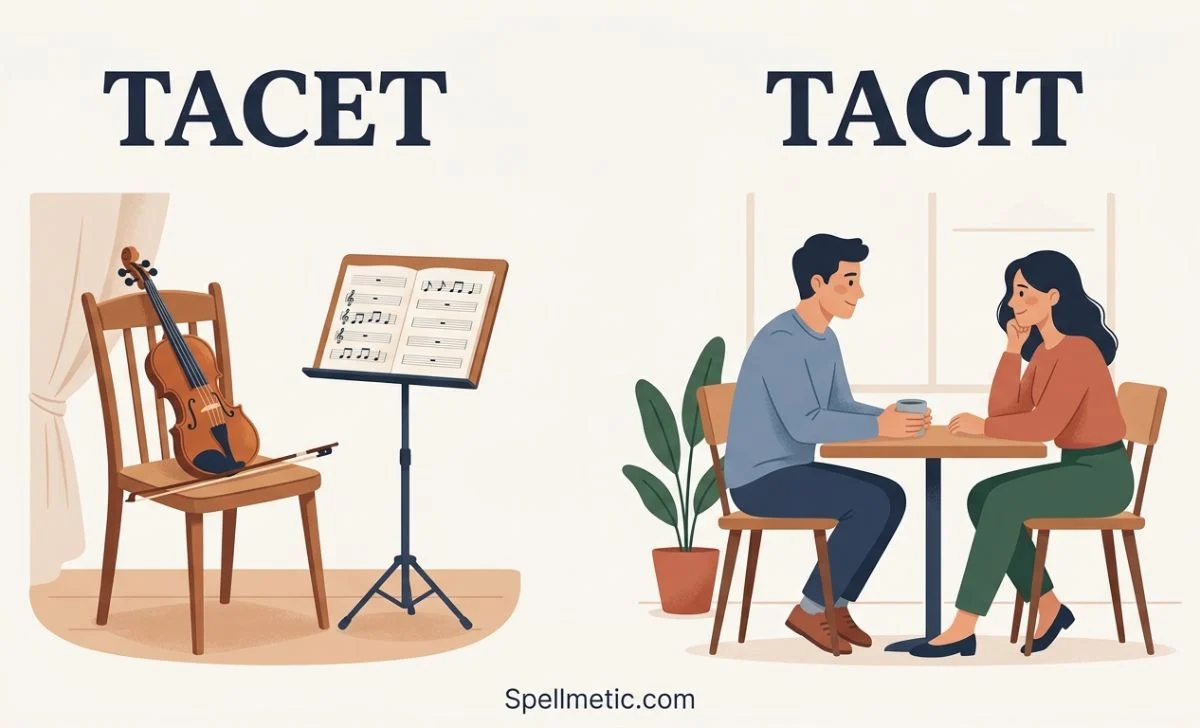
Tacet and tacit are only one letter apart, but they are used for very different purposes. That small spelling difference can cause confusion, especially when you come across either word in writing or hear them spoken.
Tacit is used in ordinary English when something is understood without being clearly said. A tacit agreement, for example, is an understanding that people accept without formally stating it. The word also appears in phrases such as tacit approval, tacit understanding, and tacit knowledge.
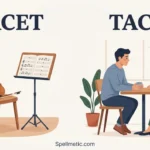
Tacet has a much narrower use. It is a term found in music, where it indicates that a particular instrument, singer, or section does not play or sing during a passage.
So neither word is a misspelling of the other. The right choice depends on the meaning of your sentence: tacit relates to something implied or understood, while tacet relates to silence in a musical performance.
Quick Answer
The difference is simple:
Tacit means understood without being directly expressed.
The manager gave his tacit approval.
The manager did not openly say “yes,” but his actions made his approval clear.
Tacet is a musical instruction meaning that a particular performer, instrument, or section does not play or sing.
The flute is tacet during the second movement.
| Word | Meaning | Typical Context |
|---|---|---|
| tacit | Implied or understood without being stated | General English |
| tacet | A performer or section does not play or sing | Music |
A quick way to remember the difference is:
Tacit = unspoken.
Tacet = musical silence.
What Does Tacit Mean?
Tacit is an adjective. It describes something that is understood or accepted without being openly stated.
It often appears with words such as agreement, understanding, approval, consent, acceptance, support, and assumption.
For example:
The two teams had a tacit agreement to avoid discussing the issue.
Nobody formally announced the agreement, but both sides understood it.
Another example:
Her silence was taken as tacit approval.
She did not directly approve the proposal, but her response suggested that she accepted it.
The idea behind tacit is not simply silence. Something can be tacit because it is implied rather than explicitly communicated.
Tacit in a Sentence
Here are some natural examples:
We reached a tacit understanding after several meetings.
His silence seemed to show tacit approval.
The employees had a tacit agreement about how the schedule would work.
Years of practice gave her tacit knowledge of the craft.
There was a tacit assumption that everyone would arrive on time.
In each case, the information is understood without being clearly spoken or written.
What Does Tacet Mean?
Tacet is primarily a term used in music and musical notation.
When a score says tacet, it tells a particular performer, instrument, or section not to play during the specified passage. For a singer or choir, it can indicate that they do not sing.
For example:
The violins are tacet during this section.
This means the violins remain silent while the other parts continue.
You may see tacet in an orchestral score, ensemble music, band arrangement, or other written music.
It is therefore much more specialized than tacit. Most people encounter tacit in ordinary English, while tacet is more likely to appear when reading or discussing music.
Tacet in a Sentence
The trumpet is tacet during the opening bars.
The cello section is tacet in the third movement.
According to the score, the percussion is tacet for this passage.
The choir is tacet until the final section.
These examples all describe musical silence, not an unspoken idea or agreement.
Tacet vs Tacit: Key Differences
| Feature | Tacit | Tacet |
|---|---|---|
| Part of speech | Adjective | Musical term/verb |
| Main meaning | Implied or understood | Does not play or sing |
| Main context | General English | Music |
| Common phrases | Tacit agreement, tacit approval | Tacet in a musical score |
| Example | We had a tacit understanding. | The violin is tacet here. |
| Everyday use | Common | Specialized |
The biggest distinction is meaning, not spelling.
A tacit agreement is an agreement that has not been directly stated.
A tacet instruction tells a performer not to play or sing.
Tacet vs Tacit Pronunciation
Pronunciation is one reason these words can cause confusion.
Tacit is pronounced approximately TASS-it in standard English.
Tacet has more than one established pronunciation. It may be pronounced like TASS-it or with a pronunciation closer to TAY-set/TAY-sit, depending on the variety of English and the speaker.
That means you should not rely on sound alone when choosing between the two words.
The sentence usually gives you the answer.
We had a ___ agreement.
The correct word is tacit.
The violin is ___ during this section.
The correct word is tacet.
Are Tacet and Tacit Pronounced the Same?
They can be pronounced alike, but they do not have to be.
This is important because calling them exact homophones in every variety of English would be too broad. Tacet has multiple recorded pronunciations, while tacit has a more consistent standard pronunciation.
The spelling and context are therefore more reliable than pronunciation alone.
Tacit Knowledge, Agreement, and Approval
The word tacit appears in several important phrases.
Tacit Knowledge
Tacit knowledge is knowledge that a person has gained through experience but may find difficult to explain fully in words.
For example, an experienced chef may know exactly when dough has the right texture without measuring every detail. That practical understanding can be tacit knowledge.
It is often developed through:
- Practice
- Experience
- Observation
- Repeated work
- Personal skill
This is different from knowledge that can easily be written down as a set of instructions.
Tacit Agreement
A tacit agreement is an understanding between people that has not been formally or openly stated.
There was a tacit agreement that nobody would mention the mistake.
The agreement exists through shared understanding rather than an explicit statement.
Tacit Approval
Tacit approval means approval that is shown indirectly rather than clearly announced.
The director’s silence was interpreted as tacit approval.
The director did not openly approve the plan, but the surrounding circumstances suggested acceptance.
Tacit Synonyms and Related Words
Depending on the sentence, useful alternatives to tacit include:
- implicit
- implied
- unspoken
- unstated
- unexpressed
- understood
- indirect
These words overlap, but they are not always interchangeable.
For example, implicit often describes something contained or suggested without being directly stated:
There was an implicit warning in his message.
Unspoken emphasizes that something was not said:
They shared an unspoken understanding.
Tacit often carries the idea that people understand or accept something without an explicit statement:
The team had a tacit agreement to finish the work together.
So the best synonym depends on the exact sentence.
Is There a British or American Difference?
There is no normal British-versus-American spelling change between tacit and tacet.
| Word | American English | British English |
|---|---|---|
| tacit | tacit | tacit |
| tacet | tacet | tacet |
The important difference is context, not regional spelling.
A British writer and an American writer can both write:
The two sides reached a tacit agreement.
And a musical score can use tacet regardless of whether the performers are working in the United States or the United Kingdom.
Pronunciation can vary, especially with tacet, but that is different from having separate British and American spellings.
Common Mistakes with Tacet and Tacit
The most common mistake is using tacet when the sentence requires tacit.
Mistake 1: Tacet Agreement
Incorrect:
We reached a tacet agreement.
Correct:
We reached a tacit agreement.
An agreement is unspoken or implied, so tacit is the correct word.
Mistake 2: Tacet Approval
Incorrect:
Her silence showed tacet approval.
Correct:
Her silence showed tacit approval.
Again, the meaning is implied approval, not musical silence.
Mistake 3: Tacit in a Musical Score
Incorrect:
The trumpet is tacit during the second movement.
Correct:
The trumpet is tacet during the second movement.
Here, the word belongs to musical notation, so tacet is appropriate.
Mistake 4: Treating Them as Spelling Variants
Tacet and tacit are not two spellings of the same word.
They have different meanings and different grammatical functions.
Tacet or Tacit in Everyday and Professional Writing
In everyday and professional writing, tacit is the word you are much more likely to need.
Workplace Writing
The team reached a tacit agreement about the new schedule.
This describes an understanding that was never formally stated.
Academic Writing
The theory depends on a tacit assumption about human behavior.
Here, the assumption is present but not directly expressed.
Business Communication
The supplier received tacit approval to continue with the project.
The approval was implied rather than formally announced.
Everyday Conversation
We had a tacit understanding that we would not discuss the matter.
The meaning is clear even though nobody explicitly stated the rule.
Music
This is where tacet belongs:
The piano is tacet during the first section.
That sentence has nothing to do with an unspoken agreement. It describes what the performer does—or, more precisely, does not do—during the music.
Tacet or Tacit: Which One Should You Choose?
Start with the meaning of the sentence.
When you are talking about an idea, agreement, understanding, approval, assumption, or knowledge that is not directly expressed, choose tacit.
tacit agreement
tacit understanding
tacit approval
tacit knowledge
When you are talking about a musical performer or section that does not play or sing, choose tacet.
The flute is tacet.
The horns are tacet during the passage.
This gives you a simple rule:
Tacit belongs to ideas and understanding. Tacet belongs to musical performance.
FAQs
1. What is the difference between tacet and tacit?
Tacit means understood or implied without being directly stated. Tacet is a musical term indicating that a performer, instrument, or section does not play or sing.
2. Is tacet a real word?
Yes. Tacet is a real word used mainly in music. It appears in musical notation to indicate that a performer or section remains silent during a particular passage.
3. What does tacit mean?
Tacit means understood, accepted, or implied without being directly expressed. Common phrases include tacit agreement, tacit approval, and tacit understanding.
4. Are tacet and tacit pronounced the same?
They can be pronounced the same, but tacet also has other established pronunciations. Therefore, pronunciation alone does not reliably distinguish the two words.
5. What does tacit knowledge mean?
Tacit knowledge is practical knowledge gained through experience that can be difficult to explain fully in words. It often develops through practice, observation, and repeated work.
6. Is “tacit agreement” correct?
Yes. Tacit agreement is the correct phrase for an agreement or understanding that has not been directly stated.
7. Can tacet be used outside music?
Its established modern use is strongly associated with music and musical notation. In ordinary English writing, tacit is the word you need when you mean implied or unspoken.
Conclusion
Tacet and tacit are easy to confuse, but their meanings are quite different.
Tacit is the common word. It is an adjective used for something that is understood, accepted, or implied without being directly expressed.
That is why we talk about a tacit agreement, tacit approval, tacit understanding, or tacit knowledge.
Tacet belongs mainly to the language of music. When a musical score says that an instrument, singer, or section is tacet, it means that part does not play or sing during the specified passage.
The pronunciation can add to the confusion because tacet has more than one established pronunciation and can sound like tacit in some varieties of English. Context is therefore the safest guide.
When the subject is unspoken understanding or implied meaning, choose tacit. When the subject is silence in a musical performance, choose tacet.
In short:
Tacit = implied or unspoken.
Tacet = does not play or sing.
Read More Blogs: