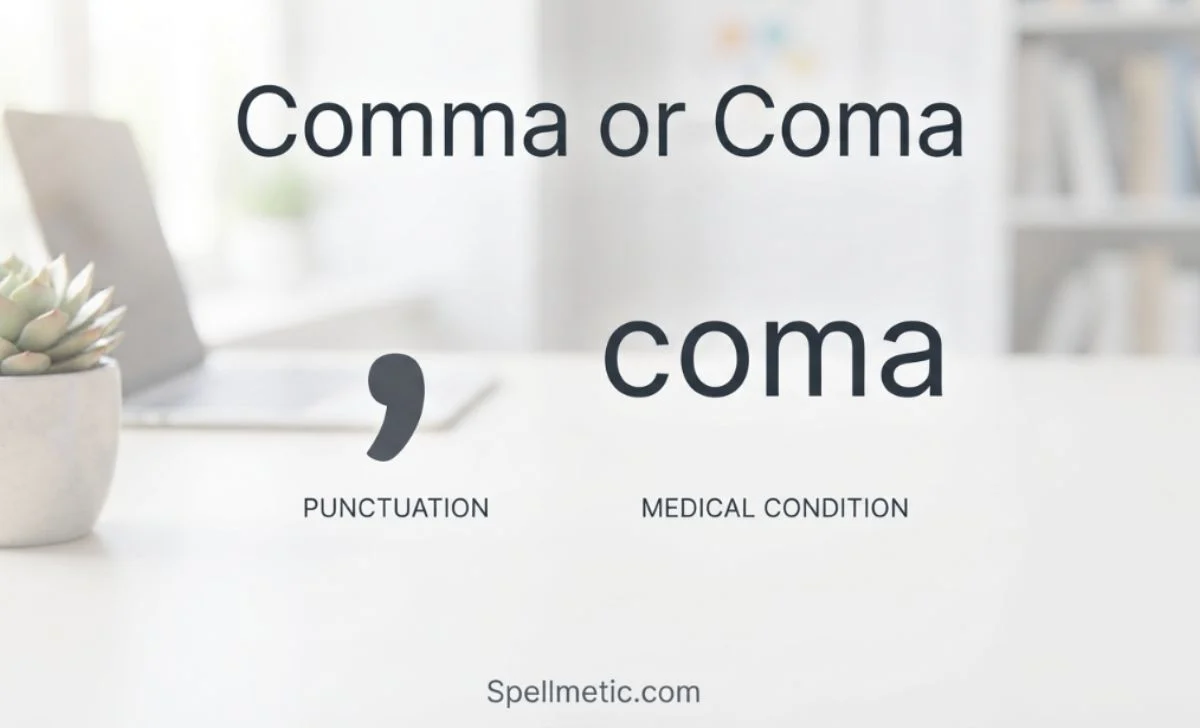
Comma and coma are two different English words with different meanings. A comma is a punctuation mark used in writing, while a coma is a medical condition in which a person is unconscious and cannot be awakened normally.
Although these words look and sound similar, they are used in completely different contexts. Understanding the difference can help you avoid common spelling and word-usage mistakes.
Quick Answer: Comma vs. Coma
The main difference between comma and coma is their meaning and use.
| Word | Meaning | Main Use | Example |
|---|---|---|---|
| Comma | A punctuation mark | Grammar and writing | Add a comma here. |
| Coma | A state of unconsciousness | Medical context | He is in a coma. |
A simple way to remember the difference is that comma has an extra m and is related to writing and punctuation.
What Is a Comma?
A comma is a punctuation mark represented by the symbol ,. It is used to separate words, phrases, clauses, or parts of a sentence. Commas help make written sentences clearer and easier to understand.
For example:
- I bought apples, oranges, and bananas.
- After lunch, we went to the park.
- Sarah, my best friend, lives nearby.
- Yes, I understand your question.
In these examples, the comma helps organize the sentence and separate different parts of the information.
When Do You Use a Comma?
Commas are used in several common situations in English grammar.
To Separate Items in a List
Use commas to separate three or more items in a series.
Example:
I bought bread, milk, eggs, and cheese.
After an Introductory Phrase
A comma can separate an introductory word or phrase from the main part of a sentence.
Example:
After school, we went home.
Before a Coordinating Conjunction
A comma is commonly used before conjunctions such as and, but, or, so, for, nor, and yet when they join independent clauses.
Example:
I wanted to go, but it started raining.
To Set Off Extra Information
Commas can separate information that adds detail but is not essential to the main sentence.
Example:
My brother, who lives in Lahore, is a teacher.
What Is a Coma?
A coma is a medical state in which a person is deeply unconscious and cannot be awakened normally. A person in a coma may not respond to their surroundings or communicate in the usual way.
For example:
- The patient is in a coma.
- The accident left him in a coma.
- She remained in a coma for several days.
- Doctors are monitoring the patient closely.
In these sentences, coma refers to a medical condition, not punctuation.
Difference Between Comma and Coma
| Feature | Comma | Coma |
|---|---|---|
| Meaning | A punctuation mark | A medical condition |
| Context | Grammar and writing | Medical context |
| Symbol | , | No punctuation symbol |
| Pronunciation | KOM-uh | KOH-muh |
| Example | Use a comma here. | The patient is in a coma. |
Comma vs. Coma Pronunciation
Comma and coma sound different. Their spellings are also different.
- Comma: pronounced KOM-uh
- Coma: pronounced KOH-muh
The main difference is the vowel sound at the start of each word.aking.
Comma or Coma: Example Sentences
The following examples show how each word is used correctly.
Examples of Comma
- Please add a comma after the introduction.
- I bought apples, oranges, and bananas.
- After dinner, we watched a movie.
- The teacher explained how to use a comma.
- She placed a comma between the two phrases.
Examples of Coma
- The patient is currently in a coma.
- The accident left him in a coma.
- Doctors are monitoring the patient.
- The patient remained in a coma for several days.
- His family visited him in the hospital.
These examples make the difference clear: comma is connected with writing, while coma is connected with a medical condition.
Common Mistakes With Comma and Coma
Because the words are similar, English learners sometimes use one in place of the other.
For example:
Incorrect: Please add a coma after the name.
Correct: Please add a comma after the name.
Here, comma is correct because the sentence is talking about punctuation.
Another example is:
Incorrect: The patient is in a comma.
Correct: The patient is in a coma.
Here, coma is correct because the sentence refers to a medical condition.
Is Comma or Coma Correct?
Both comma and coma are correct English words. The correct choice depends on the meaning of your sentence.
Use comma when you are talking about punctuation, grammar, or writing.
Example:
I forgot to put a comma in the sentence.
Use coma when you are talking about a state of prolonged unconsciousness.
Example:
The patient has been in a coma for several days.
Therefore, neither word is a misspelling of the other. They are separate words with different meanings.
How to Remember Comma vs. Coma
A simple memory trick can help you remember which word to use.
Comma = writing and punctuation
Coma = medical condition
You can also remember that comma contains an extra m compared with coma. When you see the extra letter in comma, think about making marks in written sentences.
This simple association can make the difference easier to remember.
FAQs
1. What is the difference between comma and coma?
A comma is a punctuation mark used in writing, while a coma is a medical state of prolonged unconsciousness.
2. Is it comma or coma in grammar?
Comma is the correct word when talking about grammar. It is a punctuation mark used to separate parts of a sentence.
3. Is coma a punctuation mark?
No. Coma is a medical term. The punctuation mark is spelled comma.
4. How do you remember comma vs. coma?
Remember that comma has an extra m and is related to writing and punctuation. Coma refers to a medical condition.
5. Are comma and coma pronounced the same?
No. They generally have different vowel sounds. Comma is usually pronounced KAH-muh, while coma is usually pronounced KOH-muh.
6. Which spelling is correct for punctuation?
The correct spelling is comma. For example, “Put a comma after the introductory phrase.”
7. Which spelling refers to unconsciousness?
The correct spelling is coma. For example, “The patient is in a coma.”
Conclusion
The difference between comma and coma is simple once you understand their meanings. A comma is a punctuation mark used to organize and clarify writing, while a coma is a medical state of prolonged unconsciousness.
Use comma when discussing grammar and punctuation, and use coma when referring to a medical condition.
Remembering this distinction will help you avoid a common English spelling and word-usage mistake.