Unengaged and disengaged are close in meaning, but they are not always interchangeable. Both words can describe someone who is not involved, interested, or taking part in something. The difference becomes clearer when you look at what happened before.
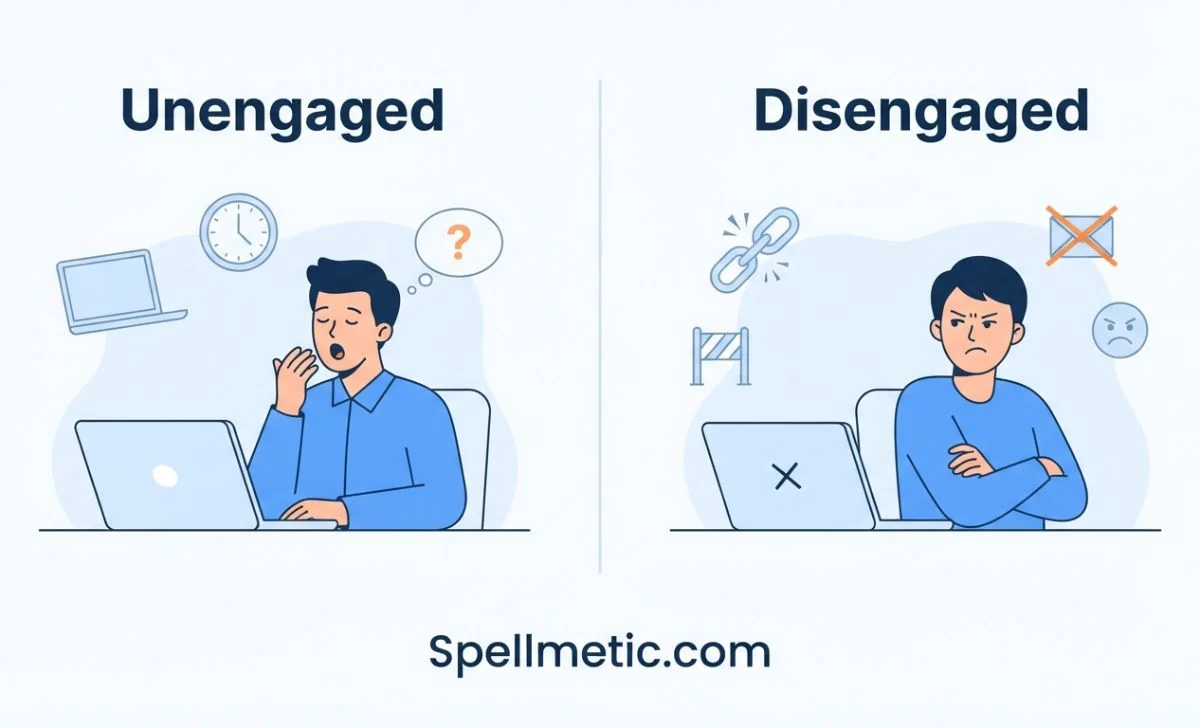
Unengaged can describe a person who is simply not involved or participating. Disengaged often describes someone who has become detached or less involved. For example, a student who does not take part in a class may be unengaged, while an employee who was once active but has lost interest in their work may be disengaged.
This is why people search for unengaged or disengaged meaning, examples, and usage. The words appear in workplace emails, education, customer service, news writing, and everyday conversation. Choosing the right one can make a sentence more precise.
This guide explains the difference in simple English, with real-life examples, common mistakes, pronunciation, synonyms, and practical guidance for professional and everyday writing.
Quick Answer
Unengaged means not engaged, involved, or participating.
Disengaged means not interested or involved, or detached from something. Cambridge defines disengaged as not feeling interested or involved in something.
| Word | Simple meaning | Example |
|---|---|---|
| Unengaged | Not engaged or involved | The students looked unengaged during the lesson. |
| Disengaged | Detached or no longer interested or involved | The employee became disengaged from the project. |
The easiest way to remember the difference is:
Unengaged = not engaged
Disengaged = detached or withdrawn from engagement
There is some overlap. In many situations, either word may describe a lack of involvement. The surrounding context tells you which one sounds more natural.
The Origin of Unengaged or Disengaged
Both words come from engage.
The verb engage developed in English from French engager. Its meanings expanded over time and now include becoming involved, attracting attention, taking part, and committing to something.
How unengaged is formed
Unengaged combines:
un- + engaged
The prefix un- commonly gives the meaning “not.” Therefore, unengaged can simply describe someone or something that is not engaged.
This makes the word useful for a straightforward description:
The audience was unengaged during the presentation.
The sentence does not necessarily tell us that the audience had previously been interested.
How disengaged is formed
Disengaged comes from disengage, which has the sense of separating, releasing, or withdrawing from something.
That idea can still be seen in modern usage. Oxford defines disengaged as not involved with or interested in someone or something and gives examples involving emotional detachment and reduced involvement.
For example:
The manager became disengaged from the team.
Here, disengaged can suggest a move away from active involvement.
British English vs American English Usage
Unlike words such as colour/color or centre/center, unengaged and disengaged do not have separate British and American spellings.
Both forms are standard in British and American English.
| Word | British English | American English | Main idea |
|---|---|---|---|
| Unengaged | Unengaged | Unengaged | Not engaged or involved |
| Disengaged | Disengaged | Disengaged | Detached or not interested/involved |
The main difference you may notice is pronunciation. Cambridge lists unengaged as /ˌʌn.ɪŋˈɡeɪdʒd/ in UK English and /ˌʌn.ɪnˈɡeɪdʒd/ in US English.
For disengaged, Cambridge gives the same IPA pronunciation for UK and US English: /ˌdɪs.ɪŋˈɡeɪdʒd/.
So, if you are writing for a US audience, UK audience, or an international audience, you do not need to change the spelling.
Which Word Should You Use?
Choose based on the situation rather than the country of your reader.
Use unengaged when there is little or no involvement
Unengaged works well when you simply want to describe a lack of participation, attention, or involvement.
Several students remained unengaged during the discussion.
The audience seemed unengaged during the first half of the event.
It does not necessarily tell the reader that the person was previously interested.
Use disengaged when someone is detached or has lost involvement
Disengaged is often more natural when someone has pulled away or is no longer interested in something.
The employee became disengaged after repeated changes to the project.
She felt disengaged from her work.
This is especially common in workplace, education, and organizational contexts. Cambridge, for example, uses disengaged for students and for people becoming disengaged from a process.
A useful comparison
Unengaged: The customer was unengaged with the presentation.
Disengaged: The customer became disengaged after the presentation became too technical.
The first describes a state. The second makes the change in involvement more noticeable.
Common Mistakes with Unengaged or Disengaged
Treating the words as exact synonyms
The meanings overlap, but the words can carry different implications.
Less precise:
The employee was disengaged from the first day.
If the employee was never involved, unengaged may be a better fit:
The employee was unengaged from the first day.
If the employee was once involved and later withdrew:
The employee became disengaged from the team.
Using disengaged to mean unemployed
Disengaged does not mean unemployed.
Someone can have a full-time job and still feel disengaged from their work.
Maria is still working at the company, but she feels disengaged from her role.
Confusing disengaged with uninterested
Uninterested focuses directly on a lack of interest.
Disengaged can include a lack of interest, but it can also suggest separation or reduced involvement.
He was uninterested in the topic.
He became disengaged from the project.
The second sentence says more about his relationship with the project.
Assuming unengaged is incorrect
Unengaged is a valid English word. Cambridge lists it as an adjective and provides related synonyms including unoccupied, free, and idle in some senses.
Unengaged or Disengaged in Everyday Examples
The right word can change slightly depending on the situation.
In an email
Some team members appeared unengaged during yesterday’s meeting.
This is a neutral way to describe limited participation.
In workplace writing
We noticed that several employees have become disengaged from the new process.
Here, disengaged suggests reduced involvement.
In education
The teacher tried a group activity because several students seemed unengaged.
If the problem is ongoing:
The teacher was concerned that some students were becoming disengaged from the course.
In customer service
The sales team noticed that the customer seemed unengaged during the product demonstration.
If the customer had shown interest earlier:
The customer became disengaged after the discussion moved away from their needs.
In news writing
The report examined why some young adults remain unengaged with local community activities.
In social media
Users became disengaged after the platform introduced several confusing changes.
This suggests that users lost interest or involvement.
In formal writing
The study identified participants who remained unengaged throughout the activity.
For a change over time:
The researchers observed increasing signs of disengagement among participants.
Unengaged or Disengaged – Synonyms and Related Words
The best synonym depends on the exact meaning.
Synonyms for unengaged
- uninvolved
- inactive
- unoccupied
- idle
- free
- detached
- uninterested
Some of these are context-specific. For example, unoccupied can mean not busy, while uninvolved focuses on participation.
Synonyms for disengaged
- detached
- uninvolved
- withdrawn
- uninterested
- distant
- disconnected
- apathetic
These are not perfect replacements in every sentence.
For example:
The employee was disengaged from the project.
can become:
The employee was detached from the project.
But apathetic is stronger because it suggests a lack of interest or concern.
Unengaged or Disengaged Pronunciation
Unengaged
- UK: /ˌʌn.ɪŋˈɡeɪdʒd/
- US: /ˌʌn.ɪnˈɡeɪdʒd/
Cambridge records these UK and US pronunciations separately.
Disengaged
- UK: /ˌdɪs.ɪŋˈɡeɪdʒd/
- US: /ˌdɪs.ɪŋˈɡeɪdʒd/
Cambridge gives the same pronunciation for the two varieties.
A simple way to practice disengaged is:
dis + en + gaged
For unengaged:
un + en + gaged
Unengaged or Disengaged – Google Trends & Usage Data
Search interest can change over time, so Google Trends should be treated as a snapshot of search behavior rather than a dictionary of correct usage.
The contexts in which the words appear are more useful for understanding their practical difference.
Unengaged is useful when the focus is on a lack of involvement or participation. It can describe students, audiences, customers, participants, and people who are simply not occupied.
Disengaged has a strong role in workplace and education language because it can describe reduced interest or involvement. Cambridge specifically includes examples involving disengaged students and people becoming disengaged from a process.
| Context | Natural choice | Example |
|---|---|---|
| Not participating | Unengaged | The students were unengaged. |
| Lost interest | Disengaged | The students became disengaged. |
| Workplace involvement | Disengaged | He feels disengaged from his work. |
| Audience participation | Unengaged | The audience seemed unengaged. |
| Withdrawal | Disengaged | She became disengaged from the group. |
| Not busy or occupied | Unengaged | He was unengaged for most of the afternoon. |
Unengaged vs Disengaged: Side-by-Side Comparison
| Feature | Unengaged | Disengaged |
|---|---|---|
| Basic meaning | Not engaged | Not interested or involved; detached |
| Main focus | Lack of engagement | Reduced or withdrawn engagement |
| Previous involvement required? | No | No, but the context often suggests a change |
| Tone | Often neutral | Often stronger |
| Workplace use | Possible | Very common |
| Education | Common | Common |
| Customer context | Possible | Common |
| Can describe lack of interest? | Yes | Yes |
| British spelling | Unengaged | Disengaged |
| American spelling | Unengaged | Disengaged |
The important point is that disengaged does not always require previous involvement. The distinction is useful, but it should not be treated as an absolute grammar rule.
Unengaged or Disengaged in a Sentence
Here are natural examples showing the difference:
Unengaged:
The audience seemed unengaged during the long presentation.
Disengaged:
The audience became disengaged when the presentation became repetitive.
Unengaged employee:
The unengaged employee rarely joined team discussions.
Disengaged employee:
The employee became disengaged after months of poor communication.
Unengaged student:
The unengaged student did not participate in the activity.
Disengaged student:
The student became disengaged after falling behind in the course.
Unengaged customer:
The customer appeared unengaged during the demonstration.
Disengaged customer:
The customer became disengaged after several unanswered questions.
FAQs
1. What is the difference between unengaged and disengaged?
Unengaged generally means not engaged or involved. Disengaged can mean detached, withdrawn, or not interested or involved. The two words can overlap.
2. Is unengaged a correct word?
Yes. Unengaged is a standard English adjective. It can describe someone or something that is not engaged, involved, or occupied.
3. Is disengaged a correct word?
Yes. Disengaged is commonly used as an adjective for someone who is not interested or involved.
4. Is unengaged the same as uninterested?
Not exactly. Unengaged focuses on a lack of involvement or participation. Uninterested focuses more directly on a lack of interest.
5. What does disengaged mean at work?
At work, disengaged can describe an employee who feels detached from their role, team, project, or organization.
6. What is a synonym for disengaged?
Depending on context, possible synonyms include detached, uninvolved, withdrawn, distant, disconnected, and uninterested.
7. Which is better: unengaged or disengaged?
Neither word is always better. Use unengaged when you want to describe a lack of engagement. Use disengaged when the context involves detachment, reduced interest, or withdrawal.
Conclusion
Unengaged or disengaged is a usage question, not a British-versus-American spelling question. Both words are correctly spelled in both major varieties of English.
Use unengaged when someone is simply not engaged, active, or involved. It works well for students, audiences, customers, and participants when you want a fairly neutral description.
Use disengaged when the meaning involves detachment, reduced interest, or a move away from active involvement. This makes it especially useful in workplace, education, and organizational writing.
The distinction is helpful, but it is not an unbreakable rule. Both words can overlap, and the surrounding sentence often determines which one sounds more natural. If you are describing a lack of participation, unengaged may be the clearer choice. If you are describing someone who has pulled away or lost interest, disengaged often fits better.
Once you focus on the intended meaning rather than the spelling, choosing between these two words becomes much easier.