Have you ever written imminent or eminent and stopped because you were not sure which word was correct? You are not alone. These two words look almost the same and sound very similar, but they describe completely different ideas.
The confusion usually appears in emails, school assignments, business writing, news reports, and formal English. A writer may know that something is “imminent” or that someone is “eminent,” but the similar spelling makes it easy to choose the wrong word.
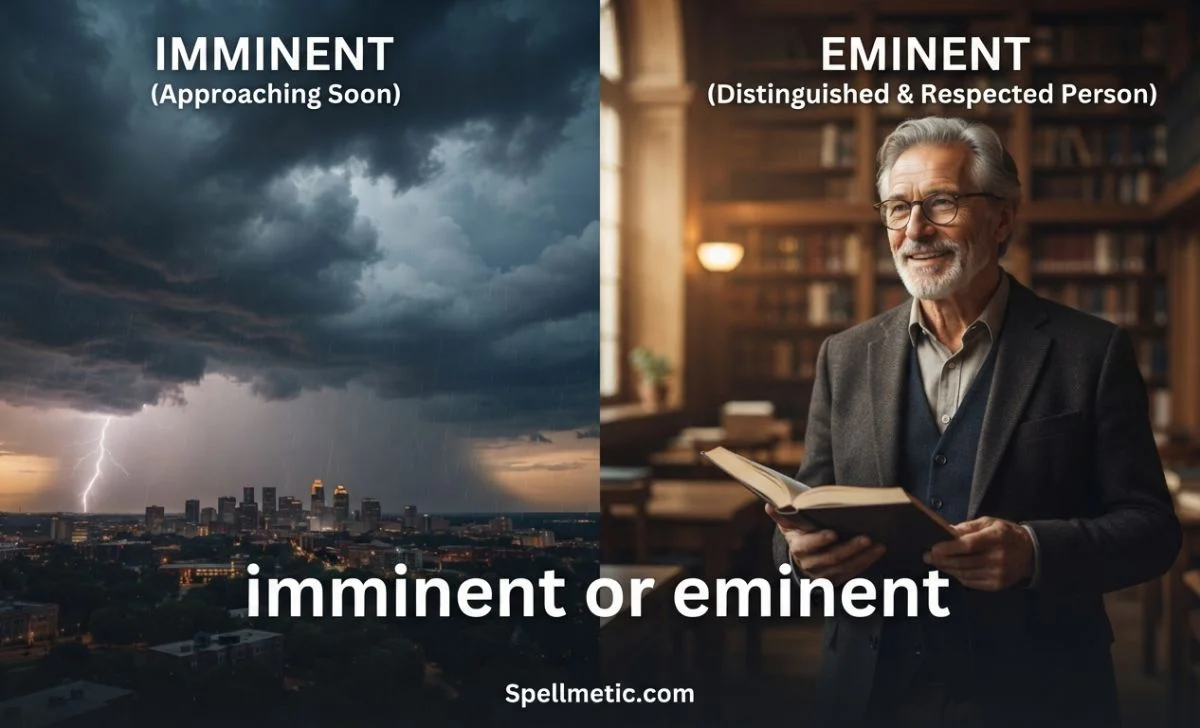
The basic difference is simple. Imminent means something is about to happen or is expected very soon. Eminent describes someone or something that is distinguished, respected, important, or well known for excellence.
For example, a storm can be imminent, but a scientist can be eminent. A deadline may be imminent, while a professor may be eminent.
This guide explains the difference, pronunciation, origin, common mistakes, synonyms, real-life examples, and the related word immanent, so you can choose the right word with confidence.
Quick Answer
Imminent means about to happen soon.
Eminent means distinguished, respected, prominent, or highly regarded.
| Word | Meaning | Example |
|---|---|---|
| Imminent | About to happen | A storm is imminent. |
| Eminent | Highly respected or distinguished | She is an eminent scientist. |
The easiest rule is:
Imminent = timing
Eminent = reputation
Use imminent for events, situations, changes, dangers, arrivals, or decisions that are close in time.
- An imminent storm
- An imminent deadline
- An imminent announcement
- An imminent arrival
- An imminent threat
Use eminent for people or things that stand out because of achievement, importance, reputation, or professional status.
- An eminent scholar
- An eminent physician
- An eminent historian
- An eminent author
- An eminent leader
This distinction is also supported by major dictionary-based explanations and current usage guides.
The Origin of Imminent and Eminent
The similar spelling of imminent and eminent is not accidental. Both words have Latin roots, but their meanings developed in different directions.
Imminent comes from Latin imminere, associated with the idea of projecting or hanging over. This developed into the modern sense of something that is close to happening or seems to be approaching.
That is why phrases such as imminent danger, imminent arrival, and imminent change make sense. The event is figuratively hanging over the situation.
Eminent comes from Latin eminere, meaning to stand out or project. Its modern meaning developed around the idea of standing above others in importance, ability, reputation, or position.
So you can connect the meanings like this:
Imminent → something is coming close.
Eminent → someone stands out.
Their shared historical background helps explain their similar appearance, but it does not make them interchangeable.
British English vs American English Usage
Unlike spelling pairs such as color/colour or center/centre, imminent and eminent do not have different British and American spellings.
The same spellings are used in both major varieties of English:
| Meaning | American English | British English |
|---|---|---|
| About to happen | imminent | imminent |
| Distinguished or respected | eminent | eminent |
| Existing within | immanent | immanent |
The difference is therefore meaning, not regional spelling.
Whether you are writing for readers in the United States, the United Kingdom, Canada, Australia, or another English-speaking audience, the correct choice depends on what you want to say.
For example:
- US: The danger is imminent.
- UK: The danger is imminent.
- US: She is an eminent historian.
- UK: She is an eminent historian.
This makes the words easier to handle in global English. You do not need to change the spelling for a British or American audience.
Which Word Should You Use?
Start by asking one simple question:
Am I talking about when something will happen, or about how important or respected someone is?
If you mean when something will happen, choose imminent.
The company expects an imminent announcement.
If you mean reputation, importance, or distinction, choose eminent.
The conference invited an eminent economist.
Use Imminent for:
- danger
- threats
- storms
- arrivals
- deadlines
- announcements
- changes
- attacks
- decisions
- events
Use Eminent for:
- scholars
- scientists
- doctors
- judges
- authors
- historians
- professors
- artists
- leaders
- experts
There is some flexibility with eminent, which can occasionally describe a quality or characteristic rather than a person. However, its most familiar modern use is for people who are distinguished or highly respected.
Common Mistakes With Imminent and Eminent
Because the words look so similar, writers often swap them.
Mistake 1: Eminent danger
Incorrect:
The city was warned about eminent danger.
Correct:
The city was warned about imminent danger.
The danger is close to happening, so imminent is correct.
Mistake 2: Imminent professor
Incorrect:
The university hired an imminent professor.
Correct:
The university hired an eminent professor.
The professor is distinguished or highly respected, so eminent is correct.
Mistake 3: Choosing by sound
The words are close in pronunciation, so listening alone may not be enough.
In US English, imminent is commonly pronounced approximately IM-uh-nuhnt, while eminent is approximately EM-uh-nuhnt. The first vowel sound is the main difference.
When you are unsure, focus on meaning rather than sound.
Mistake 4: Confusing imminent with immanent
Immanent is another word entirely. It generally means existing or operating within something and is especially common in philosophical or theological writing.
Imminent or Eminent in Everyday Examples
Seeing the words in natural situations makes the difference easier to remember.
In Emails
Imminent:
The project deadline is imminent, so please send your final changes today.
Eminent:
We are pleased to welcome an eminent researcher to our event.
In News Writing
Imminent:
Officials warned residents that flooding was imminent.
Eminent:
The award was presented to an eminent historian.
In Social Media
Imminent:
A major announcement is imminent.
Eminent:
It was an honor to meet such an eminent author.
In Formal Writing
Imminent:
The organization took immediate action because the risk of failure appeared imminent.
Eminent:
The research was reviewed by an eminent specialist in the field.
The pattern stays the same in every setting: imminent is about nearness in time; eminent is about distinction or standing.
Imminent vs Eminent vs Immanent
These three words cause even more confusion because their spellings and sounds are closely related.
| Word | Meaning | Common Context | Example |
|---|---|---|---|
| Imminent | About to happen soon | Events and situations | Danger is imminent. |
| Eminent | Distinguished or respected | People and achievements | She is an eminent scholar. |
| Immanent | Existing or operating within | Philosophy and theology | The quality is immanent in nature. |
A simple memory system can help:
Imminent → immediate
Eminent → exceptional
Immanent → inherent
The third word is less common in everyday English, but it matters when reading academic, philosophical, or theological material.
Imminent vs Inevitable: What Is the Difference?
Imminent means something is very likely to happen soon, while inevitable means something cannot be avoided.
For example:
A storm is imminent.
The storm is expected to arrive soon. However, the word does not mean that every consequence of the storm is certain.
Now consider:
Change is inevitable.
Here, the focus is not on timing. It means that change cannot be avoided.
The two words can sometimes appear in the same context, but they are not interchangeable. A company may face an inevitable change that is still years away. On the other hand, an imminent announcement may be expected within hours but could still be delayed or canceled.
The simplest distinction is:
Imminent = happening soon
Inevitable = impossible to avoid
So, use imminent when timing matters and inevitable when certainty or lack of choice matters.eful in news reports, business writing, academic work, and everyday English because an event can be close without being certain, or certain without being close.
Imminent and Eminent: Synonyms and Related Words
Using synonyms can help reinforce the difference, but the replacement must fit the context.
Imminent Synonyms
Common alternatives include:
- impending
- approaching
- forthcoming
- upcoming
- near
- looming
- coming
- at hand
For example:
An impending storm caused the event to be canceled.
Impending is a strong alternative when something negative or important is approaching. Other alternatives, such as forthcoming, may work better for announcements, reports, or events.
Eminent Synonyms
Common alternatives include:
- distinguished
- prominent
- renowned
- respected
- notable
- celebrated
- famous
- prestigious
For example:
The university invited a renowned scientist to speak.
The exact synonym depends on the sentence. Eminent often carries a formal sense of professional distinction rather than simply meaning famous.
Imminent and Eminent – Usage & Search Context
People searching “imminent or eminent” are usually trying to solve a word-choice problem, not a regional spelling problem.
Current search results repeatedly focus on the same practical questions: meaning, difference, pronunciation, examples, synonyms, immanent, and phrases such as imminent danger or eminent scholar.
The most useful way to remember the search intent is through common word combinations:
| Imminent | Eminent |
|---|---|
| imminent danger | eminent scholar |
| imminent threat | eminent scientist |
| imminent arrival | eminent physician |
| imminent deadline | eminent historian |
| imminent announcement | eminent author |
| imminent change | eminent professor |
| imminent attack | eminent leader |
These combinations reveal the difference more clearly than definitions alone.
If the noun describes something that may happen, imminent is often the natural choice.
If the noun describes a respected person or distinguished figure, eminent is often the right choice.
FAQs
1. What is the difference between imminent and eminent?
Imminent means about to happen soon. Eminent means distinguished, prominent, respected, or important.
2. Is it imminent danger or eminent danger?
The correct phrase is imminent danger because it refers to danger that is close or likely to happen soon.
3. Is an eminent person famous?
Usually, yes. Eminent often describes someone who is famous, respected, distinguished, or highly regarded in a particular field.
4. Are imminent and eminent pronounced the same?
No. Their pronunciations are very similar, but the opening vowel sound differs. This small difference can be difficult to notice in fast speech.
5. What is the difference between imminent and immanent?
Imminent means about to happen. Immanent means existing or operating within something and is more common in philosophical or theological contexts.
6. Is imminent a synonym for inevitable?
No. Imminent means likely to happen soon, while inevitable means impossible to avoid.
7. Is “eminent scholar” correct?
Yes. Eminent scholar is a natural phrase for a scholar who is highly respected or distinguished in their field.
Conclusion
Choosing between imminent or eminent becomes much easier when you focus on the idea behind the word.
Use imminent when something is about to happen or expected very soon. You can have an imminent storm, imminent danger, an imminent deadline, or an imminent announcement.
Use eminent when someone is distinguished, respected, prominent, or highly regarded. An eminent scientist, eminent scholar, eminent physician, or eminent historian has earned recognition in a particular field.
The words have similar spellings because of their Latin history, but they are not interchangeable. They also use the same spellings in British and American English, so this is a meaning and usage issue rather than a regional spelling difference.
Do not forget immanent, which has a separate meaning related to something existing or operating within something else. And while imminent can be related to inevitable, the two words are not identical.
The easiest final rule is:
Imminent = soon.
Eminent = distinguished.
If you remember those two ideas, you can avoid one of the most common word-choice mistakes in English.
Read More Blogs: