Choosing mono or fluoro sounds simple until you start looking at fishing line, leaders, lures, and different water conditions.
Both lines can catch fish, but they behave differently once they are on your reel and in the water.
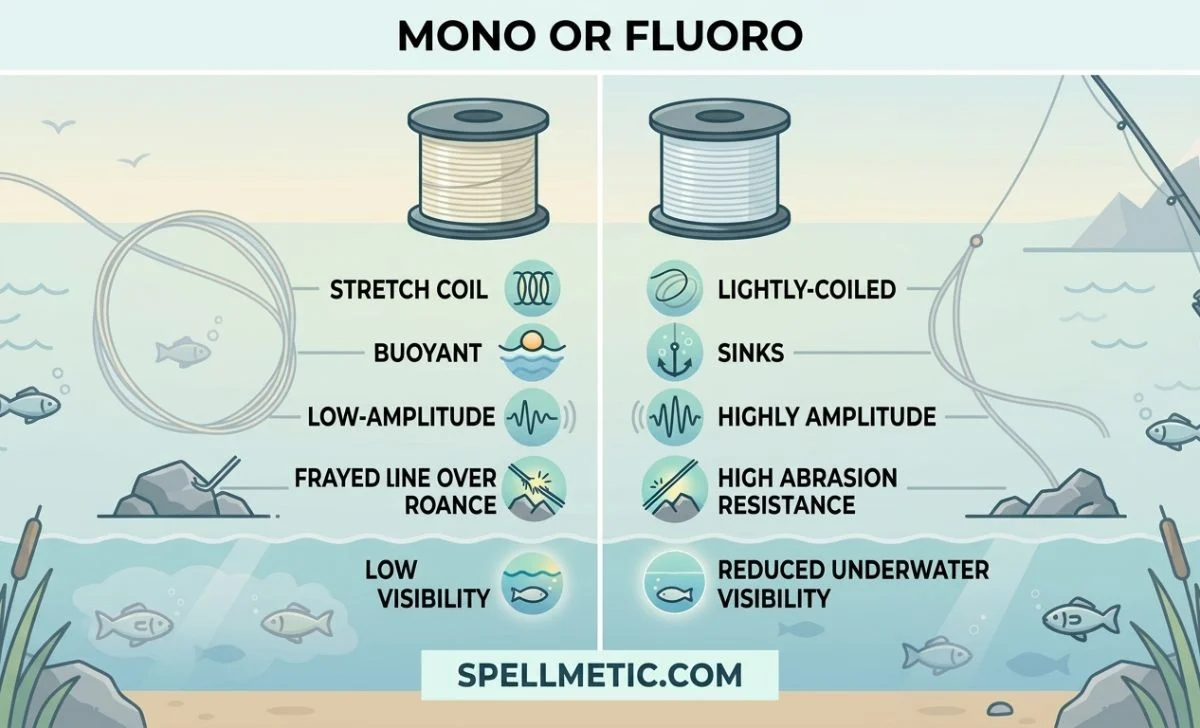
Mono is short for monofilament, usually a single nylon strand. Fluoro means fluorocarbon, a denser line that is known for low underwater visibility, low stretch, and good abrasion resistance. Neither line is automatically right for every fishing situation.
That is why anglers search for questions such as mono or fluoro leader, mono or fluoro fishing line, mono or fluoro for saltwater leader, mono or fluoro tippet, and mono or fluoro for baitcaster.
The easiest way to understand the difference is to look at what you want the line to do. If you need a floating line with more stretch, mono can make sense.
If you want a sinking line with lower visibility and a more direct feel, fluoro may fit better.The right choice depends on your lure, target fish, water clarity, cover, and fishing style.
Quick Answer
Choose mono when you want buoyancy, flexibility, easier handling, and more stretch. Choose fluoro when you want a sinking line, low underwater visibility, and more direct contact with your lure.
Here is the simple comparison:
| Feature | Mono | Fluoro |
|---|---|---|
| Full name | Monofilament | Fluorocarbon |
| Common material | Nylon | Fluorocarbon polymer |
| Buoyancy | Floats | Sinks |
| Stretch | More | Less |
| Underwater visibility | Relatively low | Very low |
| Flexibility | More flexible | Stiffer |
| Sensitivity | Lower | Higher in many situations |
| Topwater | Excellent fit | Usually not ideal |
| Clear water | Good | Often useful |
| Leader use | Common | Very common |
| Beginner friendly | Yes | Can require more care |
These are general characteristics, not absolute rules. Modern line designs can change how a particular product behaves, so the exact line and diameter still matter.
A simple rule
Topwater: Start with mono.
Clear water: Consider fluoro.
Bottom-contact lures: Fluoro is often useful.
Beginner setup: Mono is usually easier to manage.
Braid main line: Fluoro is a common leader choice.
The goal is not to find one line that wins every situation. The goal is to match the line to the presentation.
What Is Mono Fishing Line?
Mono is short for monofilament. It is made as a single strand, commonly from nylon, and has been a standard fishing line for decades. It is flexible, easy to handle, and generally less expensive than many specialized lines.
One of mono’s biggest characteristics is stretch. That stretch can be helpful when a fish strikes a lure with treble hooks because it provides some shock absorption during the fight. Mono also floats, which makes it useful for many topwater presentations.
For a new angler, mono can also be forgiving. It is relatively simple to spool, cast, and tie.
When does mono make sense?
Mono is a good option when you want:
- A floating line
- More stretch
- Easy handling
- Simple knot tying
- A budget-friendly setup
- A line for topwater lures
- Some shock absorption around treble hooks
For example, if you are throwing a popper early in the morning, you generally do not want your line pulling the lure downward. Mono’s buoyancy can help keep the presentation on the surface.
What Is Fluoro Fishing Line?
Fluoro is short for fluorocarbon. It is a polymer-based fishing line with a refractive index close to water, which is why it is much less noticeable underwater than many other lines. It is also denser than mono and sinks.
Fluoro has less stretch than traditional mono, although it is not completely stretch-free. That lower stretch can give anglers a more direct connection to a lure and help transmit information from the lure or bottom.
Its density can also be useful when fishing below the surface. This is one reason fluorocarbon is common with jigs, soft plastics, Texas rigs, and other bottom-contact presentations.
The trade-off is handling. Fluorocarbon can be stiffer than mono, and some versions have more memory. That can make casting and line management more demanding, particularly on spinning reels.
Mono or Fluoro for a Leader?
If you are choosing a leader, fluoro is often the first material anglers consider, especially in clear water.
A fluorocarbon leader can provide a less noticeable connection between your main line and lure. It also sinks and can provide good abrasion resistance in situations involving rocks, docks, vegetation, and other structure.
Mono can still be useful as a leader. Its stretch can provide some shock absorption, and its buoyancy can help when you want a lure or bait to stay higher in the water.
The important question is not simply:
“Which leader is better?”
Ask instead:
“What do I want this leader to do?”
If stealth and sinking behavior matter, fluoro may be a good fit. If stretch and buoyancy are useful, mono may make more sense.
Braid with a fluoro leader
A common setup is braided main line + fluorocarbon leader. The braid provides low stretch and a thin diameter, while the fluoro leader gives the lure a less visible connection. This setup is widely used in both freshwater and saltwater fishing.
Leader length is not fixed. Bassmaster contributor Mike Iaconelli notes that 2–4 feet is a common middle-ground range, while shorter leaders can be useful around heavy cover or when anglers want the connection knot to stay outside the rod guides.
Mono or Fluoro Fishing Line for Different Situations
The best choice becomes clearer when you look at actual fishing situations.
For topwater fishing
Mono is usually the more natural choice because it floats. That can help maintain the intended action of a surface lure. Fluoro sinks, which can work against some topwater presentations.
For clear water
Fluoro is often preferred when visibility matters. Its optical properties make it less noticeable underwater, which is useful when fish are cautious or the water is clear.
For bottom fishing
Fluoro can be useful because it sinks and provides relatively direct contact with bottom-contact lures. Jigs, soft plastics, and Texas rigs are common examples.
Around heavy cover
This is where the answer becomes more complicated. Line diameter, abrasion resistance, strength, and the type of cover all matter.
A heavy braid setup may be useful in thick vegetation, while a strong fluorocarbon leader can provide abrasion resistance and a less visible connection. Some anglers also choose mono depending on the structure and presentation.
Mono or Fluoro for Bass?
Both have a place in bass fishing.
Fluoro is commonly used for clear water, finesse fishing, jigs, soft plastics, and bottom-contact techniques. Its low visibility, sinking behavior, and relatively low stretch can suit these presentations.
Mono can be useful for topwater lures and some treble-hooked baits. Its buoyancy keeps it near the surface, while its stretch can help provide some forgiveness when a bass strikes and fights.
For example, imagine fishing a clear lake with a Texas-rigged soft plastic. Fluoro can make sense because you want the bait to work down near the bottom.
Now imagine the same lake at dawn with a topwater walking bait. Mono may be more suitable because you want the line to float and avoid pulling the bait downward.
Same fish. Same lake. Different presentation. Different line choice.
Mono or Fluoro for Saltwater Leader?
Saltwater fishing can be hard on line. Rocks, reefs, docks, shells, structure, and powerful fish can all put pressure on a leader.
Fluorocarbon is widely used for saltwater leaders because of its low underwater visibility, sinking behavior, and abrasion resistance. Dedicated fluorocarbon leader materials are also designed for impact, knot strength, and demanding conditions.
Mono remains useful when stretch, shock absorption, or buoyancy is desirable.
For saltwater, do not choose leader material by visibility alone. Consider:
- Target species
- Water clarity
- Structure
- Lure or bait
- Leader diameter
- Breaking strength
- Abrasion risk
- Knot strength
A line that works perfectly around open water may not be the right choice around sharp structure.
Mono or Fluoro for Tippet?
In fly fishing and other light-line applications, anglers may choose between mono and fluorocarbon tippet based on presentation and water conditions.
Fluorocarbon is often selected when low visibility and sinking behavior are useful. Mono can be useful when you want a more flexible material or a floating presentation.
For trout in clear water, fluorocarbon can be especially attractive because it is less visible underwater. Dedicated trout and steelhead fluorocarbon leader materials are available in light test sizes for these applications.
The key is matching the tippet to the fly, current, water clarity, and fish behavior rather than choosing a material simply because it is popular.
Mono or Fluoro for Baitcaster?
Both mono and fluoro can be used on a baitcaster.
Mono is usually easier for beginners because it is flexible and forgiving. It can also be a good choice when you are learning to control spool tension, braking, and casting technique.
Fluoro can be useful when you want a sinking line and more direct lure contact. However, its stiffness and memory can make line management more demanding.
If you are learning a baitcaster for the first time, starting with mono can make the learning process simpler. Once your casting control improves, you can experiment with fluoro for techniques that benefit from its characteristics.
Mono vs Fluoro vs Braid
Braid deserves a place in this comparison because many anglers use it as the main line and connect it to either mono or fluoro.
| Line | Floats/Sinks | Stretch | Main Advantage | Common Uses |
|---|---|---|---|---|
| Mono | Floats | More | Easy handling and shock absorption | Topwater, general fishing |
| Fluoro | Sinks | Less | Low visibility and sensitivity | Clear water, bottom contact, leaders |
| Braid | Generally floats | Very little | Strength and thin diameter | Heavy cover, long casts, main line |
Braid is especially useful when strength and low stretch are important. Its visibility can be a concern in clear water, which is one reason anglers often combine braid with a fluorocarbon leader.
There is no rule saying you must choose only one type. A single setup can combine two materials.
Common Mistakes When Choosing Mono or Fluoro
Choosing fluoro for every lure
Fluoro sinks. That can be useful for bottom presentations but can work against some topwater lures.
Assuming mono is only for beginners
Mono is still useful for specific presentations. Its buoyancy and stretch can be advantages, not flaws.
Choosing by pound test alone
Breaking strength is important, but so are diameter, stretch, abrasion resistance, visibility, and handling.
Ignoring line memory
Stiff fluorocarbon can develop coils and create casting problems. Proper spooling and careful line management can help.
Using the same line for every technique
A topwater lure and a bottom-contact jig do not ask the line to do the same job.
Thinking “invisible” means literally invisible
Fluorocarbon is less visible underwater, but no fishing line should be treated as magically invisible under every lighting and water condition.
How to Choose Between Mono and Fluoro
Use these points as a starting guide when choosing fishing line for a specific technique.
Mono works well for:
- Topwater lures
- More stretch and shock absorption
- Easy handling and knot tying
- Learning to use a baitcaster
- A general-purpose, often lower-cost option
- Treble-hooked lures where some extra stretch can help
Fluoro works well for:
- Clear water
- Bottom-contact presentations
- Situations where a sinking line is useful
- Lower-visibility leaders
- Fishing around rocks, wood, or other abrasive cover
- More direct contact with the lure
Braid with a fluoro leader works well for:
- Low stretch and strong main-line performance
- A lower-visibility connection near the lure
- Fishing situations where a leader is useful
These are practical starting points, not strict rules. Lure type, water clarity, cover, target species, and fishing technique can all change the best line choice.
What Has Changed in Fishing Line Technology?
The choice is no longer simply “old mono versus modern fluoro.” Manufacturers now make specialized versions of both.
For example, recent monofilament designs are being developed with reduced stretch, smaller diameters, and improved knot and tensile strength. Seaguar introduced its BRAWLR monofilament in 2026 with a focus on reducing some of the traditional limitations associated with mono.
Fluorocarbon has also moved beyond simple leader material. Modern fluorocarbon products are designed for specific jobs, including bass leaders, trout and steelhead applications, inshore saltwater fishing, and large offshore species.
That means anglers should look beyond the word mono or fluoro on the package. The actual product design, diameter, pound test, and intended use can make a meaningful difference.
FAQs
1. Is mono or fluoro better?
Neither is better for every situation. Mono is useful when buoyancy and stretch matter, while fluoro is useful when sinking behavior, low visibility, and a more direct connection are important.
2. Should I use mono or fluoro for a leader?
Fluoro is a common choice when low visibility and abrasion resistance matter. Mono can be useful when you want more stretch or a floating presentation.
3. Is mono or fluoro better for bass?
Both work. Fluoro is popular for clear water, finesse, and bottom-contact fishing, while mono is useful for topwater and some treble-hooked presentations.
4. Is mono or fluoro better for saltwater?
Both can work. Fluoro is widely used as a saltwater leader, especially when low visibility and abrasion resistance are important. The target species and structure should also guide the choice.
5. Should I use mono or fluoro on a baitcaster?
Mono is generally easier to manage when learning. Fluoro can be useful for sinking presentations and increased sensitivity but may require more careful line management.
6. Is fluorocarbon better in clear water?
Fluorocarbon is often chosen for clear water because it is less visible underwater than many other fishing lines.
7. Can I use braid with fluorocarbon?
Yes. Braid with a fluorocarbon leader is a common setup. It combines the characteristics of braid as a main line with the lower visibility of fluorocarbon near the lure.
8. Is mono good for topwater fishing?
Yes. Mono floats, which makes it a useful choice for many topwater presentations. Its stretch can also provide some forgiveness with treble-hooked lures.
Conclusion
The mono or fluoro question does not have one answer that works for every angler. The better choice depends on what you are asking the line to do.
Mono brings useful qualities such as buoyancy, flexibility, easy handling, and more stretch. Those traits make it a strong option for topwater fishing, beginner setups, and some treble-hooked lures.
Fluoro brings a different set of advantages. It sinks, has low underwater visibility, offers relatively low stretch, and can provide good abrasion resistance. Those qualities make it useful for clear water, bottom-contact presentations, and many leader applications.
There is also no reason to treat mono, fluoro, and braid as competing choices that must stay separate. Many setups combine them. Braid can serve as the main line while fluorocarbon handles the final connection to the lure.
So before choosing, look at the lure, water clarity, depth, cover, target species, and fishing technique. Once those factors are clear, the mono-or-fluoro decision becomes much easier.