Choosing between a Traditional or Roth IRA can feel confusing because both accounts are designed for retirement savings, but they handle taxes at different times.
A Traditional IRA may give you a tax deduction today, while a Roth IRA uses after-tax money and can provide tax-free qualified withdrawals later. The right choice depends on factors such as your current income, tax bracket, retirement plans, age, and expectations about future taxes.
This guide explains the differences in simple terms, including contributions, income limits, withdrawals, RMDs, 401(k)s, and how a Traditional or Roth calculator can help you compare the two.
Quick Answer
The basic difference is when you receive the tax benefit.
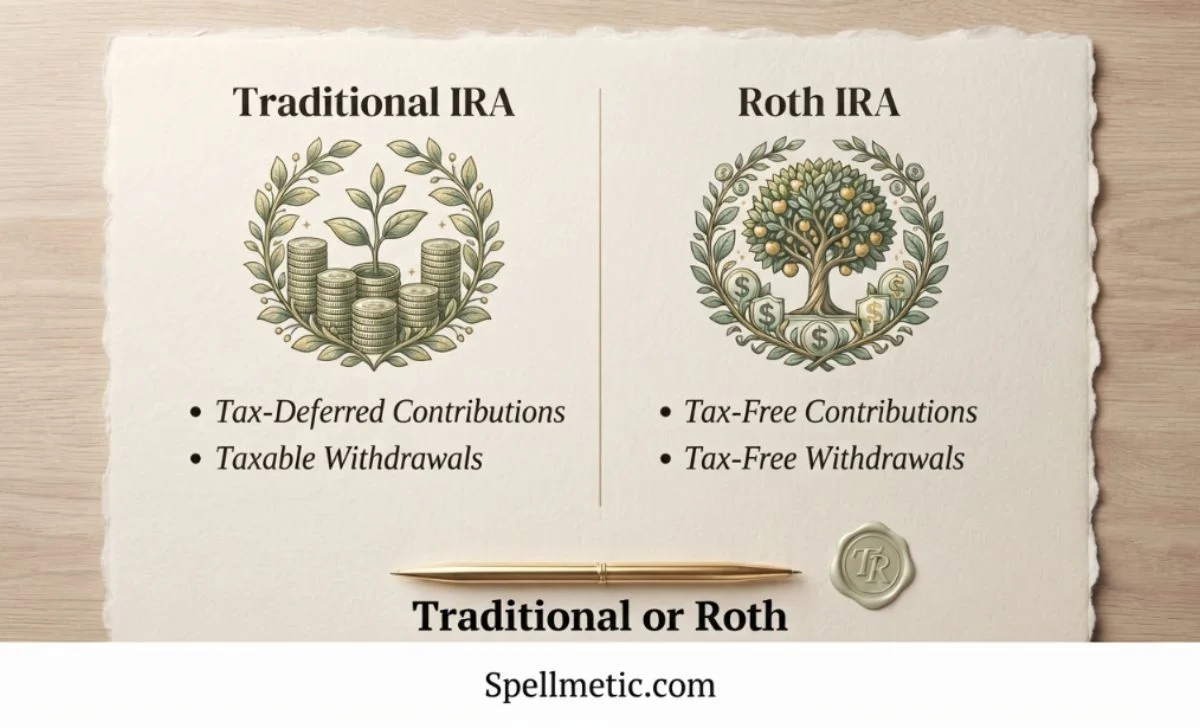
With a Traditional IRA, your contribution may be deductible depending on your circumstances. Your money can grow tax-deferred, and withdrawals are generally taxable as income.
With a Roth IRA, you contribute money after paying income tax. Qualified withdrawals can then be tax-free.
For 2026, the combined contribution limit for Traditional and Roth IRAs is $7,500, or $8,600 if you are age 50 or older, assuming you have enough taxable compensation.
That limit applies across your Traditional and Roth IRAs combined, not separately to each account.
Traditional IRA vs. Roth IRA
| Feature | Traditional IRA | Roth IRA |
|---|---|---|
| Contributions | May be tax-deductible | Not tax-deductible |
| Tax treatment | Tax-deferred | After-tax |
| Qualified withdrawals | Generally taxable | Generally tax-free |
| Income limit for contributions | No general income limit to contribute | Income limits apply |
| RMDs for original owner | Generally required | Not required during owner’s lifetime |
| Main tax benefit | Potential benefit now | Potential benefit later |
The biggest distinction is not the investment itself. Both accounts can hold investments such as stocks, bonds, mutual funds, or ETFs depending on the provider.
The major difference is how the IRS treats the money going into and coming out of the account.
How a Traditional IRA Works
A Traditional IRA is a retirement account that can provide a tax benefit when you contribute.
If you qualify for a deduction, the contribution can reduce your taxable income for the year. Money inside the account generally isn’t taxed until you take a distribution.
For example, imagine Sarah earns $80,000 and contributes $6,000 to a Traditional IRA. If she qualifies for the full deduction, that contribution may reduce the income subject to federal income tax.
Later, when Sarah withdraws money from the Traditional IRA in retirement, the taxable portion is generally included in her income.
However, the deduction is not automatically available to everyone. Your filing status, income, and whether you or your spouse participates in a workplace retirement plan can affect it.
How a Roth IRA Works
A Roth IRA works in the opposite tax direction.
You contribute money that has already been taxed. You don’t receive a federal income-tax deduction for the contribution, but qualified withdrawals can be tax-free.
For example, suppose David contributes $6,000 to a Roth IRA while he is working. He pays the applicable taxes on that income before contributing.
If the account grows substantially over several decades and his withdrawals meet the requirements for qualified Roth distributions, those withdrawals can generally be made without federal income tax.
Roth IRAs also don’t require the original owner to take lifetime RMDs.
Traditional or Roth: The Main Tax Difference
Think of the two accounts as two different tax schedules:
Traditional IRA:
Pay potentially less tax now → pay tax on taxable withdrawals later.
Roth IRA:
Pay tax now → potentially withdraw qualified money tax-free later.
That makes your current tax rate versus expected retirement tax rate an important consideration.
For example, someone who expects to have substantially higher taxable income in retirement may place more value on having tax-free qualified Roth withdrawals. Someone who expects a lower taxable income in retirement may place more value on a Traditional IRA’s potential deduction today.
That is a comparison, not a guarantee. Future tax rates, income, investment returns, and personal circumstances can all change.
Traditional or Roth Calculator: What Does It Compare?
A Traditional or Roth calculator can estimate how the two choices might compare over time.
Most calculators consider information such as:
- Current income
- Current tax rate
- Expected retirement tax rate
- Annual contribution
- Years until retirement
- Expected investment return
- Retirement age
- Other retirement accounts
For example, a 30-year-old earning $70,000 and investing for several decades could get a very different result from a 55-year-old earning $200,000 with a shorter retirement horizon.
Schwab’s Roth vs. Traditional IRA calculator similarly uses personal information and assumptions to compare estimated future values.
A calculator is useful for modeling scenarios, but its result depends on the assumptions you enter. It should not be treated as a prediction of future tax rates or investment returns.
Traditional IRA vs. 401(k): What’s the Difference?
A Traditional IRA and a 401(k) are both retirement accounts, but they are not the same thing.
A Traditional IRA is an individual account that you generally open yourself through a financial institution. A 401(k) is normally offered through an employer.
A workplace 401(k) may also include an employer match, which can be an important part of a retirement savings strategy.
The contribution limits are also different. For 2026, the employee contribution limit for a 401(k) is substantially higher than the IRA limit. The exact rules also depend on age and the type of contribution.
So the question isn’t necessarily Traditional IRA or 401(k). Someone may use both as part of the same retirement plan.
Traditional or Roth 401(k): What’s the Difference?
The same basic tax distinction exists with workplace retirement plans.
A Traditional 401(k) generally uses pre-tax contributions, with taxes generally due when taxable withdrawals are made.
A Roth 401(k) uses after-tax contributions, while qualified withdrawals can be federally tax-free.
The important difference is that a Roth 401(k) is an employer-sponsored plan, while a Roth IRA is an individual retirement account with its own income eligibility rules.
For 2026, the employee deferral limit for a 401(k), including Traditional and Roth contributions together, is $24,500 before applicable catch-up contributions.
If an employer offers both options, an employee may be able to divide contributions between Traditional and Roth 401(k) accounts, subject to the applicable combined limits.
Can You Have a Roth and Traditional IRA?
Yes. You can have both a Traditional IRA and a Roth IRA.
However, having two accounts does not give you two separate annual IRA contribution limits.
For 2026, the combined contribution limit for your Traditional and Roth IRAs is $7,500, or $8,600 if you’re 50 or older, subject to the taxable compensation rule.
For example, you could contribute:
- $4,000 to a Traditional IRA
- $3,500 to a Roth IRA
That totals $7,500.
You could also divide your contributions differently, provided you remain within the applicable annual limit.
Some people use both account types to create different sources of taxable and potentially tax-free retirement income.
Traditional IRA Income Limits
One common misconception is that Traditional IRA contributions have the same income restrictions as Roth IRA contributions.
They don’t.
You can generally contribute to a Traditional IRA if you have taxable compensation, but your ability to deduct that contribution can be limited when you or your spouse is covered by a workplace retirement plan.
For 2026, the IRS increased several income thresholds used for the Traditional IRA deduction. For example, when covered by a retirement plan at work, the deduction phaseout for a married couple filing jointly begins at $129,000 of modified AGI and ends at $149,000.
For a single filer or head of household, it begins at $81,000 and ends at $91,000.
These figures are specifically about the deduction, not a blanket prohibition on making a Traditional IRA contribution.
Roth IRA Income Limits
Roth IRA contributions have their own income rules.
For 2026, the Roth IRA contribution phaseout for single filers and heads of household is $153,000 to $168,000 of modified AGI. For married couples filing jointly, the phaseout is $242,000 to $252,000.
This is why someone can potentially make a Traditional IRA contribution but not be eligible to make a direct Roth IRA contribution.
Income limits can change from year to year, so readers should check the current IRS figures before making a contribution.
Roth IRA Age Limit and Withdrawal Rules
There is no age limit for making Roth IRA contributions as long as you meet the applicable eligibility requirements and have taxable compensation.
Withdrawals are more complicated.
For Roth IRA earnings to receive the full tax-free treatment associated with a qualified distribution, the applicable requirements generally include the five-year rule and a qualifying condition such as reaching age 59½.
This is different from simply withdrawing your original contributions. Roth IRA withdrawal rules distinguish between contributions and earnings, so it is important not to assume that every withdrawal is automatically tax-free.
Traditional or Roth Withdrawal: How Do They Differ?
The tax treatment can be summarized like this:
| Withdrawal situation | Traditional IRA | Roth IRA |
|---|---|---|
| Original contribution | Generally taxable when deducted contributions are withdrawn | Contributions were already taxed |
| Investment earnings | Generally taxable when distributed | Qualified earnings can be tax-free |
| Qualified retirement withdrawal | Generally taxable | Generally tax-free |
| Early withdrawal | Taxes and possible penalty may apply | Depends on whether contributions or earnings are withdrawn and whether an exception applies |
Traditional IRA withdrawals are generally included in taxable income unless an exception or previously taxed basis changes the result.
Roth IRA withdrawals require more careful treatment because contributions and earnings are not treated identically.
Required Minimum Distributions: Traditional vs. Roth
RMDs are another important difference.
Generally, Traditional IRAs require the original owner to begin taking required minimum distributions at age 73 under current rules. Roth IRAs do not require lifetime RMDs for the original owner.
That difference can matter for retirement income planning.
Imagine Mark has both accounts at retirement. He may have more flexibility with his Roth IRA because he isn’t required to take lifetime RMDs from it as the original owner. His Traditional IRA, however, is subject to the applicable RMD rules.
RMD rules for inherited retirement accounts are different, so beneficiaries should not assume that the owner’s rules automatically apply to them.
Roth or Traditional IRA for a Young Person
For a younger investor, the long time until retirement can make the tax treatment especially important because investments may have many years to grow.
Suppose Emma is 25, has a relatively modest income today, and expects her career income to rise substantially. A Roth IRA could allow her to pay taxes at today’s rates and potentially take qualified withdrawals tax-free later.
But age alone doesn’t determine the appropriate account. Her income, tax bracket, eligibility, employer retirement plan, and expected retirement situation still matter.
Roth or Traditional IRA for a 30-Year-Old
At 30, the same basic comparison applies.
Consider two people:
Person A has a moderate income and expects significantly higher earnings later.
Person B has a high current income and expects to have substantially less taxable income after retirement.
They are the same age, but their tax circumstances are different.
That is why “Roth or Traditional IRA for a 30-year-old” cannot be answered from age alone.
Roth or Traditional IRA for a 40-Year-Old
At 40, income and retirement savings may be more established.
A person earning substantially more than they did in their 20s may value a current Traditional IRA deduction if they qualify for it. Another person may prefer Roth contributions because they expect higher taxes or want more tax-free income later.
The important question is not simply, “What is my age?”
It is:
“Which tax treatment fits my current and expected retirement situation?”
Roth or Traditional IRA for a 50-Year-Old
At 50, retirement may be closer, but there is still time for investments to grow.
For 2026, people age 50 and older can make an IRA catch-up contribution of $1,100 in addition to the regular $7,500 limit, giving a potential total of $8,600 if they otherwise qualify.
At this stage, current income, expected retirement income, RMDs, and the need for tax diversification may become particularly important.
Roth vs. Traditional TSP
Federal employees and members of the uniformed services may encounter another comparison: Roth vs. Traditional TSP.
The Thrift Savings Plan offers Traditional and Roth options, but a TSP account is not the same as an IRA.
The basic tax distinction is familiar:
- Traditional TSP contributions receive pre-tax treatment.
- Roth TSP contributions are made with after-tax money.
- Qualified Roth withdrawals can receive tax-free treatment.
A Roth TSP should not be confused with a Roth IRA because contribution limits, eligibility rules, and account features differ.
What Factors Should You Consider?
Instead of choosing an account based on age or a simple online rule, consider these factors:
1. Your Current Tax Bracket
A Traditional contribution may be more valuable when a current deduction has significant tax value.
2. Your Expected Retirement Income
Think about where your income may come from later, including Social Security, pensions, taxable investments, and retirement accounts.
3. Your Income and Eligibility
Your income can affect Roth IRA eligibility and the deductibility of Traditional IRA contributions.
4. Your Employer Retirement Plan
If your employer offers a 401(k) match, that benefit should be considered separately from the IRA decision.
5. Your Withdrawal Plans
Consider whether you expect to need retirement money early, later, or gradually.
6. Required Minimum Distributions
Traditional and Roth accounts don’t have identical RMD treatment for the original owner.
7. Tax Diversification
Using different types of retirement accounts can create a mix of taxable and potentially tax-free income sources in retirement.
A Simple Real-Life Comparison
Imagine two workers, Alex and Maria.
Alex is in a relatively high tax bracket today and expects his taxable income to be lower after retirement. A Traditional IRA’s potential tax deduction may be valuable to him if he qualifies.
Maria is early in her career and expects her income to increase substantially over time. She may place greater value on paying taxes now and potentially receiving qualified Roth withdrawals tax-free later.
Neither example proves that one account is universally better. It shows why the current tax situation and expected future situation matter more than simply choosing based on age.
Common Mistakes to Avoid
Assuming Roth Withdrawals Are Always Tax-Free
Qualified Roth distributions can be tax-free, but Roth withdrawal rules have specific requirements.
Assuming Every Traditional IRA Contribution Is Deductible
Your income and workplace retirement-plan coverage can affect the deduction.
Treating IRA and 401(k) as the Same Account
They are different retirement arrangements with different contribution limits and rules.
Using Old Contribution Limits
Retirement limits are adjusted over time. For 2026, the IRA limit is $7,500, not the older $7,000 limit used for 2025.
Choosing Only by Age
Age is useful context, but tax rate, income, retirement plans, and withdrawal needs can be just as important.
Ignoring Tax Diversification
Having only one type of retirement account can limit the types of income available to you later. A mix of taxable and tax-free sources may provide greater flexibility, depending on your circumstances.
FAQs
1. Is Traditional or Roth better?
There is no single answer for everyone. Traditional IRAs can provide potential tax benefits today, while Roth IRAs can provide tax-free qualified withdrawals later. Your income, tax situation, retirement expectations, and eligibility all matter.
2. Can I have both a Traditional and Roth IRA?
Yes. You can have both, but the annual IRA contribution limit applies to your combined contributions across Traditional and Roth IRAs.
3. Is a Traditional IRA the same as a 401(k)?
No. A Traditional IRA is an individual retirement account, while a 401(k) is generally an employer-sponsored retirement plan.
4. Is there an age limit for Roth IRA contributions?
There is no maximum age for Roth IRA contributions, provided you meet the applicable requirements, including having taxable compensation.
5. What is the 2026 IRA contribution limit?
For 2026, the combined Traditional and Roth IRA contribution limit is $7,500, or $8,600 for people age 50 or older, subject to the taxable compensation rule.
6. What is the difference between Roth and Traditional?
The main difference is the timing of taxation. Traditional IRA contributions may provide a deduction now, while Roth contributions are made with after-tax money and qualified withdrawals can be tax-free.
7. Do Traditional IRAs have RMDs?
Generally, yes. Traditional IRA owners generally must begin taking RMDs at age 73 under current rules.
8. Does a Roth IRA have RMDs?
The original owner does not have lifetime RMDs from a Roth IRA. Beneficiaries can be subject to different rules after the owner’s death.
9. Can I contribute to a Traditional IRA if I have a 401(k)?
Yes. Having a workplace retirement plan does not automatically prevent you from contributing to an IRA, although it can affect whether a Traditional IRA contribution is deductible.
10. Should I use a Traditional or Roth calculator?
A calculator can help you compare potential outcomes using assumptions such as income, tax rates, contribution amounts, investment returns, and years until retirement. The result is only as reliable as the assumptions used.
Conclusion
The choice between Traditional or Roth mainly comes down to the timing of your tax benefit.
A Traditional IRA may offer a tax deduction today and tax-deferred growth, with taxes generally due on taxable withdrawals later.
A Roth IRA uses after-tax contributions but can provide tax-free qualified withdrawals and no lifetime RMDs for the original owner.
For 2026, remember that the combined IRA contribution limit is $7,500, or $8,600 for those age 50 or older. Income limits and deduction rules can also affect what you can contribute or deduct.
Rather than choosing solely because you’re young, close to retirement, or in a particular income range, compare your current tax situation, expected retirement income, eligibility, withdrawal plans, and employer retirement options.
Those factors give you a much clearer picture of how Traditional and Roth accounts may fit into your retirement strategy.