Have you ever seen crowler and growler on a brewery menu and wondered whether one is simply a different spelling of the other? The confusion is understandable. Both words describe containers used to take draft beer home, and they sound almost the same.
But crowler and growler are not two spellings of the same word. They describe different types of beer containers.
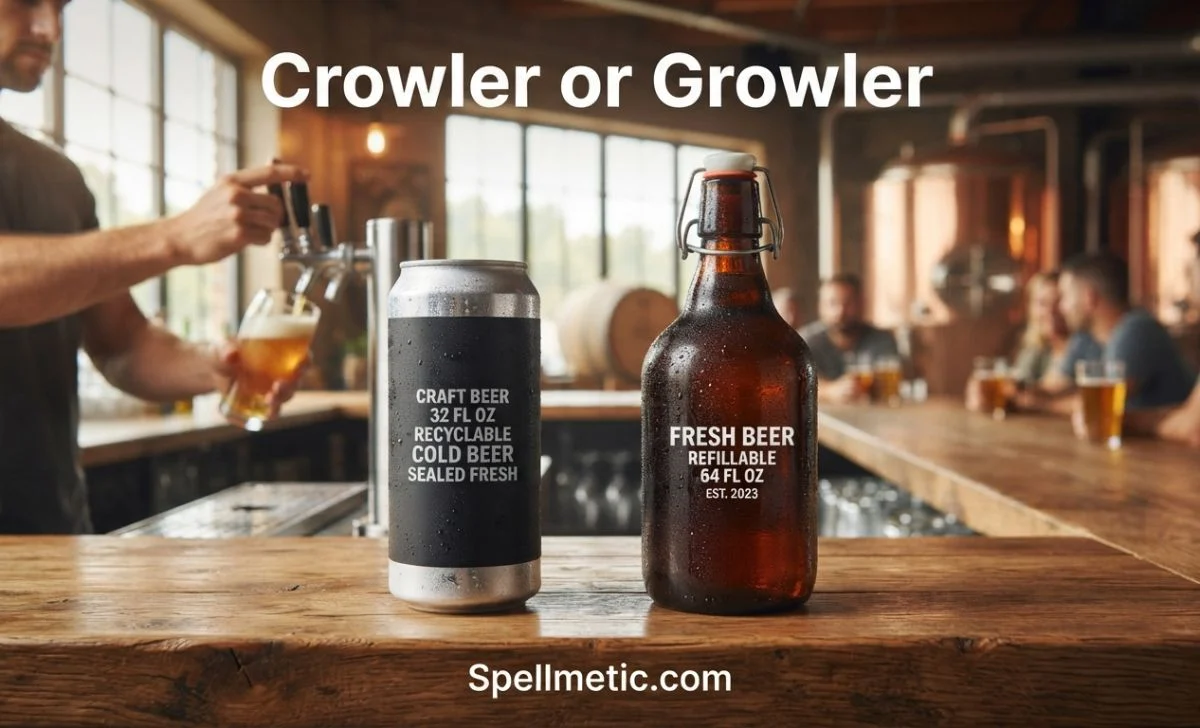
A crowler is generally a large metal can, commonly 32 fluid ounces, that is filled with draft beer and sealed with a machine. A growler is a reusable container, traditionally a jug or bottle, used to carry draft beer.
There is also a third term worth knowing: howler, which commonly refers to a smaller growler, often around 32 ounces.
So, which one should you choose? The answer depends on how much beer you want, whether you want to reuse the container, and how you plan to carry and store it.
Quick Answer
Crowler and growler are both correct words, but they mean different beer containers.
| Term | What it means | Common size | Reusable? |
|---|---|---|---|
| Crowler | Large metal beer can filled and sealed at a brewery | 32 oz | Usually no |
| Growler | Reusable beer jug or bottle | 32–64 oz and other sizes | Yes |
| Howler | Smaller growler | Often 32 oz | Yes |
A crowler is usually better suited to convenient, sealed take-home beer. A growler makes more sense when you want a container that can be cleaned and refilled.
What Is a Crowler?
A crowler is a large metal can designed for take-home draft beer. It is commonly filled directly from a tap and then sealed with a can-seaming machine.
The word crowler is associated with the idea of a “can growler.” Current dictionary and brewing references describe it as a large metal beer container, usually around 32 fluid ounces, that is machine-sealed.
A crowler is useful when you want:
- A sealed container for draft beer
- A relatively lightweight option
- Easy transport
- A container that does not need to be returned for refilling
- Protection from light because the metal can is opaque
Example:
“The brewery filled a crowler with their seasonal IPA for me.”
What Is a Growler?
A growler is a container used to take draft beer home. Traditional growlers are often made from glass, although stainless steel and other materials are also available.
Growlers are designed to be reused. You can bring a clean container back to a brewery or taproom and have it filled again, where local rules and the brewery’s policy allow it.
The most familiar growler size is 64 fluid ounces, but 32-ounce and other sizes are also available.
Example:
“I brought my growler to the brewery for a refill.”
Crowler vs Growler: Key Differences
The main difference is the container format.
| Feature | Crowler | Growler |
|---|---|---|
| Container | Large metal can | Jug or bottle |
| Common material | Aluminum | Glass, stainless steel, ceramic |
| Common size | 32 oz | 32 oz, 64 oz, and other sizes |
| Sealing | Machine-sealed | Cap, stopper, or similar closure |
| Reuse | Usually single-use | Designed for repeated use |
| Portability | Lightweight and convenient | Heavier, especially glass |
| Main purpose | Convenient take-home beer | Refillable take-home beer |
Size and Capacity
A typical crowler holds 32 fluid ounces. A traditional full-size growler commonly holds 64 fluid ounces, although smaller growlers are common too.
This means a 32-ounce crowler gives you about half the volume of a 64-ounce growler.
Material and Sealing
Crowlers are generally metal cans that are sealed with a machine. Growlers may use glass, stainless steel, ceramic, or other suitable materials and usually have a reusable closure.
The sealed can format also gives a crowler an advantage for carrying beer without worrying about a glass jug breaking.
Reusability and Portability
A growler is built around reuse. You keep the container, clean it properly, and return for another fill.
A crowler focuses more on convenience. Once opened and emptied, the container is normally recycled rather than taken back for another fill.
What Is a Howler?
A howler is commonly used for a smaller growler, often around 32 fluid ounces. In other words, it can be thought of as a half-size growler in contexts where that terminology is used.
This creates an important distinction:
A 32-ounce crowler is a can. A 32-ounce howler is a smaller growler.
They may hold the same amount of beer, but the containers are different. Brewing and packaging sources use “howler” for smaller growler formats.
Why Are They Called Crowler and Growler?
The word growler has a much older history than the modern crowler. Historical dictionary sources trace the beer-container sense of growler to 19th-century American English, but its exact origin is uncertain.
One popular explanation connects the name with the sound made by escaping gas from older beer containers. That explanation appears in dictionary material, but the exact origin is not certain.
Crowler is much newer. The modern term refers to a can-based version of the growler concept, and brewing sources describe the format as a combination of a can and a growler.
Which One Should You Choose?
Choose a crowler when you want a compact, sealed container that is easy to carry.
Choose a growler when you want a reusable container and expect to return for future fills.
A howler can make sense when you want a smaller growler-sized portion rather than a full 64-ounce container.
Your choice can also depend on what the brewery offers. Some taprooms sell only crowlers, while others offer several growler sizes.
Common Mistakes With Crowler and Growler
Mistake 1: Treating them as different spellings
They are not. Both words are correct, but they refer to different containers.
Mistake 2: Assuming every growler is 64 ounces
64 ounces is a common size, not the only size. Smaller growlers are also available.
Mistake 3: Calling every large beer can a growler
A large sealed can filled at a taproom is more precisely called a crowler.
Mistake 4: Confusing a howler with a crowler
They can have the same capacity, but a howler is generally a smaller growler, while a crowler is a can.
Crowler or Growler in Everyday Examples
At a brewery:
“Can I get this IPA in a crowler?”
Talking about a reusable container:
“I need to wash my growler before the next fill.”
Comparing options:
“Should we take home a growler or a crowler?”
Talking about size:
“I only want 32 ounces, so a howler would work.”
These examples show why choosing the right word depends on the container rather than the beer itself.
FAQs
1. Is a crowler the same as a growler?
No. A crowler is generally a machine-sealed metal can, while a growler is a reusable beer container.
2. Is a crowler or growler better?
Neither is universally better. A crowler emphasizes convenience and portability, while a growler is designed for reuse.
3. Is a crowler always 32 ounces?
No. 32 ounces is the common size, but crowler formats can vary by brewery and packaging system.
4. Is a growler always 64 ounces?
No. A 64-ounce growler is common, but 32-ounce and other sizes are also used.
5. What is a howler compared with a crowler?
A howler is generally a smaller growler, often around 32 ounces. A crowler is a sealed metal can.
6. Can you reuse a crowler?
A typical crowler is intended as a single-use package. A growler, by contrast, is specifically designed for repeated use.
7. Why do crowler and growler sound so similar?
The terms are closely related because the crowler is essentially a can-based take-home beer format built around the growler concept.
Conclusion
So, crowler or growler is not really a question of choosing the correct spelling. Both words are correct, but they describe different containers.
A crowler is usually a 32-ounce metal can filled with draft beer and sealed at the brewery. It is lightweight, portable, and generally intended for single use.
A growler is a reusable jug or bottle for draft beer, commonly available in 32-ounce and 64-ounce sizes. A howler is commonly a smaller growler, often around 32 ounces.
The easiest way to remember the difference is simple: crowler = can, growler = reusable container, howler = smaller growler.
When ordering beer, writing about beer, or explaining these terms to someone else, you can confidently use either crowler or growler—just make sure the word matches the container you mean.
Read More Blogs: