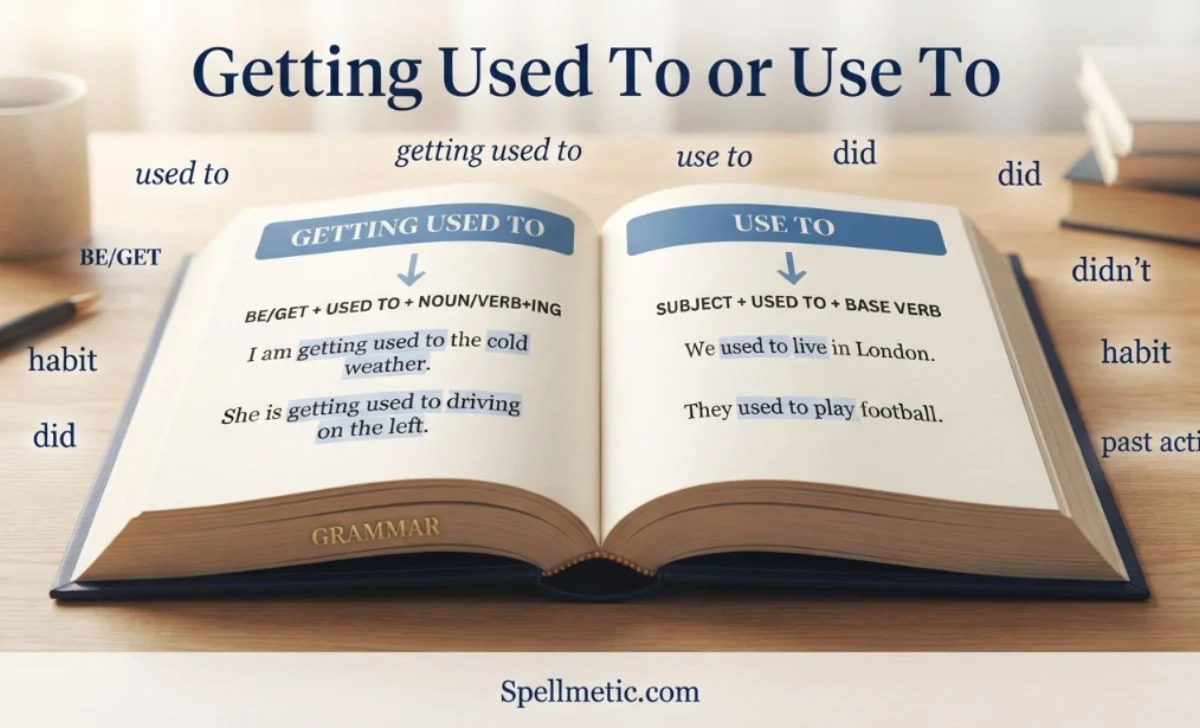
The choice between used or use depends on the grammar of the sentence. Both use and used are correct English words, but they do different jobs.
Use is the base form of the verb. It appears with I, you, we, and they in the present tense and after modal verbs such as can, should, and will.
Used is the past tense and past participle of use. It also appears in several common expressions, including used to and be used to.
For example:
I use this app every day.
I used this app yesterday.
But there is another important rule:
I used to live there.
Did you use to live there?
The difference can seem small, especially because use and used sound similar in some expressions. Once you identify the tense and sentence structure, the correct form becomes much easier to choose.
Quick Answer
Both words are correct, but they are used in different grammatical situations.
- Use = base or present form
- Used = past tense or past participle
- Used to = something that happened regularly in the past
- Use to = used after did or didn’t in questions and negatives about the past
Compare:
I use my laptop every day.
I used my laptop yesterday.
I used to work from home.
Did you use to work from home?
Cambridge specifically notes that used to + verb describes past situations or regular activities, while use to appears after did or didn’t in questions and negatives.
Correct Examples
- I use this computer for work.
- She uses a dictionary when she writes.
- We used the old system last year.
- They used to live in Chicago.
- Did you use to play tennis?
Incorrect Examples and Corrections
Incorrect: I used this app every day now.
Correct: I use this app every day now.
Incorrect: She use the software yesterday.
Correct: She used the software yesterday.
Incorrect: Did you used to live here?
Correct: Did you use to live here?
Incorrect: I didn’t used to like coffee.
Correct: I didn’t use to like coffee.
Incorrect: He can used my computer.
Correct: He can use my computer.
What Do “Use” and “Used” Mean?
The verb use means to do something with an object, tool, method, or resource for a particular purpose.
For example:
You can use this key to open the door.
It can also refer to employing a method or skill:
We use several methods to solve the problem.
Oxford lists use as a verb meaning to do something with a machine, method, object, or other thing for a particular purpose. Its verb forms include use as the present form and used as both the past simple and past participle.
The word used can therefore mean that someone performed the action in the past:
She used my phone yesterday.
It can also appear as an adjective:
I bought a used car.
In that context, used means the car has already had a previous owner or has been previously owned. Collins also lists used as an adjective for something that has already been used or, in the case of a car, previously owned.
How to Spell and Pronounce “Use” and “Used”
The spelling is straightforward, but pronunciation can cause confusion.
Use as a Verb
When use is a verb, it is pronounced:
American English: /juːz/
British English: /juːz/
It rhymes with words such as news and choose.
I use this tool every day.
Used as a Verb
The regular past form used is pronounced:
/juːzd/
She used the tool yesterday.
Oxford gives use as /juːz/ and used as /juːzd/ in its verb entry.
“Used To” Has a Different Sound
In used to, the pronunciation is commonly reduced in connected speech.
Oxford lists used to as /ˈjuːst tə/ and gives didn’t use to as /ˌdɪdnt ˈjuːs tə/.
That sound can make the spelling confusing. A learner may hear something close to use to even when the affirmative sentence requires used to.
Why Do People Mix Up “Use” and “Used”?
The confusion comes from several different grammar patterns.
One reason is pronunciation. Used to sounds different from the ordinary past-tense form used, and the d can be difficult to hear before to.
Another reason is the use of did. English normally places the main verb in its base form after did:
Did you use it?
not:
Did you used it?
The same principle applies to didn’t:
I didn’t use it.
not:
I didn’t used it.
People also confuse used to with be used to. These expressions look almost identical but have different meanings.
I used to wake up early.
I am used to waking up early.
The first sentence describes a past habit. The second says that waking up early is familiar or normal for the speaker. Oxford and Cambridge both distinguish these constructions.
Is “Use” a Real Word? Is “Used” a Real Word?
Yes. Both use and used are standard English words.
The issue is not whether one is a real word. The real question is which form fits the grammar of your sentence.
Use is the base form and present-tense form used with I, you, we, and they:
We use this software every day.
Used is the past form and past participle:
We used this software last year.
Oxford explicitly lists used as the past simple and past participle of use.
The word also appears as an adjective:
They sell used books.
So, neither word is a spelling mistake.
Where Did “Use” Come From?
The verb use has a long history in English.
Oxford traces the verb to Middle English user, based on the Latin verb uti, meaning “to use.” The noun has a related history through Old French and Latin.
Over time, use developed into one of the most common verbs in English. Today, speakers use it for physical objects, tools, methods, language, time, resources, technology, and many other things.
For example:
Use a spoon to stir the soup.
Use this method to calculate the answer.
We use English at work.
Try to use your time wisely.
The past form used developed as the regular -ed form of the verb.
What Do Major Dictionaries Say?
Trusted dictionaries make the distinction clear.
Cambridge Dictionary
Cambridge identifies use as the form used in the past construction use to after did and didn’t. It gives examples such as Did you use to… and I didn’t use to….
Its grammar guidance also explains that used to + verb describes a past situation or regular activity, while be used to + noun/gerund describes familiarity with something.
Oxford Learner’s Dictionaries
Oxford lists the verb forms as:
- present: use
- past simple: used
- past participle: used
- -ing form: using
It also distinguishes used to do something from be used to something.
Collins Dictionary
Collins recognizes used in several roles, including the past-related expression used to, the adjective meaning previously used, and the phrase be used to.
The dictionary evidence therefore supports a simple conclusion: use and used are both standard forms, but grammar determines which one belongs in a particular sentence.
American English vs. British English
The basic difference between use and used is the same in American and British English.
Both varieties use:
I use this computer every day.
I used it yesterday.
Both also use used to for past habits:
I used to live in Boston.
Questions and negatives commonly use use to after did or didn’t:
Did you use to live there?
I didn’t use to live there.
Cambridge and Oxford both document this pattern.
American English
American English commonly uses:
Did you use to play baseball?
I didn’t use to drink coffee.
British English
The same pattern applies in British English:
Did you use to play football?
I didn’t use to drink coffee.
In more formal British writing, you may also encounter used not to:
She used not to drink coffee.
However, didn’t use to remains a common and natural choice in everyday English. Oxford also recognizes used not to as a formal negative construction.ttern.
Which Form Should You Use?
The right choice depends on the structure around the word.
Use “Use” for the Present or Base Form
Choose use when the sentence calls for the base verb:
I use this program every day.
You can use my phone.
We should use a different method.
They will use the new system tomorrow.
After modal verbs such as can, could, should, may, and will, use the base form:
You can use this tool.
Not:
You can used this tool.
Use “Used” for the Past
Choose used when talking about a completed action in the past:
I used your laptop yesterday.
She used the wrong file.
They used this method last year.
The same form also works as a past participle:
I have used this software before.
The machine has been used several times.
Use “Used To” for Past Habits
Use used to + base verb to describe a past habit, repeated action, or past state that is no longer true or no longer happens.
I used to live in New York.
She used to play tennis every weekend.
We used to visit our grandparents every summer.
Oxford describes this construction as referring to something that happened regularly or was true in the past but is not now.
Use “Use To” After Did or Didn’t
After did or didn’t, use the base form use:
Did you use to work here?
I didn’t use to like coffee.
Did she use to live in Texas?
Cambridge explicitly recommends use to in questions and negatives formed with do.
A Simple Way to Remember the Difference
Think about the word that comes before the verb.
If you are talking about a normal present action:
I use it every day.
For a completed past action:
I used it yesterday.
For a past habit:
I used to use it every day.
After did or didn’t, return to the base form:
Did you use to use it?
I didn’t use to use it.
A useful memory rule is:
Did + use, not did + used.
That single rule helps solve many questions involving used to.
“Use To” or “Used To” Exercises
Practice can make the difference between used to and use to easier to remember. Choose the correct form in each sentence.
- I ______ live near the beach.
- Did you ______ play football at school?
- She didn’t ______ like spicy food.
- We ______ visit our grandparents every summer.
- Did he ______ work here?
Answers
- used to — I used to live near the beach.
- use to — Did you use to play football at school?
- use to — She didn’t use to like spicy food.
- used to — We used to visit our grandparents every summer.
- use to — Did he use to work here?
The key rule is simple: use used to in affirmative statements about past habits. After did or didn’t, use use to.
Common Mistakes With “Use” and “Used”
1. “Did you used to…?”
Standard form:
Did you use to live here?
The auxiliary did already carries the past tense, so the following verb takes its base form. Cambridge gives this exact pattern in its grammar guidance.
2. “I didn’t used to…”
Use:
I didn’t use to drink coffee.
The same rule applies after didn’t.
3. “He can used…”
Use:
He can use my computer.
Modal verbs take the base form of the following verb.
4. “I use it yesterday.”
Use:
I used it yesterday.
The past-time expression yesterday calls for the past form.
5. “I used to using…”
This construction mixes two different patterns.
For a past habit:
I used to use this software.
For familiarity:
I am used to using this software.
The second pattern requires be used to + noun or -ing form, not used to + base verb. Oxford and Cambridge both highlight this distinction.
“I’m Used to It” or “I’m Use to It”?
The correct expression is “I’m used to it.”
✅ I’m used to it.
❌ I’m use to it.
Here, used to means that something is familiar or no longer feels unusual. The structure is:
be + used to + noun/pronoun/-ing form
For example:
I’m used to it now.
She’s used to working late.
They’re used to the noise.
Do not confuse this with used to + base verb, which describes a past habit:
I used to work late.
The two structures look similar but have different meanings.
Getting Used To or Use To
Used to and use to appear in different sentence patterns.
Used to means gradually becoming familiar or comfortable with something. It comes before a noun, pronoun, or -ing form.
I am getting used to my new job.
For example, she is getting used to waking up early.
Likewise, we are getting used to the cold weather.
By contrast, use to comes after did or didn’t when you talk about a past habit.
Did you use to live here?
I didn’t use to drink coffee.
In a positive statement about a past habit, however, use used to:
I used to live here.
She used to drink coffee.
The easiest way to remember the difference is simple:
- getting used to + noun/-ing → becoming accustomed to something
- used to + base verb → a past habit
- did/didn’t + use to + base verb → a past-habit question or negative
For instance, “I’m getting used to working from home” means I am gradually becoming comfortable with it. “Did you use to work from home?” asks about a past habit.ome. “Did you use to work from home?” asks whether working from home was a past habit.
Use and Used in Everyday Writing
Emails
Please use the attached form.
I used the previous version yesterday.
I used to send these reports manually.
Business Writing
We use this system to track orders.
The company used the old system before 2024.
Employees used to submit paper forms.
Education
Students can use a dictionary during the exercise.
The teacher used an example to explain the rule.
We used to study this topic in the previous course.
Social Media
I still use this app every day.
I used to post here more often.
Did you use to follow this account?
Daily Conversation
Can I use your phone?
I used your charger earlier.
Did you use to live around here?
Technology
Technology provides some of the most natural examples:
I use this software for editing.
I used the old version last week.
We used to store everything on local drives.
These examples show why context matters more than simply looking at the word itself.
Google Trends and Usage Intent
People searching used or use may actually be asking several different grammar questions.
Some want to know whether use or used is correct as a verb form. Others are searching specifically for used to vs. use to, especially in questions and negative sentences.
The most useful distinction is therefore grammatical rather than statistical:
- use for the base/present form
- used for the simple past and past participle
- used to for past habits or states
- use to after did and didn’t in questions and negatives
Dictionary grammar resources confirm these patterns, so there is no need to invent search-volume or percentage claims.
Related Searches About Use and Used
Readers commonly connect this topic with searches such as:
- use or used grammar
- used or use correct
- use vs used
- when to use used
- when to use use
- use to or used to
- did you use to or used to
- didn’t use to or didn’t used to
- used to meaning
- be used to meaning
- get used to meaning
- use past tense
- used past tense
- use pronunciation
- used pronunciation
- use in a sentence
- used in a sentence
- use vs used examples
- grammar of used to
- English verb forms
These searches are closely related, but they do not all have the same answer. The surrounding words determine the correct form.
Use vs. Used: A Quick Comparison
| Feature | Use | Used |
|---|---|---|
| Basic role | Base/present verb | Past and past participle |
| Present example | I use this tool. | — |
| Past example | — | I used this tool yesterday. |
| After a modal | You can use it. | — |
| Past habit | — | I used to live there. |
| After did | Did you use it? | — |
| After didn’t | I didn’t use it. | — |
| Familiarity | — | I am used to it. |
| Adjective | — | a used car |
The most important exception to remember is the used to / use to pattern. In affirmative statements, use used to. After did or didn’t, use use to.
FAQs
1. Is “use” or “used” correct?
Both are correct. Use is the base or present form, while used is the past and past participle form of the verb.
2. What is the past tense of “use”?
The past tense is used.
She used my computer yesterday.
Oxford lists used as the past simple and past participle of use.
3. Should I write “did you use to” or “did you used to”?
Use:
Did you use to live here?
After did, the verb returns to its base form. Cambridge specifically recommends use to in this construction.
4. Is “I used to” correct?
Yes.
I used to live in California.
This construction describes a past situation or habit that no longer applies.
5. Is “I use to” correct?
Not normally in an affirmative sentence when you mean a past habit.
Write:
I used to live there.
However, use to is correct after did or didn’t:
Did you use to live there?
6. Is “didn’t use to” correct?
Yes.
I didn’t use to like coffee.
Cambridge identifies use to as the correct form after didn’t in this construction.
7. Is “didn’t used to” wrong?
In standard edited English, didn’t use to is the safer choice.
I didn’t use to watch television.
Some speakers use didn’t used to in everyday speech, but learners should follow the standard form in formal writing. Cambridge notes that use to follows didn’t.
8. What is the difference between “used to” and “be used to”?
Used to + verb describes a past habit or state:
I used to wake up early.
Be used to + noun or -ing form describes familiarity:
I am used to waking up early.
Oxford and Cambridge both make this distinction.
9. Can I say “I am used to wake up early”?
No. Use a noun or -ing form after be used to:
I am used to waking up early.
10. Is “used” a real word?
Yes. Used is a standard English word. It is the past simple and past participle of use and can also function as an adjective.
11. Is “use” a real word?
Yes. Use is a standard English verb and noun. As a verb, it means to employ something for a particular purpose.
12. How do you pronounce “use” and “used”?
As a verb, use is pronounced /juːz/. The regular past form used is /juːzd/. In used to, the pronunciation commonly becomes /ˈjuːst tə/.
13. Which is correct: “I used it” or “I use it”?
Both can be correct, but they express different time.
I use it every day. — present or habitual action
I used it yesterday. — past action
The time and context determine the correct form.
Final Verdict
Use and used are both standard English forms, but each one belongs in a different grammatical context.
For the present or base form, choose use:
I use this tool every day.
For a completed action in the past, used is the right choice:
I used this tool yesterday.
When talking about a past habit or situation, the expression used to is appropriate:
I used to live there.
However, questions and negative statements with did or didn’t take the base form use:
Did you use to live there?
I didn’t use to live there.
There is another related pattern worth remembering: be used to means that something feels familiar or normal:
I am used to working late.
Overall, the surrounding grammar tells you which form belongs in the sentence. Remember use for the base form, used for the past form, and used to/use to according to the sentence structure. With that distinction in mind, choosing the right form becomes much easier.
Read More Blogs: