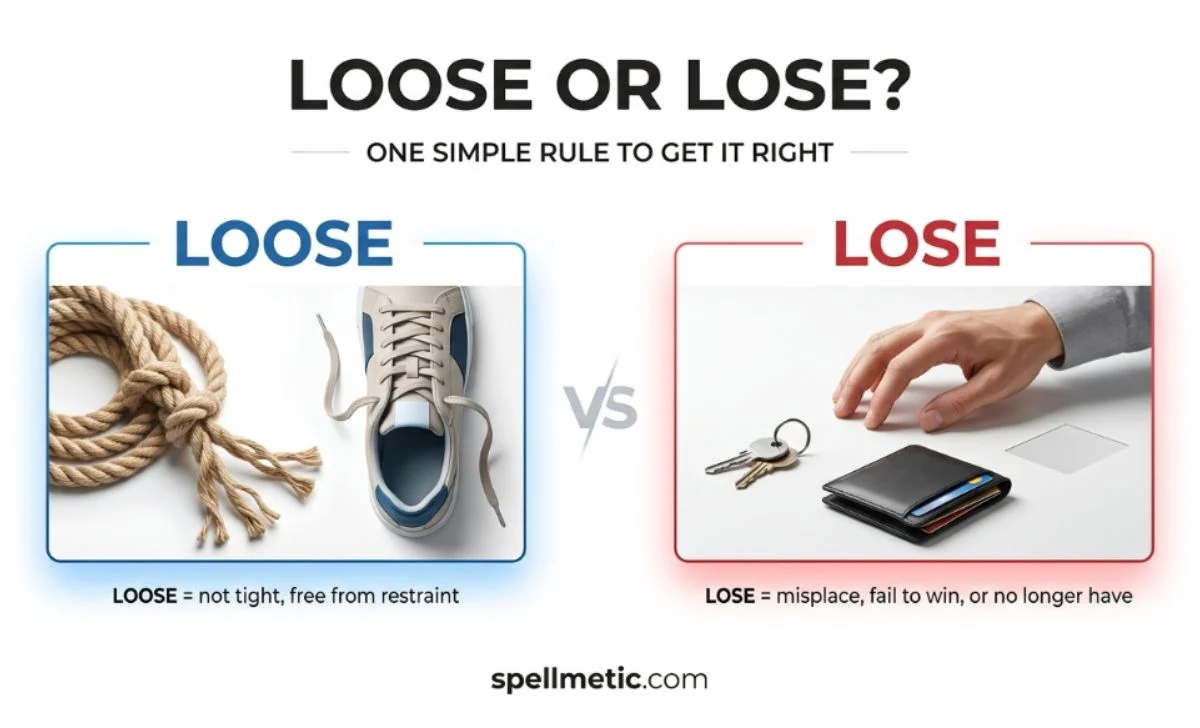
Loose and lose look almost identical, but they do very different jobs in a sentence. This small spelling difference can completely change the meaning of what you write.
Lose is usually a verb. It can mean to misplace something, no longer have something, fail to win, or have less of something.
Loose is usually an adjective describing something that is not tight, firmly attached, controlled, or closely fitted.
They also sound different. Lose is pronounced /luːz/, while loose is pronounced /luːs/.
Compare these two sentences:
I don’t want to lose my keys.
These jeans are too loose.
The easiest way to remember the difference is to connect lose with something going away or being no longer yours, while loose describes something that is not tight or securely fixed.
Loose or Lose: Quick Answer
Use lose when you need a verb for something you misplace, fail to keep, fail to win, or reduce.
Use loose when you are describing something that is not tight, firmly attached, or closely controlled.
| Word | Usual part of speech | Main idea | Example |
|---|---|---|---|
| lose | Verb | Misplace, no longer have, fail, or reduce | Don’t lose your phone. |
| loose | Adjective | Not tight, fixed, or closely controlled | My watch strap is loose. |
There is one less common exception worth knowing: loose can also be used as a formal verb meaning “release” or “make something loose.” This use is different from the everyday verb lose.
What Does “Lose” Mean?
Lose is a verb with several common meanings. The exact meaning depends on the context.
Lose Means to Misplace Something
When you cannot find something because you no longer know where it is, you lose it.
I always lose my keys.
She lost her wallet on the train.
Don’t lose your passport while traveling.
Oxford lists this as one of the main uses of lose, including being unable to find something or someone.
Lose Means to Fail to Win
You also use lose when someone does not win a competition, game, election, or contest.
Our team might lose the match.
They lost the game by two points.
Nobody likes to lose, but mistakes can be useful.
This is why lose is the opposite of win in many competitive situations.
Lose Means to No Longer Have Something
Lose can describe something that is taken away, disappears, or is no longer possessed.
He lost his job last year.
The company could lose several customers.
She lost her phone during the trip.
The word can also describe losing a person, opportunity, relationship, or other valuable thing.
Lose Means to Have Less of Something
Another familiar use appears when talking about weight, money, time, or other quantities.
I want to lose weight.
We lost three hours waiting for the flight.
The business lost money last quarter.
This is the correct reason we say lose weight, not loose weight.
Lose in Common Expressions
Lose appears in many everyday expressions, including:
- lose hope
- lose interest
- lose control
- lose your temper
- lose track of time
- lose your way
- lose touch
- lose confidence
For example:
I lost track of time while reading.
Try not to lose hope after one bad result.
These expressions all use lose, not loose.
What Does “Loose” Mean?
Loose is most commonly an adjective. It describes something that is not held tightly, does not fit closely, or is not firmly controlled.
Loose Means Not Tight
This is the most familiar meaning of loose.
This knot is loose.
The lid is loose.
My shoelaces are loose.
If something can move because it is not pulled or fastened tightly, loose is usually the word you need.
Loose Means Not Firmly Attached
Something can be loose when it is no longer securely fixed in its normal position.
The door handle is loose.
One of the buttons on my shirt is loose.
The dentist said the tooth was loose.
Oxford includes this sense for things such as buttons, teeth, and plugs that are not firmly fixed.
Loose for Clothing
When clothing does not fit closely against the body, we describe it as loose.
She prefers loose clothing in hot weather.
This shirt is too loose around the waist.
He bought a loose-fitting jacket.
Here, loose describes the fit. It has nothing to do with the verb lose.
Loose Means Free or Uncontrolled
Loose can also describe someone or something that is free to move when it should normally be contained or restrained.
The dog got loose and ran into the street.
One of the horses broke loose from the fence.
Keep the gate closed so the animals don’t get loose.
This meaning is common in phrases such as break loose and set loose.
Other Common Uses of Loose
The meaning of loose can extend beyond physical objects.
I found some loose change in my pocket.
The report gives a loose summary of the proposal.
They formed a loose group of independent writers.
In these examples, loose can suggest something not tightly organized, exact, connected, or controlled.
Loose vs. Lose Pronunciation
The spelling difference becomes easier to remember when you hear the final sound.
Lose is pronounced /luːz/. The ending has a /z/ sound. Cambridge gives the same pronunciation in both British and American English.
Loose is pronounced /luːs/. The ending has an /s/ sound. Cambridge lists this pronunciation for both British and American English as well.
A simple comparison is:
- lose → /luːz/ → ends like the sound in zoo
- loose → /luːs/ → ends with an s sound
They begin with the same /luː/ sound, but the final consonant is different.
Lose Weight or Loose Weight?
The correct phrase is lose weight.
I want to lose weight.
She is trying to lose weight before the summer.
Regular exercise can help you lose weight.
Loose weight is a spelling mistake when you mean reducing your body weight.
The related noun is weight loss:
The program focuses on healthy weight loss.
This gives you a useful pattern to remember:
lose → verb
loss → noun
Oxford lists both lose and loss in this sense, including lose weight and weight loss.
Common Mistakes With Loose and Lose
Because the words differ by only one letter, these mistakes are common in texts, emails, social media posts, and everyday writing.
Incorrect: I don’t want to loose my phone.
Correct: I don’t want to lose my phone.
Incorrect: These shoes are too lose.
Correct: These shoes are too loose.
Incorrect: Don’t loose hope.
Correct: Don’t lose hope.
Incorrect: I need to loose some weight.
Correct: I need to lose some weight.
Incorrect: The screw is lose.
Correct: The screw is loose.
There is another related mistake worth watching for: loosing is a real word, but it is not the normal spelling of the -ing form of lose. The correct form is losing. Oxford gives the verb forms as lose, lost, lost, losing.
Lose, Lost, Losing, and Loss
These words belong to the same word family, but they do different grammatical jobs.
| Word | Function | Example |
|---|---|---|
| lose | Base verb | Don’t lose your ticket. |
| lost | Past tense / past participle | I lost my ticket yesterday. |
| losing | -ing form | We are losing valuable time. |
| loss | Noun | The company reported a financial loss. |
Notice the spelling of losing: it has one o.
I am losing weight.
Not:
I am loosing weight.
Loss is also different from loose. A loss is the result or experience of no longer having something, or it can refer to a failure to win.
The team suffered a heavy loss.
The loss of the documents caused a delay.
Oxford identifies loss as a noun covering meanings such as no longer having something, financial loss, and failure to win.
Loose vs. Loosen
Loose and loosen are related, but they are not interchangeable.
Loose is generally an adjective:
The screw is loose.
Loosen is a verb meaning to make something less tight or firmly fixed:
Please loosen the screw.
She loosened the knot.
A useful pattern is:
loose = describes the condition
loosen = describes the action that makes something less tight
Cambridge gives loosen the pronunciation /ˈluː.sən/, while Oxford defines it as the verb used for making something less tight or firmly fixed.
There is also a formal verb loose, pronounced /luːs/, meaning to release or let something go. For example:
The hunter loosed an arrow.
This is a legitimate dictionary word, but it is much less common in ordinary modern conversation than loose as an adjective.
How to Remember Loose vs. Lose
You do not need a complicated grammar rule to remember these words.
Think about the meaning first.
If something is missing, gone, misplaced, or no longer yours, you probably need lose:
Don’t lose your keys.
If something is not tight or not firmly attached, you probably need loose:
The handle is loose.
You can also use the extra o as a visual clue. Think of the two O’s in loose as giving the word a little extra room—just like something that is not tight.
For pronunciation, remember:
lose → /z/
loose → /s/
Once you connect the spelling with the meaning and sound, the distinction becomes much easier to use naturally.
Loose vs. Lose in Everyday Sentences
Seeing both words in realistic situations makes the difference easier to recognize.
At Home
The kitchen cabinet handle is loose, so I need to tighten it.
Don’t lose the spare key.
At Work
We cannot afford to lose an important client.
The document is only a loose outline of the project.
While Shopping
I don’t want to lose my receipt.
These pants are too loose around the waist.
In Sports
Our team could lose the final.
The ball came loose after the tackle.
In Daily Conversation
I always lose track of time when I’m watching a good movie.
Her hair was loose rather than tied back.
The key is not the number of O’s alone. Look at what the sentence is actually saying. If the idea is misplacing, failing, or no longer having, choose lose. If the idea is not tight, fixed, or controlled, choose loose.
FAQs
1:Is it loose or lose?
Both words are correct, but they have different meanings. Lose is usually a verb, while loose is usually an adjective. Use lose for actions such as misplacing something or failing to win, and loose for something that is not tight or firmly attached.
2:Is it lose weight or loose weight?
The correct phrase is lose weight. Lose is the verb meaning to have less weight. The noun phrase is weight loss.
3:What is the easiest way to remember loose and lose?
Use the meaning as your first test. Lose relates to something going missing, being taken away, or not winning. Loose describes something that is not tight, fixed, or closely controlled.
4:Is loose an adjective or a verb?
Loose is most commonly an adjective, but it can also be a formal verb meaning to release something or make something loose. In everyday writing, however, the adjective is far more common.
5;Is it loosing or losing?
When you mean the -ing form of lose, the correct spelling is losing.
She is losing weight.
Loosing does exist as the -ing form of the less common verb loose, but it has a different meaning and is not a replacement for losing.
6:What is the difference between lose and loss?
Lose is a verb, while loss is a noun.
We might lose the game.
The defeat was a disappointing loss.
The same distinction appears in lose weight and weight loss.
Conclusion
Loose and lose are easy to confuse because their spellings are nearly identical, but their meanings are quite different.
Lose is usually a verb used for misplacing something, failing to win, no longer having something, or reducing something such as weight.
Loose is usually an adjective for something that is not tight, firmly attached, or closely controlled.
Their pronunciation provides another useful clue: lose ends with a /z/ sound, while loose ends with an /s/ sound.
When you’re unsure, ask what the sentence means. If something is going missing or you fail to keep or win it, choose lose. If something is not tight or securely fixed, choose loose.
A quick final reminder:
Lose = misplace, fail, or no longer have.
Loose = not tight or firmly attached.