If you have ever looked through a toolbox and wondered which piece is the nut and which is the bolt, you are not alone. They often work together, so it is easy to confuse them.
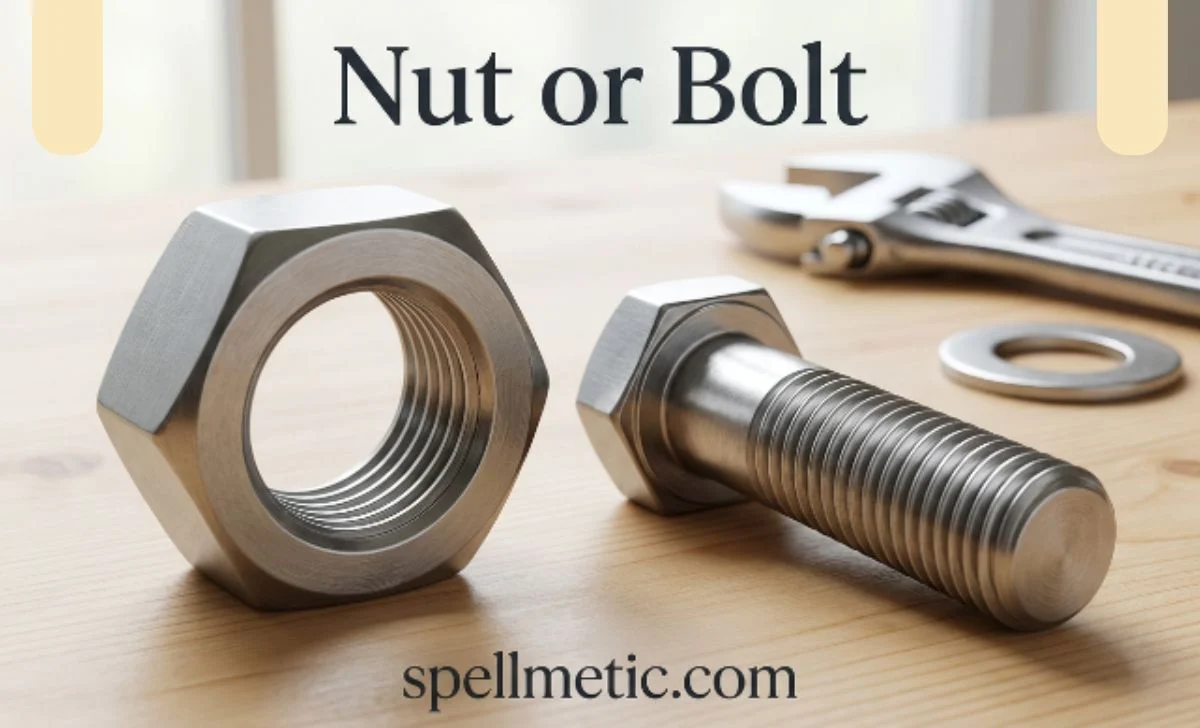
The good news is that the basic difference is simple. A nut has threads inside its opening. A bolt normally has external threads on its shaft and a head at one end.
You can find these fasteners in furniture, bicycles, cars, machinery, construction equipment, and many home repairs.
They come in different shapes and sizes, but their basic features make them easier to identify.
The best place to start is the thread. Once you know whether the thread is inside or outside, the difference becomes much clearer.
Nut or Bolt: The Quick Answer
A nut is a fastening component with an internally threaded hole. A bolt is a fastening component with external threads and usually a head.
They are commonly used together to hold two or more parts securely.
| Feature | Nut | Bolt |
|---|---|---|
| Thread location | Inside the opening | On the outside of the shaft |
| General shape | Usually short and compact | Usually longer |
| Head | Normally has no head | Usually has a head |
| Main function | Fits onto a matching thread | Passes through a hole or opening |
| Common tool | Wrench or socket | Wrench or socket |
A simple memory trick is:
Nut = thread inside.
Bolt = thread outside.
This works well for common hardware. Specialized fasteners can have different designs, so appearance and intended use may also matter.
What Is a Nut?
A nut is a small fastening component with a threaded opening. The threads inside it are made to match the external threads of a compatible bolt or other threaded fastener.
The hex nut is one of the most familiar examples. It has six sides, which makes it easy to grip with a wrench or socket.
Other designs have different shapes. A wing nut has extensions that allow hand tightening. A lock nut helps reduce unwanted loosening. A cap nut covers the exposed end of a bolt.
Despite these differences, the main feature remains the same: the nut has an internally threaded opening.
How to Recognize a Nut
Start by looking at the center.
If you can see threads inside the hole, you are probably looking at a nut. It will usually be much shorter than the bolt that fits into it.
Shape can give you another clue. A standard nut often has six sides, but not every nut follows this design.
For example, a wing nut looks very different from a hex nut. However, both have an internally threaded opening.
What Is a Bolt?
A bolt normally has a head and a shaft. The shaft has external threads, either along part of its length or closer to the end.
The head gives you a surface to hold or turn during installation. A common hex bolt has a six-sided head and works with a wrench or socket.
Not all bolts look alike. A carriage bolt usually has a rounded head. An eye bolt has a loop at one end. A U-bolt has a curved shape and is often used to secure pipes or similar components.
The design can change, but the bolt still provides an external threaded section for fastening.
A Simple Way to Spot One
Look at the shaft first.
If the threads are on the outside and the fastener has a head, it is commonly a bolt. The head may be hexagonal, rounded, square, or another shape.
A bolt is also usually longer than the nut that fits onto it. However, length alone is not enough to identify every type.
How the Two Fasteners Work Together
The easiest way to understand the difference is to see how they are used.
Imagine two metal plates that need to be joined. Each plate has a matching hole.
The bolt passes through both holes. The nut then goes onto the threaded end.
When you tighten the nut, its internal threads move along the bolt’s external threads. This pulls the two plates together and creates a secure connection.
A washer may also be used. It can sit under the nut or bolt head and help spread pressure across the surface.
For example, a metal bracket may need to be attached to a frame. The bolt passes through the bracket and frame, while the washer and nut sit on the other side.
This is the basic idea behind a nut and bolt connection.
Nut, Bolt, or Screw?
Nuts, bolts, and screws are all associated with threaded fastening, so confusion is common.
A nut has internal threads. A bolt and a screw normally have external threads. However, the difference between a bolt and a screw is not always defined by one simple physical feature.
For everyday use, this basic guide is helpful:
- Nut: receives an external thread.
- Bolt: commonly works with a nut to join parts.
- Screw: commonly engages directly with a threaded hole or the material being fastened.
Real-world terminology can vary between manufacturers, industries, and technical standards. Some fasteners may also look similar while serving different purposes.
For that reason, the design and intended application should be considered when an exact identification is important.
How to Identify the Fastener in Your Hand
You can usually identify common hardware with a quick visual check.
First, check the thread.
Threads inside an opening usually indicate a nut.
Next, check the shaft.
External threads on a shaft point toward a bolt or another externally threaded fastener.
Finally, look for a head.
A conventional bolt normally has a head that provides a surface for a tool.
For example, a short six-sided piece with a threaded center is likely a hex nut. A longer piece with external threads and a head is likely a hex bolt.
This simple method is useful for basic DIY tasks and everyday repairs.
Where You Commonly Find Them
You can find these fasteners in many ordinary objects.
A bicycle may use them to secure different components. A car contains many specialized fastening systems. Furniture may use them to connect frames, brackets, and other parts.
They are also common in construction, machinery, metalwork, and home improvement.
If you need to replace one, do not choose a fastener based only on appearance. Size, length, thread type, material, and strength can all affect whether it is suitable.
For machinery or safety-critical equipment, always follow the manufacturer’s specifications. A fastener that looks similar may not have the required strength or thread characteristics.
Common Designs You May Come Across
Nuts and bolts are available in many designs. Each one suits a different type of job.
You do not need to know every specialist fastener. A few common types are enough for most everyday situations.
Familiar Nut Styles
Hex nut: This is the standard six-sided design. It is widely used with matching bolts.
Lock nut: This type is designed to resist loosening. It can be useful where vibration or movement is present.
Wing nut: It has two wing-like sides. You can usually tighten or loosen it by hand.
Cap nut: This covers the exposed end of a bolt. It can protect the thread and give the connection a cleaner finish.
Flange nut: It has a wider base that can spread pressure over a larger surface.
Useful Bolt Varieties
Hex bolt: It has a six-sided head and is common in general fastening work.
Carriage bolt: It usually has a rounded head and a square section below it. This design can help stop the bolt from turning during installation.
Flange bolt: A flange sits beneath the head. It can distribute pressure over a wider area.
Eye bolt: One end forms a loop. This design is used for specific attachment and lifting applications.
U-bolt: It has a U-shaped design and is often used to secure pipes, tubes, or similar components.
The correct choice depends on the application. Size, material, thread specification, load, and installation method can all matter.
Why a Washer Can Matter
A washer is a separate component. It is not a type of nut or bolt.
Most washers look like flat rings with a hole in the center. They are often placed beneath a nut or bolt head.
One common purpose is to spread pressure across a wider area. This can help protect the surface and improve the fastening connection.
Different washer designs have different purposes. Some can help reduce loosening, while others provide spacing or suit specific materials.
For example, when fastening a metal bracket to a softer surface, a suitable washer can help distribute the pressure instead of concentrating it around one small area.
The right washer depends on the design of the connection. A standard flat washer is not automatically suitable for every application.
Where These Fasteners Are Used
You will find threaded fasteners in almost every area of mechanical work.
Home Improvement
A nut and bolt can help attach a bracket, join metal parts, or repair a piece of equipment.
For a simple repair, a wrench or socket may be all you need. The tool should fit correctly to avoid damaging the fastener.
Automotive Repairs
Cars contain many different fastening systems. They may hold brackets, assemblies, covers, and other components in place.
Automotive work often requires specific sizes and grades. A fastener that looks similar may not be a safe replacement.
Furniture Assembly
Some furniture uses bolts, threaded inserts, washers, and other fastening components.
Following the manufacturer’s instructions is important. Overtightening can damage wood, metal, or the fastener itself.
Construction and Machinery
Construction and industrial equipment use fasteners in many sizes and materials.
Larger bolts may join heavy components or structural parts. These applications require careful attention to strength, dimensions, thread type, and installation requirements.
Using “Nut” and “Bolt” in English
The words are also useful outside technical discussions.
When you mean one of each component, nut and bolt is the natural phrase.
For example:
I need a nut and bolt to fix this bracket.
When you mean several pieces, nuts and bolts is the plural form.
The toolbox contains several nuts and bolts.
There is also a figurative use that has nothing to do with hardware.
What “The Nuts and Bolts” Means
The nuts and bolts of something is an English idiom. It means the basic practical details of a subject, process, or activity.
For example:
Let’s discuss the nuts and bolts of the project.
Here, the speaker is talking about the practical details of the project, not physical hardware.
You may also see the expression in professional writing:
The training explains the nuts and bolts of running a small business.
She understands the nuts and bolts of website management.
This expression is common in everyday and workplace English.
Singular and Plural Usage
Choosing the right form depends on what you are describing.
Use a nut when you mean one component.
I found a nut on the floor.
Use a bolt when you mean one threaded fastener.
The bolt is too long.
A nut and bolt when referring to one pair.
The bracket needs a new nut and bolt.
A nuts and bolts when referring to multiple pieces.
The box contains different nuts and bolts.
The phrase can also be plural in a figurative sense:
We need to discuss the nuts and bolts of the agreement.
Context makes the intended meaning clear.
Mistakes People Often Make
Calling Both Pieces a Bolt
A nut and a bolt are separate components. The nut has an internal thread, while the bolt normally has an external thread.
Assuming Every Nut Has Six Sides
Hex nuts are common, but they are only one design. Wing, cap, flange, and other styles have different shapes.
Calling Every Threaded Part a Bolt
A threaded component is not automatically a bolt. Screws, studs, and threaded rods can also have external threads.
Choosing a Replacement by Appearance
Two fasteners can look almost identical but have different thread specifications or strength ratings.
When the application matters, check the required dimensions and specifications rather than relying on appearance.
Examples From Real Life
Here are a few simple examples that show how these words work naturally.
The mechanic tightened the nut with a wrench.
The bolt passed through the metal bracket.
I need a nut and bolt for this repair.
The technician checked the nuts and bolts before using the machine.
We need to understand the nuts and bolts of the new system.
The first four examples refer to physical hardware. The final example uses the phrase as an idiom for practical details.
When Identification Needs More Than a Quick Look
Some fasteners are difficult to identify by sight alone.
A specialized bolt may have an unusual head or partial threading. A stud can have external threads but no conventional head. A threaded rod can also look very different from a standard bolt.
In these situations, check the dimensions and intended application.
Important details can include:
- Diameter
- Length
- Thread type
- Thread pitch
- Material
- Strength grade
- Head design
For an ordinary household repair, matching the original component may be enough. For a vehicle, machine, structure, or safety-related application, use the manufacturer’s specifications or guidance from a qualified professional.
That extra care can prevent a small fastening mistake from becoming a bigger problem.
FAQs
1. Is a nut the same as a bolt?
No. A nut and a bolt are different fastening components. A nut has internal threads, while a bolt normally has external threads and a head.
They are often designed to work together to hold parts securely.
2. Which one is the nut and which one is the bolt?
The piece with threads inside its opening is the nut. The piece with external threads and usually a head is the bolt.
A simple way to remember it is: inside threads = nut, outside threads = bolt.
3. What is the main difference between a nut and a bolt?
The main difference is where the threads are located. A nut has internal threads, while a bolt normally has external threads along its shaft.
Both can work together to create a secure fastening connection.
4. Can a bolt work without a nut?
Yes, depending on its design and application. Some bolts can engage with a threaded hole or another threaded component.
However, the common nut-and-bolt setup uses both components together.
5. Is a screw the same as a bolt?
No. A screw and a bolt can look similar, but their designs and intended uses can differ.
A screw commonly engages directly with a threaded hole or the material being fastened. A bolt is commonly used with a nut.
Technical terminology can vary between industries and manufacturers.
6. What is a washer used for?
A washer is a separate fastening component. It is commonly placed under a nut or bolt head.
It can help spread pressure across a wider area and protect the surface underneath. Some specialized washers also help with locking or spacing.
7. What does “nuts and bolts” mean?
It has both a literal and figurative meaning.
Literally, it refers to fastening hardware.
The toolbox contains nuts and bolts.
Figuratively, the nuts and bolts of something means its basic practical details.
We need to understand the nuts and bolts of the process.
8. Is “nut and bolt” correct English?
Yes. Nut and bolt is a natural phrase when referring to one nut and one bolt.
For example:
I need a nut and bolt to repair this bracket.
For several pieces, use nuts and bolts.
9. What tool is normally used to tighten a nut?
A wrench or socket is commonly used.
The correct tool depends on the size and design of the fastener. Using the right size helps prevent damage.
10. Are all nuts hexagonal?
No. Hex nuts are common, but they are not the only type.
Wing nuts, lock nuts, cap nuts, and flange nuts have different shapes and purposes.
11. Are all bolts completely threaded?
No. Some bolts have threads along only part of their shaft.
The smooth section is commonly called the shank. The amount of threading depends on the bolt’s design.
12. How can I identify an unfamiliar fastener?
Start by checking the threads.
Threads inside an opening usually indicate a nut. External threads may indicate a bolt, screw, stud, or another threaded fastener.
If you need an exact replacement, check the diameter, length, thread type, material, and strength rating as well.
Conclusion
The difference between a nut and a bolt becomes easy once you know what to look for. A nut has internal threads, while a bolt normally has external threads and a head.
These components often work together to secure two or more parts. You can find them in furniture, bicycles, vehicles, machinery, construction equipment, and many household repairs.
The easiest rule to remember is simple: threads inside usually mean a nut, while external threads with a conventional head usually mean a bolt.
The words also have an everyday English meaning. Nut and bolt refers to the physical hardware, while the nuts and bolts of something means its basic practical details.
When replacing a fastener, do not rely on appearance alone. Check its size, thread specification, material, and strength, especially for vehicles, machinery, and safety-related applications.