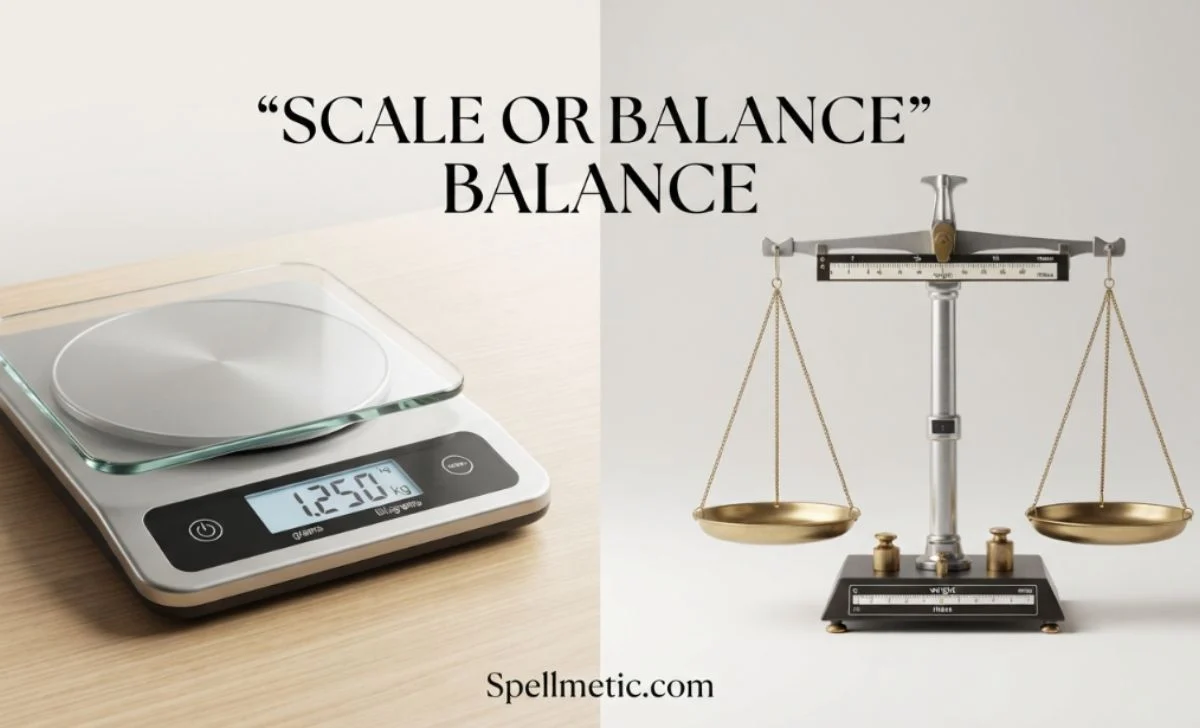
If you are wondering whether to say scale or balance, you are not alone. The two words are closely related because both can describe instruments used for weighing. However, they are not always used in the same situations.
In everyday English, scale is the usual word for a bathroom scale, kitchen scale, luggage scale, or shipping scale.
Balance is more common when talking about precise measurements, especially in science and laboratory work.
The technical difference is also important. Traditionally, a balance compares an unknown mass with a known mass, while a scale measures the force produced by an object under gravity.
Modern electronic instruments have blurred this distinction, so the best word often depends on the instrument and context.
Quick Answer: Scale or Balance?
Scale is the better choice for most everyday weighing situations.
- Bathroom scale: checks your body weight.
- Kitchen scale: weighs food and ingredients.
- Luggage scale: weighs bags.
- Shipping scale: weighs packages.
- Laboratory balance: measures small quantities with high precision.
- Analytical balance: is designed for very precise laboratory measurements.
So, if you step on a device to check your weight, call it a scale. If a scientist measures a tiny sample in a laboratory, balance is usually the more appropriate term.
What Does Scale Mean?
A scale is a device used to determine the weight or weight-equivalent of an object. In everyday use, people commonly use the word when talking about weighing people, food, packages, animals, or other objects.
For example:
- I stepped on the scale this morning.
- Put the flour on the kitchen scale.
- The airline weighed my suitcase on a luggage scale.
- The warehouse uses a large platform scale for heavy boxes.
Scales come in many forms, including digital scales, spring scales, bathroom scales, kitchen scales, platform scales, and industrial scales.
In technical terms, many electronic scales use load cells to detect the force applied by a load. The device then converts that signal into a displayed reading
Common Types of Scales
A bathroom scale is designed for body weight.
A kitchen scale is used for ingredients and food.
A digital scale gives a numerical reading on an electronic display.
A platform scale is built to weigh larger or heavier objects.
A shipping scale is commonly used to weigh packages before delivery.
An industrial scale is designed for demanding commercial or manufacturing environments.
What Does Balance Mean?
A balance is a weighing instrument designed to determine mass, traditionally by comparing an unknown object with a known reference.
The classic example is a beam balance with two pans. You place the object on one side and known weights on the other. When the two sides reach equilibrium, the unknown mass can be determined.
Modern balances are usually electronic. Laboratory balances can provide extremely fine readings and are used when small differences in mass matter. Some advanced balances use electromagnetic force restoration or similar precision measurement systems.
For example:
The student used a balance to measure a small sample of powder.
The chemist placed the compound on an analytical balance.
This is why you are more likely to hear balance in a chemistry or laboratory setting than when talking about a bathroom weighing device.
Scale vs Balance: The Main Difference
The easiest way to understand the difference is to look at purpose, precision, and common use.
| Scale | Balance |
|---|---|
| Common general-purpose weighing instrument | Usually a precision weighing instrument |
| Often designed for larger loads | Often designed for smaller samples |
| Common in homes, stores, warehouses, and industry | Common in laboratories and scientific work |
| Bathroom and kitchen examples are common | Analytical and precision balances are common |
| Often uses load cells or similar sensors | May use high-precision electronic measurement systems |
| Usually focuses on capacity and practical weighing | Usually focuses on resolution and precision |
The traditional scientific distinction is that a scale measures the force associated with weight, while a balance determines mass through comparison.
Modern electronic balances and scales make that distinction less straightforward, because electronic instruments can convert force measurements into mass readings after calibration.
That is why saying “a scale measures weight and a balance measures mass” is useful as a basic rule, but it should not be treated as an absolute rule for every modern device.
Does a Scale Measure Weight or Mass?
Technically, weight is a force, while mass is the amount of matter in an object.
Weight depends on gravity. Mass does not change simply because you move an object from one location to another.
An electronic scale detects the force applied to its sensor and uses that information to produce a reading. Because everyday weighing is normally done under known gravitational conditions, the result is commonly displayed in units such as kilograms or pounds.
This is why people normally say:
“I weigh 70 kilograms.”
In everyday English, that is completely normal. In strict physics terminology, 70 kilograms describes mass, while weight is expressed as a force, such as newtons.
Does a Balance Measure Mass or Weight?
A traditional balance determines mass by comparing an object with a known reference mass.
Imagine a two-pan balance. If an unknown object is placed on one pan and standard weights are placed on the other, both sides experience the same gravitational effect. When they balance, the known mass gives you the mass of the unknown object.
Modern electronic balances work differently, but they are still designed for highly precise weighing.
Laboratory balances are calibrated and used under controlled conditions because small environmental factors can affect their readings.
So in basic science education, the expected answer is:
A balance is used to measure mass.
What Is a Balance Scale Used to Measure?
A balance scale is used to determine the mass of an object by comparing it with known masses.
A traditional balance scale may have:
- two pans
- a central beam
- a pointer
- standard weights
- an equilibrium position
For example, if a student wants to find the mass of a small object, they can put the object on one pan and known weights on the other. The balance point shows when the two sides are equal.
A balance scale is therefore useful for teaching mass, measurement, comparison, and equilibrium.
The phrase balance scale can also refer to the classic two-pan instrument used in classrooms and basic science demonstrations.
What Is a Balance Scale Measurement Unit?
A balance does not have just one universal measurement unit. The unit depends on the instrument and the task.
Common units include:
- grams (g)
- kilograms (kg)
- milligrams (mg)
- micrograms (µg)
- ounces (oz)
- pounds (lb)
A classroom balance might commonly work with grams, while a laboratory analytical balance may display milligrams or even smaller quantities.
The important point is that the balance is the measuring instrument; the gram, kilogram, milligram, or another unit is the unit used to express the result.
What Is a Balance Scale Used for in a Laboratory?
A laboratory balance is used when a sample must be weighed accurately and consistently.
Common applications include:
- measuring chemical compounds
- preparing solutions
- weighing pharmaceutical ingredients
- measuring research samples
- quality-control testing
- food science
- environmental testing
- gravimetric analysis
An analytical balance is designed for especially precise measurements. Laboratory work may also use precision balances, microbalances, and other specialized instruments depending on the required readability and sample size.
Calibration is important because a balance can give inconsistent or inaccurate results if it is not properly maintained or used in suitable conditions.
What Is a Balance in Science?
In science, a balance is a measuring instrument used to determine mass.
A traditional balance compares an unknown mass with a known reference. Modern electronic balances use more advanced sensing systems but serve the same broad purpose: obtaining a reliable measurement of a sample.
For students, the easiest example is a triple-beam balance. It has a pan for the object and movable riders along graduated beams. The user adjusts the riders until the pointer reaches equilibrium, then reads the mass.
A balance is therefore more than simply a device that tells you “how heavy” something is. In scientific work, it is an instrument for obtaining a controlled and repeatable mass measurement.
Balance Scale Name: What Is It Called?
The traditional two-pan instrument may be called a:
- balance scale
- beam balance
- two-pan balance
- equal-arm balance
- pan balance
In school science, beam balance and triple-beam balance are also common terms.
The exact name depends on the design of the instrument.
A modern laboratory instrument, however, may simply be called a laboratory balance, precision balance, or analytical balance.
Digital Scale vs Digital Balance
The word digital only tells you that the instrument provides an electronic numerical display. It does not automatically mean that the device is a laboratory balance.
For example:
Digital bathroom scale
Used to monitor body weight.
Digital kitchen scale
Used to weigh food and ingredients.
Digital shipping scale
Used to weigh parcels.
Digital laboratory balance
Used for more precise scientific measurements.
So, a digital scale and a digital balance can both have electronic displays, but their capacity, resolution, accuracy, intended use, and measurement requirements may be very different.
Bathroom Scale or Balance?
For checking your body weight, scale is the natural word.
You would normally say:
“I bought a new bathroom scale.”
You would not normally say:
“I bought a bathroom balance.”
Although both devices relate to weighing, balance sounds unusual in this everyday context.
A bathroom scale is designed for practical body-weight measurement, while a laboratory balance is designed for a very different purpose.
This is one of the clearest examples of why scale or balance depends on context.
Scale or Balance for Weight?
If your goal is simply to weigh a person or everyday object, scale is generally the word you want.
Use a:
- bathroom scale for body weight
- kitchen scale for food
- luggage scale for bags
- shipping scale for parcels
- platform scale for larger objects
For highly precise scientific work, a balance is usually more appropriate.
The choice is not simply about whether something has a digital screen. It depends on the instrument’s capacity, readability, accuracy, repeatability, calibration, and intended application.
When Should You Use “Scale”?
Use scale when talking about ordinary or general-purpose weighing.
Examples:
The doctor asked me to step on the scale.
I used a kitchen scale to measure 250 grams of flour.
The courier weighed the package on a shipping scale.
The warehouse installed a large platform scale.
This is also the word most people expect in everyday American English when discussing a weighing device.
When Should You Use “Balance”?
Use balance when the context involves a precision weighing instrument, especially in science or laboratory work.
Examples:
The researcher used an analytical balance to weigh the sample.
The students learned how to use a beam balance.
The technician calibrated the laboratory balance before the experiment.
The pharmacist measured the ingredient using a precision balance.
In specialist settings, the distinction can matter because laboratory balances are designed around much finer measurement requirements than many general-purpose scales
Can “Scale” and “Balance” Be Used Interchangeably?
Sometimes, yes.
In everyday conversation, people may use both words broadly for weighing equipment. Even laboratory literature acknowledges that scale and balance are often used interchangeably in general usage.
However, they are not always interchangeable in technical writing.
For example:
I checked my weight on the scale.
sounds natural.
I checked my weight on the balance.
sounds unusual unless you are specifically talking about a particular scientific instrument.
Likewise:
The chemist used an analytical balance.
is much more natural than:
The chemist used an analytical scale.
The best choice therefore depends on the device and context, not just the measurement itself.
Scale or Balance Quiz
Test yourself with these examples.
Which word fits?
I stepped on the ___ to check my weight.
Answer: scale
The scientist placed the sample on an analytical ___.
Answer: balance
She used a kitchen ___ to measure the flour.
Answer: scale
The students used a beam ___ in science class.
Answer: balance
The airline checked the suitcase using a luggage ___.
Answer: scale
The technician measured the tiny chemical sample on a laboratory ___.
Answer: balance
He bought a digital bathroom ___ for his home.
Answer: scale
The chemistry lab uses a precision ___ for small samples.
Answer: balance
If you can choose the word based on the situation rather than simply memorizing a rule, you have understood the difference.
Common Mistakes With Scale and Balance
One common mistake is assuming that every scale measures mass directly and every balance works in exactly the same way. Modern electronic instruments are more complicated than that simple rule suggests.
Another mistake is thinking that digital scale and digital balance mean the same thing. Both can be electronic, but their design and intended level of precision may differ greatly.
It is also easy to confuse weight and mass. In everyday conversation, people often use “weight” when they really mean mass. Scientific writing requires more care.
Finally, don’t assume that balance is always more accurate simply because it is called a balance. The actual specifications—such as readability, repeatability, accuracy, capacity, and calibration—matter more than the label
Scale or Balance: Which One Should You Choose?
The simplest rule is:
Choose a scale for everyday weighing.
Use it for body weight, food, luggage, packages, retail goods, and many industrial applications.
Choose a balance for precision measurement.
Use it for laboratory samples, chemistry, pharmaceutical work, research, and other applications where small differences matter.
But don’t treat this as an unbreakable rule. Modern electronic weighing instruments have blurred the traditional distinction, and the right choice should ultimately be based on the instrument’s specifications and intended use.
FAQs
1. What is the difference between a scale and a balance?
A scale is generally used for general-purpose weighing, while a balance is commonly associated with precise measurement, especially in laboratories. Traditionally, a scale measures weight and a balance determines mass.
2. Is a weighing scale the same as a balance?
Not always. Both are weighing instruments, but they can differ in their measurement systems, capacity, precision, and intended applications.
3. Does a scale measure weight or mass?
Technically, an electronic scale detects force related to weight and converts that measurement into a useful displayed value, often in kilograms or pounds.
4. Does a balance measure mass or weight?
A traditional balance determines mass by comparison. Modern electronic balances use sophisticated sensing systems and calibration to provide highly precise mass readings.
5. What is a balance scale used to measure?
A balance scale is used to determine the mass of an object by comparing it with known masses or reference standards.
6. What is a balance scale used for in a laboratory?
It can be used to measure chemical samples, research materials, pharmaceutical ingredients, and other substances where accurate weighing is important.
7. What units are used on a balance scale?
Common units include grams, kilograms, milligrams, micrograms, ounces, and pounds, depending on the instrument.
8. Is a bathroom scale a balance?
In everyday English, it is called a bathroom scale. Although it is a weighing instrument, “balance” is not the normal term for this type of household device.
9. Which is more accurate, a scale or a balance?
There is no universal answer. Laboratory balances are generally designed for much finer measurements than ordinary weighing scales, but accuracy depends on the specific instrument and its specifications.
10. Can “scale” and “balance” be used interchangeably?
They can overlap in everyday language, but they are not always interchangeable in technical contexts. Scale is more natural for everyday weighing, while balance is common for precision laboratory instruments.
Conclusion
So, scale or balance?
For everyday weighing, scale is usually the right word. You use a bathroom scale, kitchen scale, luggage scale, or shipping scale.
For precise scientific measurements, balance is usually the better term. A laboratory balance or analytical balance is designed for controlled, accurate weighing of samples.
The technical difference between the two is more nuanced than the simple rule that “scales measure weight and balances measure mass.
” Modern electronic instruments can convert force measurements into mass readings, so the type of instrument, its specifications, and its intended use matter most.