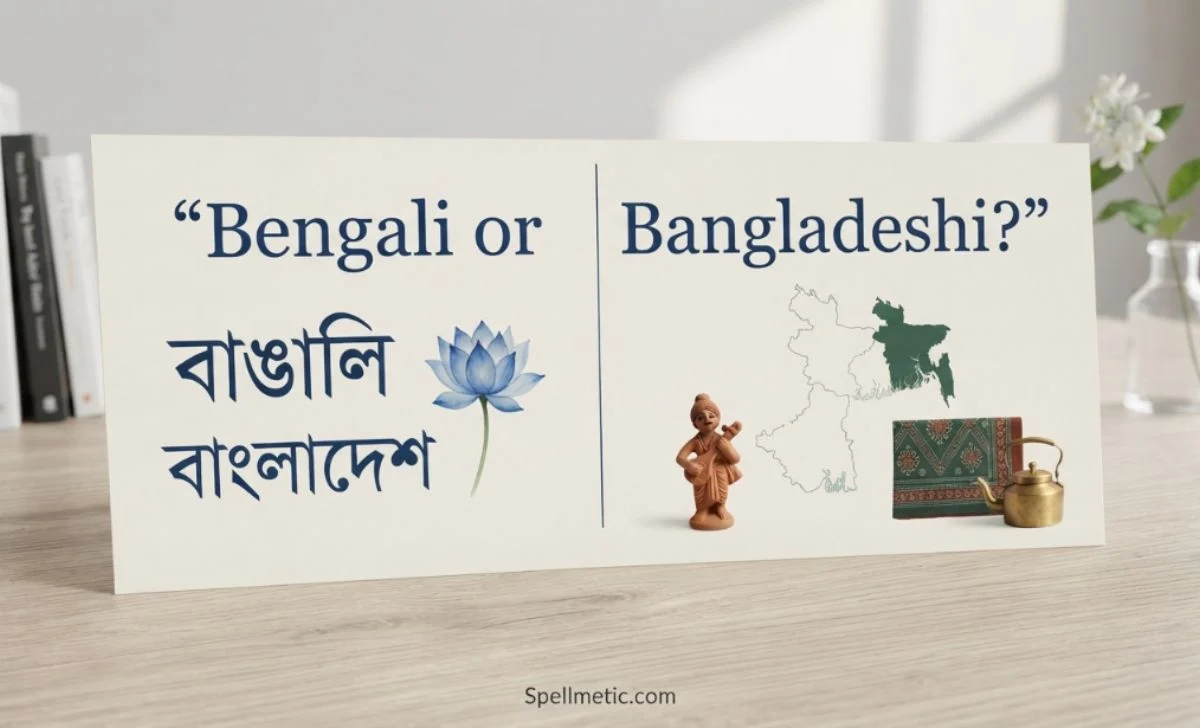
Bengali or Bangladeshi can be confusing because the two words are closely connected, but they do not mean the same thing.
Bengali can refer to a language, a cultural or ethnolinguistic identity, or a person connected with Bengal. Bangladeshi refers to a person or nationality associated with the country of Bangladesh.
The easiest way to remember the difference is this: Bengali describes a language or broader cultural identity, while Bangladeshi describes nationality.
However, the context matters, so the terms should not be treated as interchangeable.
Quick Answer
Bengali usually refers to the Bengali language, Bengali culture, or people connected with the Bengali-speaking world.
Bangladeshi refers to someone from Bangladesh or to Bangladesh’s national identity.
For example:
- She speaks Bengali. → This tells us her language.
- He is Bangladeshi. → This tells us his nationality.
- She is an Indian Bengali. → She is Bengali but her nationality is Indian.
- He is a Bangladeshi Bengali. → He is Bangladeshi and identifies with the Bengali linguistic or cultural community.
The terms overlap because Bengali is widely spoken in Bangladesh, while Bengali-speaking communities also exist in India, especially in West Bengal. The Government of West Bengal describes the state as having a rich Bengali cultural heritage, while Bangladesh’s High Commission describes Bangla as the country’s official language.
What Does Bengali Mean?
Bengali has more than one use.
It can describe the Bengali language, which is also commonly called Bangla. It can also describe people, culture, literature, traditions, and a broader linguistic or cultural identity associated with Bengal.
Bengali is therefore not the name of a country.
A person may be Bengali because of their language, family background, cultural identity, or connection to the Bengali-speaking region. That person could be a citizen of Bangladesh, India, or another country.
The cultural meaning of Bengali is especially visible in West Bengal, where the state government highlights Bengali literature, arts, music, traditions, and the wider cultural heritage of Bengal.
Is Bengali a Language or an Ethnicity?
The answer depends on how the word is being used.
Bengali is definitely the name of a language. In discussions about people, it can also describe a broader cultural or ethnolinguistic identity. It is not, however, the name of a sovereign country.
That distinction matters because saying someone is Bengali does not automatically tell you their nationality.
For example, an Indian Bengali and a Bangladeshi Bengali can share a language and cultural heritage while having different nationalities.
What Does Bangladeshi Mean?
Bangladeshi is primarily a national term connected with Bangladesh.
Someone who is a citizen or national of Bangladesh can be described as Bangladeshi. The word does not name the Bengali language.
This is where many searches for “Bengali or Bangladeshi” become confusing. A Bangladeshi person may speak Bengali, but Bangladeshi and Bengali answer different questions.
For example:
“What language do you speak?” → Bengali/Bangla
“What is your nationality?” → Bangladeshi
Bangladesh’s official information identifies Bangla as the country’s official language and notes that it is spoken by the overwhelming majority of the population.
Is Bangladeshi a Nationality?
Yes. Bangladeshi is used as a nationality term for people associated with Bangladesh.
It should not be used as the name of the language. The language is generally called Bangla or Bengali in English.
Is Bengali Indian or Bangladeshi?
Bengali can be Indian or Bangladeshi, depending on the person.
This is one of the most common points of confusion.
Bengali-speaking people live in Bangladesh and India, particularly in West Bengal. West Bengal is an Indian state, and its government identifies Bengali language and culture as an important part of the state’s heritage.
So:
- A person from Bangladesh may be Bengali and Bangladeshi.
- A person from West Bengal may be Bengali and Indian.
- A Bengali-speaking person living elsewhere may have yet another nationality.
This is why “Bengali” does not automatically mean “Bangladeshi.”
Can an Indian Be Bengali?
Yes.
An Indian can be Bengali. The clearest example is a Bengali person from West Bengal, although Bengali-speaking communities also exist in other parts of India.
The Government of West Bengal maintains official Bengali-language institutions and describes Bengali heritage, literature, arts, and culture as central parts of the state’s identity.
A simple example is:
Rina is Indian and Bengali.
Here, Indian describes her nationality, while Bengali describes her linguistic or cultural identity.
Can a Bangladeshi Be Bengali?
Yes.
In fact, most people in Bangladesh are Bengali by ethnic or linguistic background, although Bangladesh also includes other ethnic and Indigenous communities.
Bangladesh’s High Commission states that the overwhelming majority of the country’s population is ethnically Bengali and that Bangla is the official language.
So the following sentence can be perfectly natural:
Karim is Bangladeshi and Bengali.
“Bangladeshi” identifies his nationality, while “Bengali” identifies his broader linguistic or cultural identity.
Is Bengali and Bangladeshi the Same Language?
No. Bengali and Bangladeshi are not two names for the same language.
Bengali, also called Bangla, is the language.
Bangladeshi is a nationality term.
For example:
- Bengali language ✅
- Bangla language ✅
- Bangladeshi language ❌ as the standard name of the language
- Bangladeshi person ✅
Bangladesh’s official materials use Bangla/Bengali terminology for the language, while West Bengal government sources maintain dedicated Bengali language institutions and official-language functions.
Bengali Language
The Bengali language, commonly called Bangla, is spoken across Bangladesh and parts of India.
It has a long literary tradition, with Bengali literature, poetry, drama, and scholarship forming a major part of Bengal’s cultural history. The Government of West Bengal traces Bengali literary works back many centuries and highlights figures such as Rabindranath Tagore and Bankim Chandra Chattopadhyay.
Is Bengali the Same as Bangla?
In ordinary English usage, Bengali and Bangla refer to the same language.
“Bangla” is the name commonly used by native speakers, while “Bengali” is the common English term.
For example:
I speak Bengali.
I speak Bangla.
Both statements can refer to the same language.
Bengali vs Bangladeshi vs Bangla
These three terms are easier to understand when separated:
| Term | What it generally refers to |
|---|---|
| Bengali | Language or Bengali cultural/ethnolinguistic identity |
| Bangla | The Bengali language |
| Bangladeshi | A person or nationality associated with Bangladesh |
Consider these examples:
“She speaks Bengali.”
This refers to language.
“She speaks Bangla.”
This also refers to language.
“She is Bangladeshi.”
This refers to nationality.
“She is Bengali.”
This can refer to her linguistic or cultural identity, depending on context.
That small distinction removes most of the confusion around Bengali vs Bangladeshi vs Bangla.
Bengal vs Bangladesh vs West Bengal
The words Bengal, Bangladesh, and West Bengal are related historically and culturally, but they are not interchangeable.
What Is Bengal?
Bengal refers to the broader historical and cultural region associated with Bengali-speaking people. Modern political boundaries divide this region primarily between Bangladesh and the Indian state of West Bengal, with Bengali-speaking communities also found elsewhere.
What Is Bangladesh?
Bangladesh is an independent country in South Asia.
A person from Bangladesh is generally described as Bangladeshi.
What Is West Bengal?
West Bengal is a state of India. Its capital is Kolkata, and Bengali language and culture are major parts of its cultural landscape. The official West Bengal portal describes the state as being in eastern India and highlights its multilingual and multicultural character.
So:
Bengal → historical/cultural region
Bangladesh → country
West Bengal → Indian state
Are All Bangladeshis Bengali?
Not necessarily.
The majority of Bangladesh’s population is Bengali, but Bangladesh is not made up of only one ethnic or cultural community. Bangladesh’s official diplomatic information also recognizes Indigenous and other communities within the country.
That is why it is better to avoid treating Bangladeshi and Bengali as exact synonyms.
“Bangladeshi” is the broader national term, while “Bengali” can describe a particular linguistic or cultural identity.
Are All Bengalis Bangladeshi?
No.
This is another common misconception.
Bengali people and Bengali speakers can be found in both Bangladesh and India. In particular, West Bengal has a major Bengali-speaking population and a strong Bengali cultural tradition.
For example:
An Indian Bengali from Kolkata is Bengali, but not Bangladeshi.
Likewise:
A Bengali person from Dhaka can be both Bengali and Bangladeshi.
The difference comes down to context: Bengali describes an identity or language, while Bangladeshi identifies nationality.
Bengali vs Bangladeshi Food
The question “Is it Bengali or Bangladeshi food?” is slightly different because food traditions cross modern borders.
Bengali cuisine can refer broadly to food traditions associated with Bengali culture and the Bengal region.
Bangladeshi cuisine refers specifically to culinary traditions from Bangladesh.
There is significant overlap because Bangladesh and West Bengal share historical and cultural roots.
Common foods and ingredients associated with Bengali culinary traditions include:
- rice
- fish
- hilsa or ilish
- mustard
- bhorta
- pitha
- fish curry
- sweets and milk-based desserts
That does not mean every dish is uniquely Bengali or uniquely Bangladeshi. Regional recipes, cooking methods, ingredients, and family traditions vary.
So if someone asks, “Is Bengali food Indian or Bangladeshi?”, the best answer depends on the specific dish and regional tradition.
Bengali cuisine exists across national borders, while Bangladeshi cuisine specifically refers to food traditions from Bangladesh.
Bengali Culture and Bangladeshi Culture
Bengali and Bangladeshi culture overlap in language, literature, music, food, and historical traditions, but they are not identical concepts.
Bengali culture can refer to the wider cultural heritage of Bengali-speaking communities.
Bangladeshi culture refers to the culture of Bangladesh, which includes Bengali traditions alongside the country’s other communities and regional influences.
West Bengal’s government highlights Bengali literature, music, theatre, art, festivals, and cultural traditions as important parts of the region’s heritage.
Bangladesh likewise has a strong Bangla-language literary and cultural tradition. Bangladesh’s legal framework includes institutions and measures dedicated to developing Bengali language and literature.
The shared cultural background explains why Bengali traditions can feel familiar across Bangladesh and parts of India, even though the people may have different nationalities.
Common Mistakes With Bengali and Bangladeshi
These are some of the most common mistakes:
Calling Bengali a country
Bengali is not a country. Bangladesh is a country.
Calling Bangladeshi a language
Bangladeshi is not the standard name of the language. Bengali or Bangla is the language.
Assuming every Bengali person is Bangladeshi
Bengali people also live in India and elsewhere.
Assuming every Bangladeshi is Bengali in exactly the same sense
Bangladesh has diverse communities and identities.
Treating Bengal and Bangladesh as the same place
Bengal is a historical and cultural region; Bangladesh is a modern sovereign country.
Treating Bengali and Bangla as different languages
In ordinary usage, Bengali and Bangla refer to the same language.
Bengali or Bangladeshi: Examples in Sentences
Here are some simple examples that show how the words work:
She speaks Bengali.
→ Bengali is her language.
He speaks Bangla at home.
→ Bangla is another name for Bengali.
He is Bangladeshi.
→ Bangladeshi describes his nationality.
She is an Indian Bengali.
→ She is Indian by nationality and Bengali by linguistic or cultural identity.
They are Bangladeshi Bengalis.
→ They are Bangladeshi and belong to the Bengali linguistic or cultural community.
Bengali literature has a long history.
→ Bengali describes the language and literary tradition.
Bangladeshi cuisine includes many regional dishes.
→ Bangladeshi identifies the national culinary context.
These examples show why replacing one word with the other can change the meaning.
FAQs
1. Is Bengali Indian or Bangladeshi?
Bengali can refer to people from both India and Bangladesh. A Bengali person may be Indian, Bangladeshi, or have another nationality.
2. Are Bengali and Bangladeshi the same?
No. Bengali can describe a language or cultural identity, while Bangladeshi generally refers to nationality associated with Bangladesh.
3. Is Bengali a nationality?
Bengali is not generally a nationality name. It can describe language, cultural identity, or a Bengali person.
4. Is Bangladeshi a nationality?
Yes. Bangladeshi is the nationality term associated with Bangladesh.
5. Is Bengali the same as Bangla?
Yes. Bengali and Bangla commonly refer to the same language.
6. Are all Bangladeshis Bengali?
No. Most Bangladeshis are Bengali, but Bangladesh also includes other ethnic, Indigenous, and linguistic communities.
7. Are all Bengalis Bangladeshi?
No. Bengali people also live in India, especially in West Bengal.
8. What country is Bengali?
Bengali is not a country. It is primarily the name of a language and can also describe a cultural or linguistic identity associated with Bengal.
9. Is Bengali a language?
Yes. Bengali, also called Bangla, is a major South Asian language spoken in Bangladesh and India.
10. What is the difference between Bengali and Bangladeshi?
Bengali usually describes language or cultural/ethnolinguistic identity, while Bangladeshi describes nationality associated with Bangladesh.
Conclusion
The difference between Bengali or Bangladeshi becomes simple once language, identity, and nationality are separated.
Bengali can refer to the Bengali language, also called Bangla, as well as a wider cultural or ethnolinguistic identity.
Bangladeshi refers to nationality associated with Bangladesh. Bengal is the broader historical and cultural region, while West Bengal is a state of India.
So, a person can be Bengali and Bangladeshi, or Bengali and Indian. The correct word depends on what you are describing: language, culture, identity, place, or nationality.