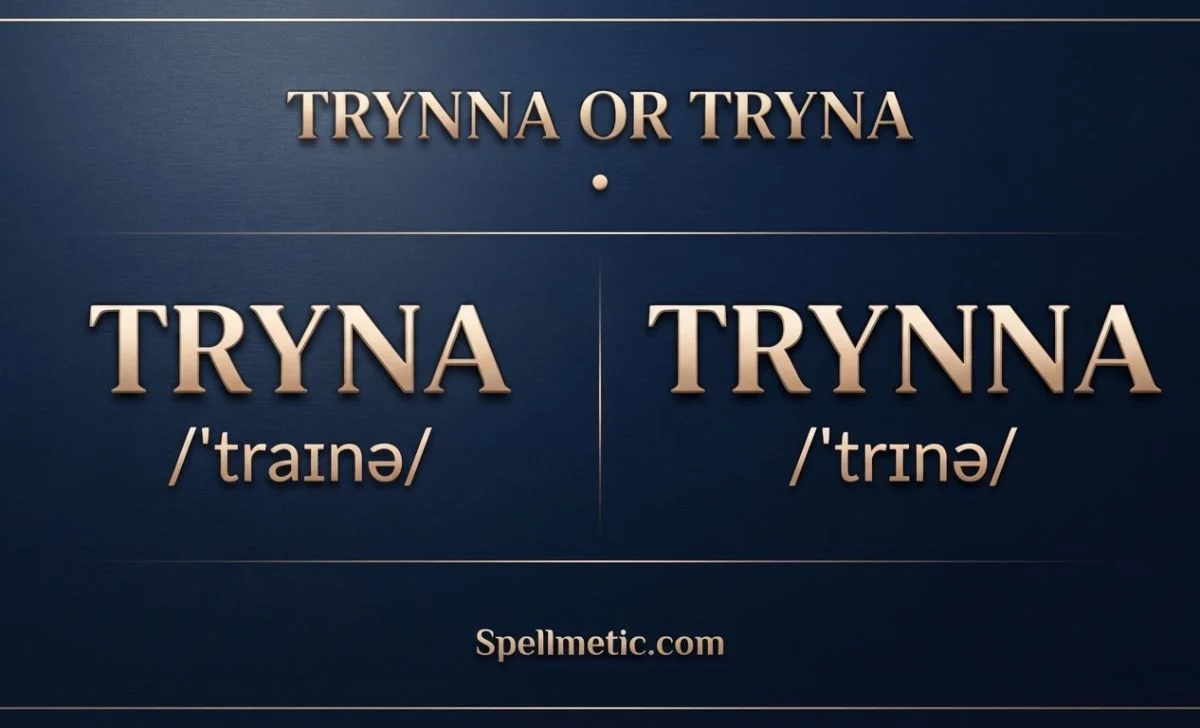
Trynna or tryna is a common spelling question because both forms appear frequently on social media, in text messages, and online conversations.
However, they are not equal. Tryna is the widely recognized informal spelling that represents the spoken phrase trying to, while trynna is generally treated as a misspelling of that informal form.
Although tryna is popular in casual writing, it is not considered standard English. In formal situations such as school assignments, business emails, reports, and professional documents, you should always write trying to.
Understanding this difference helps you choose the right form for every situation and avoid common writing mistakes.
This guide explains the meaning, pronunciation, usage, dictionary recognition, and the best choice for both formal and informal English.
Quick Answer
If you are writing informally, tryna is the preferred spelling because it reflects the casual pronunciation of trying to.
Trynna is not recognized as a standard or commonly accepted spelling. For formal writing, always use trying to.
Correct Examples
- I’m tryna finish this project before tonight.
- She’s tryna learn Spanish before her vacation.
- They’re tryna fix the problem together.
- We’re tryna save more money this year.
- He’s tryna call you right now.
Incorrect Examples
- I’m trynna finish my homework. → I’m tryna finish my homework.
- She’s trynna help everyone. → She’s tryna help everyone.
- They’re trynna leave early. → They’re tryna leave early.
- We’re trynna understand the lesson. → We’re trying to understand the lesson.
- He was trynna explain everything. → He was tryna explain everything.
Understanding the Meaning of Tryna
The word tryna is an informal written version of the phrase trying to. It is commonly used in casual conversations, text messages, online chats, song lyrics, and social media posts.
Instead of typing the full phrase, many people shorten it to make writing faster and sound more like everyday speech.
For example:
- I’m tryna get some sleep.
- She’s tryna finish her work.
- They’re tryna catch the last train.
In each sentence, tryna simply means trying to. It does not create a new meaning or change the grammar of the sentence.
On the other hand, trynna does not have its own meaning. It is generally considered an incorrect spelling that appears because some people try to write the word exactly as they hear it spoken.
Pronunciation and Spelling Guide
The standard English phrase is trying to. In relaxed speech, native speakers often pronounce these two words quickly, making them sound similar to tryna.
Pronunciation
| Feature | Pronunciation |
|---|---|
| American English (IPA) | /ˈtraɪɪŋ tə/ |
| British English (IPA) | /ˈtraɪɪŋ tə/ |
| Casual Spoken Form | “TRY-nuh” |
When people speak quickly, the -ing to sound becomes smoother and shorter. As a result, listeners often hear something close to tryna instead of trying to.
This natural pronunciation explains why the informal spelling became popular online.However, pronunciation does not change the standard written form.
In professional writing, trying to remains the correct choice regardless of how it sounds in conversation.
Tryna is commonly pronounced roughly like “TRY-nuh” and represents a reduced form of “trying to” in casual speech. Yale’s Grammatical Diversity Project gives the pronunciation /tɹaɪnə/.
Why People Mix Up These Spellings
The confusion between trynna and tryna comes from the way English is spoken rather than from grammar rules.
In everyday conversation, words often blend together, especially when people speak quickly.
Several factors make these spellings easy to confuse:
- Fast speech causes trying to to sound like one word.
- People often spell words the way they hear them.
- Text messages encourage shorter spellings.
- Social media slang spreads informal writing styles quickly.
- Some writers mistakenly add an extra n, creating trynna.
Because tryna is already an informal spelling, many people assume there are several acceptable versions.
In reality, trynna is simply an incorrect variation and is not the preferred informal spelling.
Is Trynna a Real Word?
No. Trynna is not recognized as a standard English word.
Major dictionaries do not list trynna as an accepted spelling or independent word. Instead, it is generally viewed as a misspelling that developed from the informal spelling tryna.
If you’re writing casually with friends, tryna is the spelling people are most likely to recognize. However, if you’re writing for school, work, or any professional audience, replace tryna with trying to.
That simple rule will help you write clearly and match standard English expectations.
Trynna is a less-established informal spelling of tryna. Some linguistic and dictionary-style sources recognize it as an alternative spelling, but trying to remains the standard choice for formal English.
Where Did Tryna Come From?
The informal spelling tryna developed from the spoken phrase trying to. In everyday conversation, English speakers often connect words together to speak more naturally.
Over time, people began writing these connected sounds the same way they heard them, especially in text messages, online chats, and social media.
Unlike standard English words, tryna did not originate from a dictionary or grammar rule. Instead, it grew through everyday communication and internet culture.
It is now commonly seen in casual writing, but it has never replaced trying to in formal English.
The spelling trynna has a different story. It did not evolve into an accepted informal form. Instead, it usually appears because writers incorrectly add an extra n while trying to imitate pronunciation.
Is Tryna AAVE?
Tryna is used in colloquial English, including varieties of English associated with African American speech.
Linguistic research describes tryna as a spoken form meaning “trying to,” while some contexts also use it to express “want to” or “desire to.”
It is also used more broadly in informal speech and online writing, so it should not be treated as exclusively AAVE.
What Do Major Dictionaries Say?
Trusted English dictionaries recognize trying as the standard word and trying to as the correct phrase. They do not list trynna as an accepted English word.
| Dictionary | Recognition |
|---|---|
| Merriam-Webster | Recognizes trying as a standard English word. |
| Oxford Dictionary | Lists trying and its meanings in standard English. |
| Cambridge Dictionary | Recognizes trying but not trynna. |
| Collins Dictionary | Accepts trying as standard English usage. |
These dictionaries focus on standard written English used in education, business, journalism, and professional communication.
While you may find tryna in informal online writing, dictionaries continue to recommend trying to whenever standard English is expected.
Tryna Meaning in Urdu
In Urdu, tryna can usually be understood as “کوشش کرنا”, “کوشش کر رہا ہوں”, or, depending on context, “چاہنا”.
For example, “I’m tryna help” means “میں مدد کرنے کی کوشش کر رہا ہوں,” while “I’m tryna go home” can sometimes mean “میں گھر جانا چاہتا ہوں.” The exact meaning depends on the sentence.
British English vs American English
One common question is whether tryna is American English while another spelling is British English.
The answer is no.Both American and British English use the standard phrase trying to in formal writing.
The informal spelling tryna appears in casual online communication across many English-speaking countries, but it is not an official spelling in either variety of English.
| Feature | British English | American English |
|---|---|---|
| Standard form | trying to | trying to |
| Informal online form | tryna | tryna |
| Formal writing | trying to | trying to |
| Preferred in school and business | trying to | trying to |
No major English-speaking country recommends trynna. If your audience expects correct grammar and professional writing, trying to is always the safest choice regardless of where they live.
Which Form Should You Use?
American English
In the United States, use trying to for emails, reports, academic work, and professional communication. Tryna is acceptable only in casual texting, social media posts, or friendly conversations where informal language is expected.
British English
British English follows the same rule. Standard writing uses trying to, while tryna may appear in informal online conversations. It should not replace the standard phrase in formal contexts.
Canada
Canadian English also prefers trying to in schools, workplaces, and official documents. Although younger speakers may use tryna in text messages, it is considered informal and should be avoided in professional writing.
Australia
Australian English treats trying to as the correct written form. Casual spellings like tryna sometimes appear in digital conversations, but they are not suitable for academic or business communication.
International English
If your writing will be read by an international audience, choose trying to. It is clear, widely understood, and accepted in every major style of English.
Using the standard phrase also helps your writing appear more professional and easier to understand.
An Easy Way to Remember the Correct Form
A simple memory trick can help you avoid this mistake.
Think of it this way:
If you’re writing for work or school, never shorten “trying to.”
Another easy reminder is:
Tryna belongs in texts. Trying to belongs everywhere else.
These quick rules make it easy to choose the right form without stopping to think about grammar every time you write.
Common Mistakes to Avoid
Many writers understand that tryna is informal but still make mistakes when using it. The examples below show the most common errors and how to fix them.
1. Using trynna Instead of tryna
Wrong: I’m trynna finish this book today.
Correct: I’m tryna finish this book today.
Why it matters: The extra n is unnecessary. If you’re using the informal form, tryna is the commonly accepted spelling.
2. Using tryna in Professional Writing
Wrong: We are tryna complete your request as soon as possible.
Correct: We are trying to complete your request as soon as possible.
Why it matters: Business emails, reports, and official documents should always use standard English.
3. Using tryna in Academic Assignments
Wrong: The researcher is tryna explain the results.
Correct: The researcher is trying to explain the results.
Why it matters: Schools, colleges, and universities expect formal grammar and standard spelling.
4. Assuming tryna Is a Dictionary Word
Wrong: Since everyone uses tryna, it must be a standard English word.
Correct: Tryna is an informal spelling of trying to and is not standard English.
Why it matters: Popular online usage does not automatically make a word suitable for formal writing.
5. Mixing Formal and Informal Language
Wrong: Dear Customer, we’re tryna resolve your issue quickly.
Correct: Dear Customer, we’re trying to resolve your issue quickly.
Why it matters: Keeping the same writing style throughout a document makes your communication more professional and easier to read.
6. Thinking trynna and tryna Mean Different Things
Wrong: Trynna has a different meaning from tryna.
Correct: Trynna is simply an incorrect spelling of the informal form tryna.
Why it matters: Both are intended to represent trying to, but only tryna is commonly recognized in informal writing.
7:Imma Tryna or Imma Trying To?
Imma tryna and I’m trying to are not the same expression. Imma is an informal representation of “I’m going to,” while tryna commonly represents “trying to.”
In casual writing, you may see them together, such as “Imma tryna finish this today,” meaning “I’m going to try to finish this today.” Neither form is suitable for formal writing.
Using the Right Form in Everyday Writing
The best choice depends on where and why you’re writing. In casual conversations, tryna may sound natural. In formal situations, trying to is always the better option.
Emails
Professional emails should always use trying to.
Example:
- We are trying to process your order today.
- I’m trying to schedule a meeting for next week.
Using standard English creates a more professional impression and reduces confusion.
Business Writing
Business documents, reports, proposals, and customer communications should never replace trying to with tryna.
Example:
- Our team is trying to improve customer support.
- We are trying to reduce response times.
Professional writing should be clear, consistent, and grammatically correct.
Education
Teachers, professors, and examiners expect standard English in assignments and exams.
Example:
- The scientist is trying to explain the experiment.
- Students are trying to improve their writing skills.
Using trying to demonstrates good grammar and appropriate academic style.
Social Media
Social media is where tryna is most commonly used. People often shorten words to make posts sound more natural and conversational.
Example:
- I’m tryna stay positive.
- She’s tryna reach her goals.
- We’re tryna make this weekend unforgettable.
Although this usage is common online, it remains informal.
Daily Conversation
Friends and family often use relaxed language in text messages and chats.
Example:
- I’m tryna call you.
- They’re tryna find a restaurant.
- We’re tryna get there before sunset.
In spoken English, many people naturally pronounce trying to in a way that sounds similar to tryna.
Technology and Online Messaging
Messaging apps, gaming chats, discussion forums, and online communities frequently include shortened spellings.
Example:
- I’m tryna update my computer.
- She’s tryna fix the Wi-Fi.
- They’re tryna download the latest update.
Even in digital communication, remember that trying to is the better choice whenever you’re writing to teachers, employers, clients, or anyone in a professional setting.
Search Trends and Online Usage
People search for trynna or tryna because they want to know which spelling is correct. Others hear the phrase in songs, videos, or everyday conversations and wonder how it should be written.
Search interest also increases because informal spellings spread quickly through social media platforms, messaging apps, and online communities.
As more people see different versions, they naturally question which one is accurate.
While tryna appears far more often in casual online writing than trynna, neither form replaces trying to in standard English.
If your goal is clear, professional communication, trying to remains the recommended choice.
Related Searches
If you’re searching for trynna or tryna, you may also be looking for answers to related questions about spelling, pronunciation, and informal English.
Here are some of the most common searches:
- tryna meaning
- tryna definition
- tryna pronunciation
- trynna meaning
- trying to vs tryna
- is tryna a real word
- how to spell trying to
- tryna in English
- tryna grammar
- tryna dictionary
- informal English words
- common spelling mistakes in English
- standard English vs slang
- English writing tips
- correct spelling of trying to
These searches all relate to the same goal: understanding when an informal spelling is acceptable and when standard English is the better choice.
Quick Comparison
| Feature | Tryna | Trynna |
|---|---|---|
| Meaning | Informal spelling of trying to | No separate meaning |
| Standard English | No | No |
| Dictionary Entry | Not listed as a standard word | Not listed |
| Common Online Usage | Yes | Rare |
| Professional Writing | Not recommended | Not recommended |
| Best Choice Between the Two | Yes | No |
The table shows that tryna is the more familiar informal spelling used in casual online communication.
However, neither spelling belongs in formal writing. Whenever you’re writing for school, work, or any professional purpose, trying to is the correct and safest option.
FAQs
1. Is tryna a real English word?
No. Tryna is an informal spelling of trying to. It is widely used in casual online communication but is not considered standard English.
2. Is trynna correct?
No. Trynna is generally viewed as a misspelling. If you’re writing informally, tryna is the more common form. For formal writing, use trying to.
3. Which is correct: trynna or tryna?
Between the two, tryna is the accepted informal spelling. Trynna is not commonly recognized.
4. Can I use tryna in school assignments?
No. Academic writing should always use trying to because it follows standard English grammar and spelling.
5. Is tryna acceptable in business emails?
No. Business communication should use trying to to maintain a professional tone.
6. Why do people write tryna?
People often shorten trying to because that’s how it sounds in fast, everyday speech. Social media and texting have made this informal spelling popular.
7. Why do some people spell it trynna?
Most people add the extra n because they are spelling the word by sound rather than following common informal usage.
8. Do dictionaries recognize tryna?
Major dictionaries recognize trying, but they do not list tryna as a standard English word.
9. Does British English use tryna?
You may see it in casual online conversations, but British English also uses trying to in formal writing.
10. Does American English use tryna?
Yes, it appears in informal texting and social media. However, professional and academic writing still uses trying to.
11. Is tryna considered slang?
It is best described as an informal written spelling that reflects casual speech. It is not appropriate for formal communication.
12. How can I avoid this spelling mistake?
Remember one simple rule: use trying to whenever your writing needs to be clear, correct, and professional. Reserve tryna only for casual conversations if you choose to use it.
13:Is Tryna English?
Yes, tryna is found in informal English, especially in casual speech, texting, social media, and representations of spoken language. However, it is not the standard form used in formal English. For school, business, academic, and professional writing, use trying to instead.
Collins lists tryna as an informal contraction of “trying to” and notes that the word is being monitored for evidence of usage.
Final Verdict
When comparing trynna or tryna, the better informal spelling is tryna because it reflects the casual pronunciation of trying to.
The spelling trynna is generally treated as a misspelling and is not commonly accepted, even in informal writing.
The most important point, however, is that trying to remains the correct form in standard English.
Whether you’re writing an essay, a business email, a report, or any professional document, the full phrase is always the right choice.
While tryna has become popular in texting, social media, and online conversations, it should stay in informal contexts where relaxed language is expected.
A simple way to remember the rule is this: use “trying to” whenever accuracy matters, and recognize “tryna” as a casual shortcut ,not a replacement for standard English.
Following this guideline will help your writing stay clear, natural, and appropriate for every audience.
Read More…