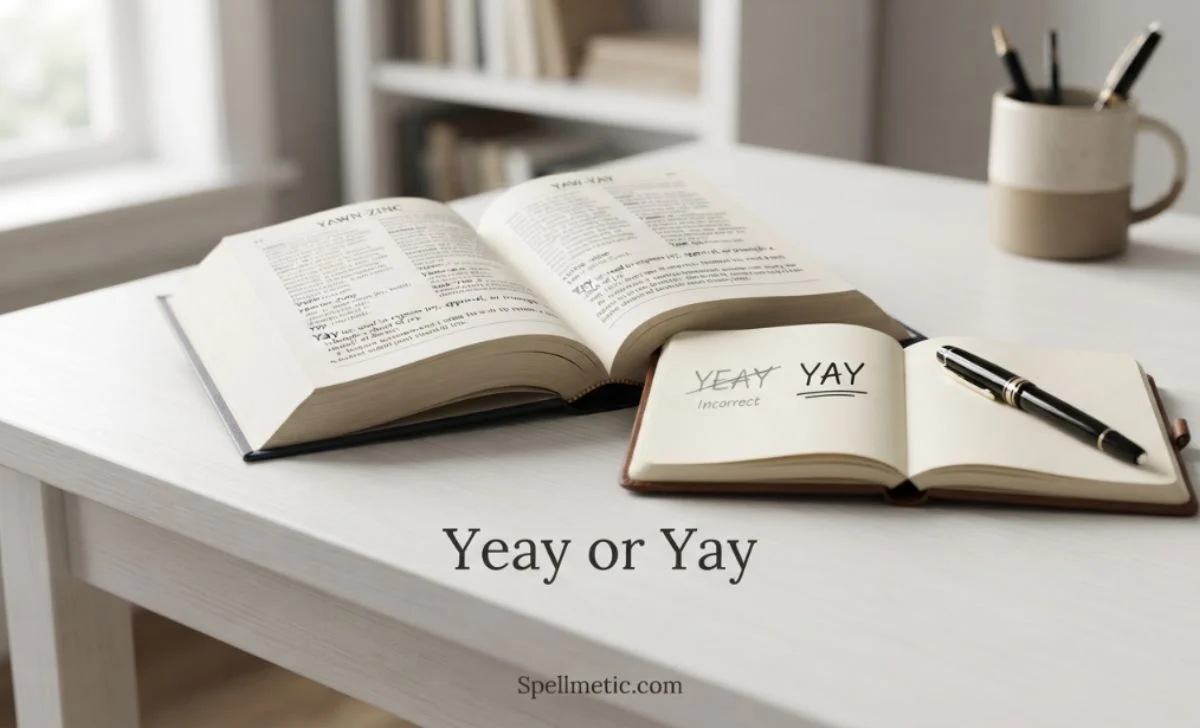
If you’re wondering whether “yeay” or “yay” is correct, the answer is simple: “yay” is the correct spelling.
“Yeay” is a common misspelling and is not recognized as a standard English word by major dictionaries.
People often type “yeay” because it sounds similar to “yay” when spoken, but only “yay” is accepted in everyday English.
This confusion appears frequently in text messages, social media posts, emails, and online comments. Since “yay” is an informal exclamation, many writers spell it the way it sounds instead of using the standard form.
Fortunately, the rule is easy to remember. Whenever you want to express excitement, happiness, approval, or celebration, “yay” is the correct choice.
In this guide, you’ll learn the correct spelling, pronunciation, meaning, why people confuse these words, dictionary recognition, common mistakes, and practical examples.
By the end, you’ll know exactly when to use “yay” and why “yeay” should be avoided in standard English writing.
Quick Answer
The correct spelling is “yay.”
“Yeay” is a misspelling and is not accepted in standard English. Use “yay” whenever you want to express excitement, joy, approval, or celebration.
Correct Examples
- Yay! We finished the project on time.
- Yay! It’s finally the weekend.
- Everyone shouted, “Yay!” after the winning goal.
- Yay! My package arrived today.
- She smiled and said, “Yay, we did it!”
Incorrect Examples
- ❌ Yeay! We won the game. → ✅ Yay! We won the game.
- ❌ Yeay, my order is here. → ✅ Yay, my order is here.
- ❌ The children yelled “Yeay!” → ✅ The children yelled “Yay!”
- ❌ Yeay! Summer vacation begins tomorrow. → ✅ Yay! Summer vacation begins tomorrow.
- ❌ I texted “Yeay!” after hearing the news. → ✅ I texted “Yay!” after hearing the news.
What Does Yay Mean?
Yay is an informal exclamation used to express happiness, excitement, relief, approval, or celebration. It often appears in conversations, text messages, social media posts, and casual writing.
Definition
Yay means “I’m happy,” “That’s great,” “Excellent,” or “Hooray!”
Common Uses
- Celebrating good news
- Expressing excitement
- Showing approval
- Reacting to success
- Sharing joyful moments
Examples
- Yay! We passed the exam.
- Yay! The tickets are finally available.
- Yay! Our favorite team won.
The spelling “yeay” has no accepted meaning in standard English. It is simply a typing or spelling mistake rather than a separate word.
What Does Yea Mean?
Yea is an old-fashioned or formal word that means “yes” or expresses agreement. It is different from yay, which is an exclamation used to show excitement or happiness.
You may see yea in formal voting language, historical writing, religious texts, or expressions such as “yea or nay.”
Examples of Yea
- The members voted yea on the proposal.
- She answered yea when asked if she agreed.
- The final vote included 15 yea votes and 3 nay votes.
Remember: yea = yes, while yay = excitement or celebration.
How to Spell and Pronounce Yay
The correct spelling is yay.
Correct Spelling
- ✅ Yay
- ❌ Yeay
IPA Pronunciation
| Variety | IPA | Sounds Like |
|---|---|---|
| American English | /jeɪ/ | “yay” (rhymes with day) |
| British English | /jeɪ/ | “yay” (rhymes with day) |
The pronunciation is the same in American and British English. There is no regional spelling difference.
Simple Pronunciation Guide
Say “yay” as one syllable that rhymes with:
- day
- play
- say
- may
Because it is spoken quickly in conversation, some people mistakenly spell it “yeay.” However, standard English recognizes only “yay.”
How Do You Spell “Yeah” as in Hooray?
If you mean the cheerful expression used to celebrate something, the correct spelling is yay, not yeah.
For example:
- Yay! We won the game.
- Yay! I got the job.
- Yay! Summer vacation starts tomorrow.
Yeah normally means an informal “yes,” while yay expresses happiness, excitement, approval, or celebration.
So if you mean “hooray,” use yay.
Why Do People Confuse These Words?
The confusion between “yeay” and “yay” comes from spelling habits rather than grammar. Since “yay” is an informal exclamation, many people write it the way they think it sounds.
Common reasons include:
- Phonetic spelling: Writers spell the sound instead of the accepted word.
- Typing mistakes: The extra “e” is often added accidentally.
- Fast texting: Informal messages are usually typed quickly.
- Social media habits: Incorrect spellings spread through posts and comments.
- Lack of dictionary checks: Many people never verify the spelling of informal expressions.
Although “yeay” appears online, its popularity does not make it a correct English word.
Is “Yeay” a Real Word?
No. “Yeay” is not a recognized English word.
Major English dictionaries do not list “yeay” as a standard entry. Instead, it is treated as a common misspelling of “yay.”
Use “yay” whenever you want to express:
- Excitement
- Celebration
- Happiness
- Approval
- Relief
If you are writing for school, work, business, or publication, always choose “yay.”
The Word Origin
The exact origin of “yay” is uncertain, but language experts generally consider it a modern English exclamation that developed as a cheerful expression of approval or excitement.
It became especially common during the twentieth century through spoken English and later spread widely in children’s books, television, advertising, and digital communication.
Unlike many English words, “yay” does not come from Latin or Greek roots. Instead, it belongs to a group of emotional expressions such as “hooray,” “wow,” “oops,” and “oops.”
These words are created to imitate natural speech rather than follow traditional word-building patterns.
Today, “yay” is widely understood by English speakers around the world and remains the standard spelling.
Dictionary Evidence
Leading English dictionaries consistently recognize “yay” as the correct spelling of this informal exclamation.
- Merriam-Webster lists “yay” as an interjection expressing joy, approval, or excitement.
- Oxford Dictionary recognizes “yay” as an informal expression used during happy or successful moments.
- Cambridge Dictionary includes “yay” as an exclamation showing pleasure or celebration.
- Collins Dictionary also accepts “yay” as the standard spelling.
None of these dictionaries recognize “yeay” as a standard English word.
British English vs American English
There is no spelling difference between British English and American English for this word. Both varieties use “yay.”
| Feature | British English | American English |
|---|---|---|
| Standard spelling | Yay | Yay |
| Pronunciation | /jeɪ/ | /jeɪ/ |
| Dictionary recognition | Yes | Yes |
| “Yeay” accepted? | No | No |
Since both forms of English use the same spelling, you never need to change “yay” for your audience.
Which Spelling Should You Use?
American English
Use “yay.” It is the standard spelling in American dictionaries and everyday writing.
British English
Use “yay.” British English follows the same spelling and pronunciation.
Canada
Canadian English also uses “yay.” The misspelling “yeay” is not accepted.
Australia
Australian writers should choose “yay.” It is the standard form in both casual and professional contexts.
International English
Whether your audience is local or global, “yay” is the recommended spelling. It is widely recognized and understood by English speakers worldwide.
How to Remember the Correct Spelling
Remember this simple trick:
“Yay” has one extra “Y” for extra joy.
The word begins and ends with the same letter, making it easy to recognize. If you see an extra “e” in “yeay,” it’s a sign that the spelling is incorrect.
Another helpful tip is to connect “yay” with other words that rhyme:
- day
- may
- play
- say
Since all of these end with “-ay,” the correct spelling “yay” follows the same pattern.
Common Mistakes
Below are some frequent errors people make when using “yay.”
1. Adding an Extra Letter
Wrong: Yeay! We finally finished.
Correct: Yay! We finally finished.
Why: The extra “e” is unnecessary.
2. Using “Yeay” in Professional Writing
Wrong: Yeay! Your application has been approved.
Correct: Your application has been approved. Great news!
Why: While “yay” is acceptable in casual writing, professional communication often benefits from more formal wording.
3. Treating “Yeay” as a Dictionary Word
Wrong: I checked, and “yeay” is an English word.
Correct: “Yeay” is a common misspelling of “yay.”
Why: Standard dictionaries recognize “yay,” not “yeay.”
4. Confusing “Yay” with “Yeah”
Wrong: Yeah! We won the championship! (when expressing celebration)
Correct: Yay! We won the championship!
Why: “Yeah” means yes, while “yay” expresses excitement or celebration.
5. Using “Yay” in Very Formal Documents
Less Appropriate: Yay! We are pleased to announce our annual financial results.
Better: We are pleased to announce our annual financial results.
Why: Formal reports and business documents usually avoid informal exclamations.
Yea or Yeah: What Is the Difference?
Yea and yeah can both express agreement, but they are used in different ways.
Yea is a more formal, old-fashioned, or traditional way of saying “yes.” It is also commonly seen in voting language, such as “yea or nay.”
Yeah is an informal form of “yes” used in everyday conversation, texting, and casual writing.
Examples
- Yea, I agree with the proposal. (formal or traditional)
- Yeah, I agree with you. (informal)
- The vote was 20 yea and 5 nay.
- Yeah, that sounds like a good idea.
So, yea = yes, yeah = informal yes, and yay = excitement or celebration.
Everyday Examples
Emails
- Yay! I received your message.
- Yay! The meeting has been confirmed.
- Yay! Everything is ready for tomorrow.
Business Writing
Although “yay” is informal, it may appear in friendly internal messages.
Examples:
- Yay! We reached our monthly target.
- Yay! The project launched successfully.
For client emails or official reports, choose a more professional expression such as “Great news!” or “We’re pleased to announce.”
Education
Teachers and students often use “yay” in casual classroom settings.
Examples:
- Yay! You answered every question correctly.
- Yay! Our class won the reading challenge.
- Yay! We finished the science project.
Social Media
“Yay” is especially popular on social media because it quickly shows excitement.
Examples:
- Yay! Vacation starts tomorrow!
- Yay! My package finally arrived.
- Yay! Thanks for all the support.
- Yay! New video is live.
- Yay! We hit 10,000 followers.
Daily Conversation
People commonly use “yay” when speaking with friends and family.
Examples:
- Yay! Let’s celebrate.
- Yay! Dinner is ready.
- Yay! I found my keys.
- Yay! It’s Friday.
- Yay! We made it on time.
Technology
The word also appears in digital communication, including chats, gaming, and messaging apps.
Examples:
- Yay! The update installed successfully.
- Yay! My account is working again.
- Yay! We completed the game level.
- Yay! The download finished.
- Yay! The website is back online.
Google Trends & Usage Data
Search interest shows that “yay” is overwhelmingly more common than “yeay.” Most searches for “yeay” come from users checking whether they have spelled the word correctly.
Common search intentions include:
- Is “yeay” correct?
- How do you spell “yay”?
- Yay meaning
- Yay pronunciation
- Yay or yeay
- Is “yeay” a real word?
Because search engines recognize “yeay” as a likely misspelling, they often direct users toward the standard spelling “yay.”
Related Searches
People searching for “yeay or yay” also look for:
- yay meaning
- yay definition
- yay pronunciation
- how to spell yay
- is yeay a word
- correct spelling of yay
- yay vs yeah
- English spelling rules
- common spelling mistakes
- dictionary spelling of yay
Comparison Summary
| Feature | Yay | Yeay |
|---|---|---|
| Correct spelling | ✅ Yes | ❌ No |
| Standard English word | ✅ Yes | ❌ No |
| Recognized by dictionaries | ✅ Yes | ❌ No |
| Meaning | Expresses joy, excitement, or approval | No accepted meaning |
| American English | ✅ Yay | ❌ Not used |
| British English | ✅ Yay | ❌ Not used |
| Suitable for everyday writing | ✅ Yes | ❌ No |
| Recommended spelling | ✅ Always use yay | ❌ Avoid |
FAQs
Is “yeay” a correct spelling?
No. “Yeay” is a common misspelling. The correct spelling is “yay.”
What does “yay” mean?
“Yay” is an informal exclamation used to show excitement, happiness, celebration, or approval.
Is “yay” found in English dictionaries?
Yes. Major dictionaries, including Merriam-Webster, Oxford, Cambridge, and Collins, recognize “yay” as a standard informal interjection.
Why do people write “yeay” instead of “yay”?
Most people add the extra “e” because they spell the word by sound or make a simple typing mistake.
Do British and American English spell it differently?
No. Both British and American English use the spelling “yay.”
Is “yay” appropriate for formal writing?
Usually not. It is best suited to casual conversations, text messages, social media, and friendly emails. In formal writing, choose alternatives such as “Excellent,” “Great news,” or “Congratulations.”
Can I use “yay” in professional emails?
You can use it in friendly internal messages or informal workplace chats. For official communication with clients or business partners, a more professional expression is a better choice.
Is “yay” the same as “yeah”?
No. “Yay” expresses excitement or celebration, while “yeah” is an informal way of saying “yes.”
What is the easiest way to remember the correct spelling?
Think of words like day, play, and say. Since they all end in -ay, yay follows the same spelling pattern.
Should I ever use “yeay”?
No. Standard English does not recognize “yeay.” Always use “yay.”
Final Verdict
When comparing “yeay or yay,” the correct choice is always “yay.” It is the only spelling accepted in standard English and recognized by trusted dictionaries.
Writers use “yay” to express happiness, excitement, approval, or celebration in casual communication.
Although “yeay” sometimes appears in text messages and online posts, it remains a misspelling rather than a legitimate English word.
Since both American and British English use “yay,” you never need to change the spelling for different audiences.
A simple memory trick can help: **”Yay” rhymes with “day” and “play,” so it naturally ends with -ay.
Whenever you want to celebrate good news or show enthusiasm, choose “yay” with confidence and avoid “yeay” in all forms of standard writing.