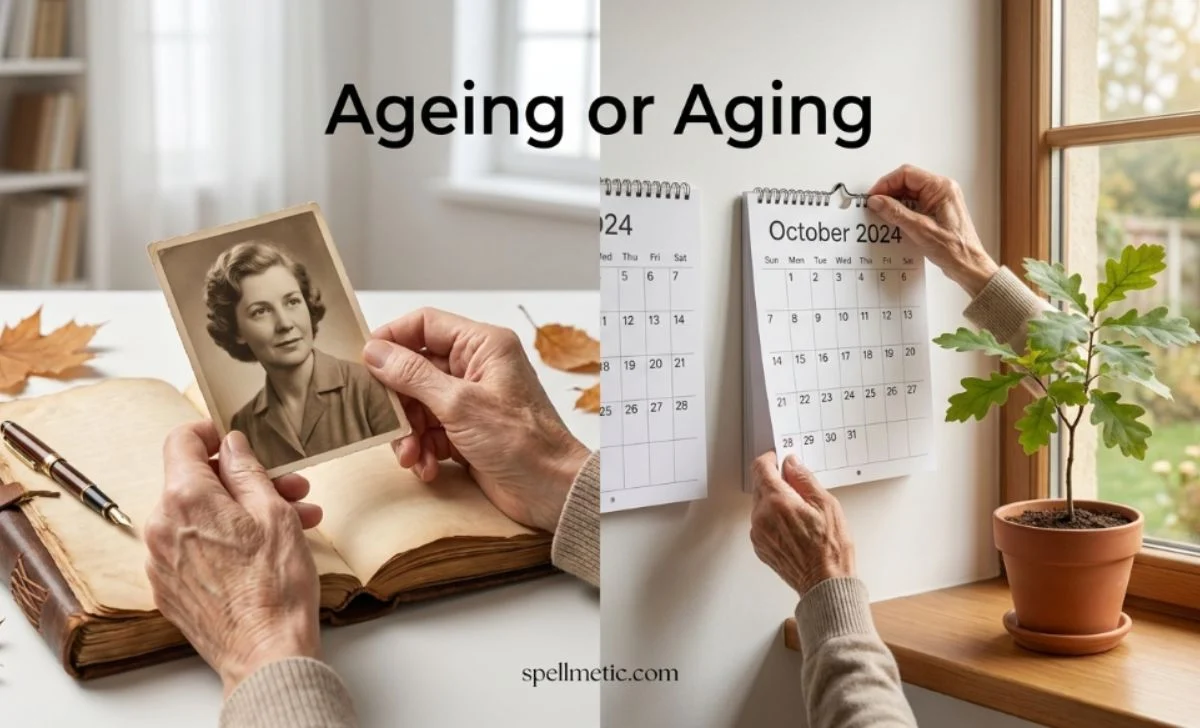
If you have ever written about getting older, growing older, or the natural process of becoming older, you may have wondered whether the correct spelling is ageing or aging.
Both forms are correct, but the one you should use depends largely on the variety of English you are writing in.Ageing is the traditional spelling used in British English and many other varieties of English.
Aging is the standard spelling in American English and is also widely used internationally, particularly in American-influenced writing.
The difference can be confusing because most English words ending in -ing do not require you to remove a letter from the base word.In this case, however, the spelling follows different conventions on each side of the Atlantic.
The good news is that there is no need to memorize two completely different meanings. Ageing and aging have the same meaning, pronunciation, and grammatical function. The main difference is regional spelling.
Quick Answer: Ageing or Aging?
Both “ageing” and “aging” are correct spellings.
- Ageing = preferred in British English
- Aging = preferred in American English
- Both mean the process of becoming older or showing the effects of growing older
- Both can function as a verb form, adjective, or noun-related form depending on context
- The pronunciation is essentially the same
Examples
British English:
The population is ageing rapidly.
American English:
The population is aging rapidly.
Neither sentence is grammatically wrong. The choice depends on the English variety being used.
What Does “Ageing” or “Aging” Mean?
Ageing and aging refer to the process of becoming older over time. The words can describe people, animals, objects, materials, systems, or populations.
For example:
The ageing population is creating new challenges for healthcare systems.
Here, ageing describes a population that has an increasing proportion of older people.
The words can also describe something that has existed or been used for a long time:
The aging building needs extensive repairs.
In this sentence, aging means that the building is becoming older and may be showing the effects of time.
The two spellings do not have different meanings. The difference is primarily one of regional spelling convention.
Simple Definition
Ageing/Aging: the process of becoming older or developing characteristics associated with age.
Depending on context, it can describe:
- people growing older
- an aging population
- aging skin
- aging technology
- aging buildings
- aging materials
- the aging process
Ageing vs. Aging: What Is the Difference?
The key difference is where the spelling is used.
| Spelling | Main Usage | Example |
|---|---|---|
| Ageing | British English | The population is ageing. |
| Aging | American English | The population is aging. |
Both spellings come from the verb age.
The difference becomes especially noticeable when writing for a specific audience. If your article is aimed primarily at readers in the United States, aging will usually look more natural. If you are following British English conventions, use ageing.
Ageing in British English
British English normally keeps the e before -ing:
She is ageing gracefully.
The ageing population needs more support.
Scientists are studying the effects of ageing.
This spelling is also common in other varieties influenced by British English.
Aging in American English
American English generally drops the e:
She is aging gracefully.
The aging population needs more support.
Scientists are studying the effects of aging.
This is the standard spelling for American audiences.
Why Is It “Ageing” in British English but “Aging” in American English?
The difference comes from different spelling conventions rather than a difference in pronunciation or meaning.
English has several words in which British and American spelling conventions differ. Some differences are widely recognized, such as:
- colour / color
- favour / favor
- travelling / traveling
- cancelled / canceled
The ageing/aging distinction follows a similar regional pattern.
British English commonly retains the e in ageing, while American English commonly uses aging.
It is therefore better to think of the two spellings as regional variants, rather than calling one correct and the other incorrect.
Is “Ageing” or “Aging” More Common?
Usage depends heavily on the region.
For American English, aging is the normal choice.
For British English, ageing is the traditional standard spelling.
You may still encounter aging in British publications, especially in scientific, medical, business, or international contexts influenced by American usage. Likewise, American readers will generally understand ageing without difficulty.
For consistent writing, however, it is best to choose the spelling that matches the variety of English you are using throughout the article.
How Do You Pronounce “Ageing” and “Aging”?
Both spellings are pronounced essentially the same way.
Ageing / Aging → approximately AY-jing
The spelling changes, but the pronunciation does not normally change.
The word comes from age, so the first syllable has the same sound as the beginning of agent or the word age itself.
This is one reason the spelling difference can be confusing: readers hear the same word but may see either ageing or aging depending on the writer’s preferred variety of English.
Is “Ageing” or “Aging” a Verb?
Yes. Ageing and aging can be the present participle and gerund forms of the verb age.
The verb age means to become older or to cause something to become older.
As a Verb
The population is ageing rapidly.
(British English)
The population is aging rapidly.
(American English)
In both sentences, the meaning is exactly the same.
As a Gerund
The word can also function as a noun when it refers to the process of becoming older.
Ageing is a natural part of life.
Aging is a natural part of life.
Again, the spelling depends on the variety of English.
Ageing vs. Aging in British and American English
The most important rule is simple: choose the spelling that matches your target audience.
| English Variety | Preferred Spelling | Example |
|---|---|---|
| British English | ageing | The population is ageing. |
| American English | aging | The population is aging. |
British English: Ageing
British English generally prefers ageing.
You may see it in:
- British newspapers
- UK government publications
- British academic writing
- UK educational materials
- Commonwealth English
Example:
The country has an ageing population.
American English: Aging
American English normally uses aging.
You may see it in:
- American newspapers
- U.S. government publications
- American academic writing
- American websites
- U.S. educational materials
Example:
The country has an aging population.
If your website primarily targets readers in the United States, aging is generally the better choice for consistency.
Which Spelling Should You Use?
There is no universal winner between ageing and aging. Your choice should depend on the English variety you are following.
Use “Aging” for American English
Choose aging if you are writing for a U.S. audience.
Aging is a natural part of life.
The aging workforce presents new challenges.
Researchers are studying healthy aging.
Use “Ageing” for British English
Choose ageing if you are following British English conventions.
Ageing is a natural part of life.
The ageing workforce presents new challenges.
Researchers are studying healthy ageing.
Keep Your Spelling Consistent
The most important thing is consistency.
If an article follows American English, use:
aging
traveling
canceled
color
If it follows British English, use:
ageing
travelling
cancelled
colour
Mixing spelling systems unnecessarily can make your writing look inconsistent.
Examples of Ageing and Aging in Sentences
Because the meanings are identical, you can use the same sentence patterns with either spelling.
Everyday Examples
Everyone goes through the process of aging.
Everyone goes through the process of ageing.
She is aging gracefully.
She is ageing gracefully.
Population Examples
The word is particularly common when discussing demographics.
The country has an aging population.
The country has an ageing population.
An aging population can affect healthcare and pension systems.
An ageing population can affect healthcare and pension systems.
Technology and Objects
Aging/ageing is not limited to people.
The aging computer system needs to be replaced.
The ageing computer system needs to be replaced.
Engineers are monitoring the effects of aging materials.
Engineers are monitoring the effects of ageing materials.
Scientific and Health Contexts
Both forms are widely understood in discussions about biology and health.
Researchers are studying the effects of aging on the human body.
Researchers are studying the effects of ageing on the human body.
Healthy aging can be influenced by lifestyle and environment.
Healthy ageing can be influenced by lifestyle and environment.
The spelling changes according to regional convention, not the underlying scientific meaning.
Common Mistakes With “Ageing” and “Aging”
Thinking One Spelling Is Wrong
A common mistake is assuming that ageing is a misspelling of aging, or that aging is incorrect because British English uses ageing.
Both are standard spellings.
The correct choice depends on the variety of English.
Mixing British and American Spelling
Using aging in one paragraph and ageing in another can make an article look inconsistent.
For example:
The aging population is growing, and the ageing workforce needs additional support.
There is nothing inherently ungrammatical about this sentence, but if the article is written in one consistent variety of English, switching between the two forms is unnecessary.
Assuming the Pronunciation Is Different
The two spellings are normally pronounced the same way.
The extra e in ageing does not create a different pronunciation.
Confusing “Aging” With a Different Word
Some learners think aging has a completely different meaning from ageing.
It does not.
Aging skin
and
Ageing skin
mean the same thing.
The difference is spelling convention, not vocabulary.
Using “Aging” in a British-English Article Without a Reason
While British readers will understand aging, writers following British English style will generally prefer ageing.
Likewise, American writers normally choose aging rather than ageing.
Ageing/Aging and Related Words
Understanding the base word can make the spelling easier to remember.
| Word | Meaning |
|---|---|
| age | To become older |
| aged | Having reached a particular age or becoming old |
| ageing | British spelling |
| aging | American spelling |
| ageing process | British form |
| aging process | American form |
| age-related | Connected with age |
For example:
The aging process affects everyone.
The ageing process affects everyone.
Both sentences are correct.
Ageing vs. Aging in Formal and Informal Writing
Both ageing and aging are acceptable in standard English. The choice is not really about formality; it is about regional spelling conventions.
In American English, aging is appropriate in both casual and formal writing:
The study examines the effects of aging on memory.
In British English, ageing can be used in the same contexts:
The study examines the effects of ageing on memory.
The important point is to follow the style of the publication, institution, or audience you are writing for.
Ageing or Aging in Scientific and Medical Writing
Both spellings appear in scientific and medical English, but the preferred form generally follows the publication’s chosen style.
American publications commonly use terms such as:
- aging process
- healthy aging
- aging population
- aging-related changes
- biological aging
British publications may use:
- ageing process
- healthy ageing
- ageing population
- ageing-related changes
- biological ageing
For professional or academic work, always check the publication’s style guide if one is provided.
Ageing or Aging in SEO and Online Content
From an SEO perspective, ageing and aging should not be treated as two different concepts. They are spelling variants of the same word.
If your website primarily targets U.S. readers, aging will generally be the more natural primary spelling.
If your audience is primarily in the UK, ageing is the better choice.
You can still mention the alternative spelling naturally when it helps readers:
Aging, also spelled ageing in British English, refers to the natural process of becoming older.
This provides useful information without repeatedly forcing both keywords into every paragraph.
Search engines can generally understand the relationship between spelling variants, so there is no need to awkwardly repeat both forms throughout an article.
Ageing vs. Aging: Quick Comparison
| Feature | Ageing | Aging |
|---|---|---|
| British English | Preferred | Understood but less typical |
| American English | Understood | Preferred |
| Meaning | Becoming older | Becoming older |
| Pronunciation | Same | Same |
| Part of speech | Verb form / gerund | Verb form / gerund |
| Main difference | Regional spelling | Regional spelling |
The simplest rule is:
UK English → ageing
US English → aging
Related Terms You May See
The word appears in many common expressions, especially in discussions about health, demographics, science, and society.
Aging Population / Ageing Population
The country has an aging population.
The country has an ageing population.
This refers to a population in which the proportion of older people is increasing.
Aging Process / Ageing Process
Scientists continue to study the aging process.
Scientists continue to study the ageing process.
This refers to the biological and physical changes that occur as an organism gets older.
Healthy Aging / Healthy Ageing
Regular exercise can support healthy aging.
Regular exercise can support healthy ageing.
The term is common in health, wellness, and public-health discussions.
Aging Society / Ageing Society
An aging society may face increased demand for healthcare services.
An ageing society may face increased demand for healthcare services.
This expression is often used when discussing demographic changes and their effects on society.
FAQs
1. Which is correct, “ageing” or “aging”?
Both are correct. Ageing is the standard British English spelling, while aging is the standard American English spelling.
2. Is “ageing” British or American?
Ageing is primarily the British English spelling. It is also used in other varieties of English that follow British spelling conventions.
3. Is “aging” American or British?
Aging is the standard American English spelling. British readers understand it, but British English traditionally prefers ageing.
4. Is “aging” a correct spelling?
Yes. Aging is completely correct, particularly in American English.
The aging population is growing.
5. Is “ageing” a correct spelling?
Yes. Ageing is completely correct, particularly in British English.
The ageing population is growing.
6. Do “ageing” and “aging” have the same meaning?
Yes. They have the same meaning and pronunciation. The difference is mainly regional spelling.
7. Which should I use for a U.S. audience?
Use aging for a U.S. audience.
For example:
Healthy aging is an important part of modern healthcare.
8. Which should I use for a UK audience?
Use ageing for a UK audience.
For example:
Healthy ageing is an important part of modern healthcare.
Final Verdict
Ageing and aging are both correct spellings of the same word. The main difference is regional: ageing is preferred in British English, while aging is preferred in American English.
Both refer to the process of becoming older and can be used in the same grammatical contexts.
If you are writing for readers in the United States, choose aging. If you are following British English conventions, choose ageing.
The most important thing is to keep your spelling consistent throughout the same piece of content.
Whether you are discussing an aging population, the ageing process, healthy aging, or ageing-related changes, the underlying meaning remains unchanged.
Once you know the regional spelling rule, choosing between ageing and aging becomes straightforward.