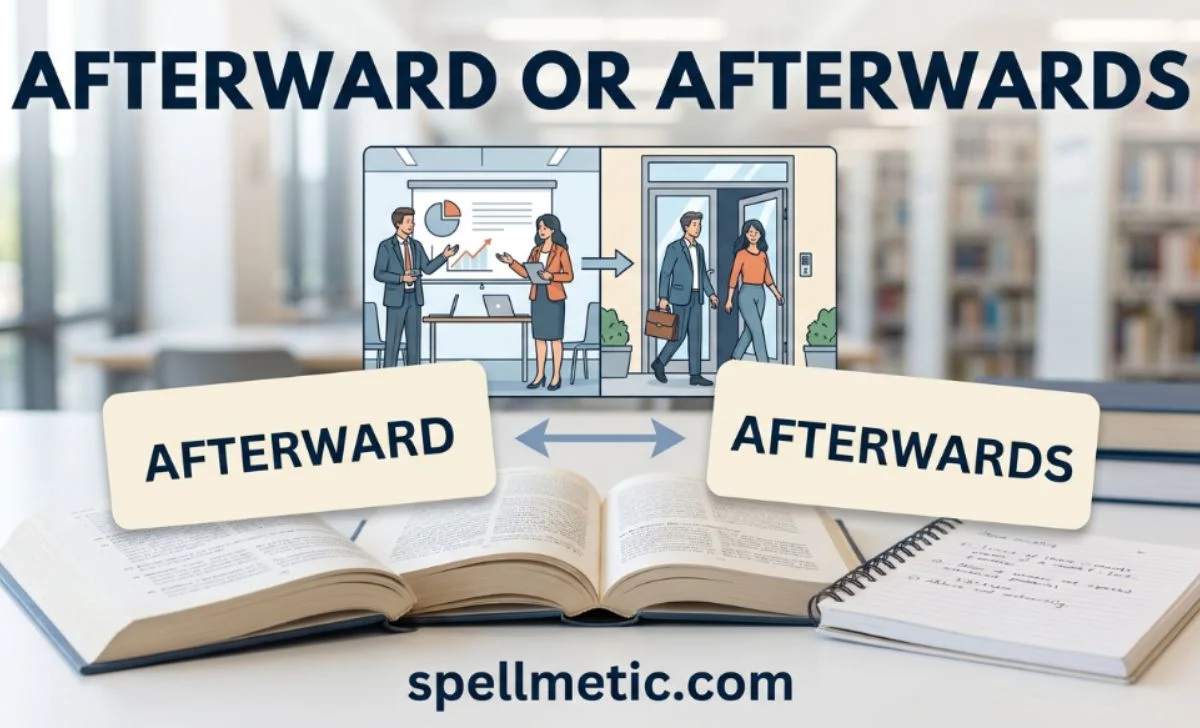
Have you ever stopped while writing and wondered, “Should I write afterward or afterwards?” Both forms look natural, and that is what makes this small grammar question confusing.
The good news is simple: both afterward and afterwards are correct. They have the same basic meaning—“at a later time” or “after something has happened.” The main difference is regional usage.
Afterward is the usual form in North American English, while afterwards is especially common in British English.
For example, an American writer might say, “We went home afterward,” while a British writer may naturally write, “We went home afterwards.” Neither sentence is grammatically wrong.
This guide explains the difference, shows how each word works in real sentences, and helps you choose the right form for your audience.
Afterward or Afterwards: Quick Answer
Afterward and afterwards are both correct adverbs meaning “at a later time.” The main difference is regional preference:
afterward is usually preferred in North American English, while afterwards is especially common in British English.
| Word | Meaning | Common usage |
|---|---|---|
| afterward | At a later time | North American English |
| afterwards | At a later time | British English |
| after | Later than something; following | Used in several grammatical roles |
So, if you are writing for a U.S. audience, afterward is the natural choice. If you are following British English, afterwards is a common choice.
What Does Afterward Mean?
Afterward is an adverb that means at a later time, after something has already happened.
Cambridge Dictionary labels afterward as a U.S. form and gives afterwards as a mainly UK alternative. Oxford’s American Dictionary also lists afterward as the North American form and defines it as a later time after an event.
Examples of Afterward
- We had dinner and went for a walk afterward.
- She called me afterward to explain what happened.
- I felt much better afterward.
- The students went home shortly afterward.
Notice that afterward does not need a noun directly after it. It works as an adverb and tells us when something happened.
What Does Afterwards Mean?
Afterwards has the same basic meaning as afterward: at a later time or after an event that has already been mentioned.
Oxford Learner’s Dictionaries marks afterwards as especially British English and notes that North American English usually uses afterward.
Examples of Afterwards
- We went out for coffee afterwards.
- She apologized afterwards.
- They moved to London and lived there for years afterwards.
- Shortly afterwards, the company changed its policy.
The meaning does not change simply because the word has an -s at the end.
What Is the Difference Between Afterward and Afterwards?
The easiest answer is that there is no meaningful difference in what they mean.
Both words can describe something that happens later:
We went to the restaurant afterward.
We went to the restaurant afterwards.
Both sentences mean that the restaurant visit happened after the earlier event.
The important difference is regional preference, not meaning or grammatical correctness.
Cambridge identifies afterward as the U.S. form and afterwards as mainly UK. Oxford similarly describes afterwards as especially British and says North American English usually uses afterward.
A Simple Rule to Remember
- American English: afterward
- British English: afterwards
- Meaning: the same
- Grammar: both are adverbs
- Correctness: both are standard English
There is no need to treat afterwards as a misspelling of afterward or vice versa.
Afterward vs Afterwards in American and British English
Regional English is the main reason you see two forms.
American English
Afterward is generally the preferred form in American English.
For example:
We finished the meeting and went home afterward.
I realized my mistake afterward.
The Oxford Advanced American Dictionary lists afterward as the main form while also recognizing afterwards.
British English
Afterwards is especially common in British English.
For example:
We finished the meeting and went home afterwards.
I realized my mistake afterwards.
Oxford Learner’s Dictionaries specifically labels afterwards as “especially British English” and says North American English usually uses afterward.
What Should International Writers Do?
If your audience includes readers from different English-speaking countries, either form can work. The best approach is to choose one style and use it consistently.
For a U.S.-focused website, afterward is a sensible default. For British English content, afterwards may sound more natural.
When Should You Use Afterward?
Use afterward when you want to say that something happened later, particularly when following North American English.
It works well in:
- Everyday conversation
- Emails
- Blog posts
- Essays
- Business writing
- Personal stories
- General American English
Real-Life Examples
At work:
We discussed the issue and sent an email afterward.
At school:
The students took the test and talked about it afterward.
In daily conversation:
Let’s get coffee afterward.
In a story:
He realized what had happened only afterward.
That last example shows an important point: afterward can appear at different points in a sentence.
When Should You Use Afterwards?
Use afterwards in the same situations when following British English or when it fits the style of your writing.
Real-Life Examples
At work:
We had a short meeting and spoke to the manager afterwards.
At school:
She finished her presentation and answered questions afterwards.
In conversation:
We can have lunch afterwards.
In storytelling:
Only afterwards did he understand why she had left.
Oxford provides examples of afterwards at the beginning, middle, and end of sentences, including phrases such as shortly afterwards and soon afterwards.
Where Do Afterward and Afterwards Go in a Sentence?
Both words are flexible adverbs. They can appear in different positions depending on the sentence.
At the Beginning
Afterwards, we went back to the hotel.
Afterward, she called her parents.
A comma is commonly used after the introductory adverb.
At the End
We went back to the hotel afterward.
She called her parents afterwards.
This is a very natural position in everyday English.
With Another Time Word
Both forms can follow words such as soon and shortly:
We left soon afterward.
They moved away shortly afterwards.
These combinations are common in natural English. Cambridge and Oxford both provide examples using soon afterward/afterwards and shortly afterward/afterwards.
Afterward vs After vs Afterwards
These three words are related, but they do not always work in the same way.
| Word | Main function | Example |
|---|---|---|
| after | Preposition or conjunction; also an adverb | We left after dinner. |
| afterward | Adverb | We left afterward. |
| afterwards | Adverb | We left afterwards. |
After commonly comes before a noun phrase or clause:
We went home after the meeting.
We left after the movie ended.
Cambridge explains that after can work as a preposition or conjunction, while as an adverb it is commonly used in an adverb phrase. Afterwards is more common when used independently as an adverb.
Compare:
We talked after the meeting.
Here, after connects the action with “the meeting.”
We talked afterwards.
Here, afterwards simply tells us that the talking happened later.
Afterward vs Afterword: Do Not Confuse Them
This is one spelling difference worth remembering.
Afterward
Afterward means later.
We discussed the book afterward.
Afterword
Afterword is a noun referring to a section added at the end of a book.
The author included an afterword in the new edition.
The words look similar, but their meanings are completely different.
A useful memory trick is:
afterward = later
afterword = part of a book
Common Mistakes With Afterward and Afterwards
Mistake 1: Thinking One Form Is Wrong
Some learners assume that afterwards is an incorrect version of afterward. It is not. Both forms are standard English. The difference is mainly regional.
Mistake 2: Treating the “S” as a Meaning Change
The -s in afterwards does not create a different meaning.
We talked afterward.
We talked afterwards.
The meaning is essentially the same.
Mistake 3: Confusing Afterwards With Afterword
These words belong to different grammatical categories:
- afterwards = adverb
- afterword = noun
Mistake 4: Using After When You Need an Independent Adverb
Consider:
We went home afterwards.
This is natural.
If you simply write:
We went home after.
the sentence can sound incomplete unless the context clearly supplies what “after” refers to. Cambridge notes that when after functions as an adverb, it is usually part of an adverb phrase.
Mistake 5: Mixing Regional Styles Without a Reason
Using both forms is not automatically wrong, but consistency makes polished writing easier to read.
If your article is written in American English, using afterward throughout may be the cleaner choice. If it follows British English, afterwards may be more natural.
Afterward and Afterwards: Which One Should You Use?
The choice is simple when you know your audience.
Choose Afterward If:
- You mainly write for Americans.
- Your website follows American English.
- Your school or workplace uses U.S. English.
- You want the usual North American form.
Choose Afterwards If:
- You mainly write for British readers.
- Your content follows British English.
- Your organization uses British English.
- You want the form especially associated with British usage.
If You Write for a Global Audience
You do not need to worry that one form will confuse readers. Both are widely understandable.
The more important point is to follow a consistent English variety throughout the article or website.
Formal Alternatives to Afterward
Sometimes you may want a more formal word, especially in academic, legal, business, or professional writing.
Subsequently
Subsequently means afterward or later and is explicitly marked as formal by Oxford.
The report was reviewed and subsequently approved.
This sounds more formal than:
The report was reviewed and afterward approved.
Thereafter
Thereafter means after the time or event mentioned and is also formal.
The company changed its policy and thereafter followed a new process.
Later
Later is simpler and more conversational.
I’ll call you later.
The best choice depends on the context. Do not use a formal word simply to make a sentence sound more advanced.
Afterward and Afterwards: Common Expressions
Some combinations appear often in natural English.
Soon afterward / soon afterwards
Meaning: a short time later.
She left the office, and soon afterward the phone rang.
He moved to Canada and soon afterwards found a new job.
Shortly afterward / shortly afterwards
Meaning: a short time later.
The meeting ended, and shortly afterward everyone left.
Long afterward / long afterwards
Meaning: much later.
Long afterward, she still remembered that conversation.
These expressions help you show the amount of time between two events more clearly.
Quick Comparison: Afterward, Afterwards, and Similar Words
| Word or phrase | Meaning | Style or use |
|---|---|---|
| afterward | At a later time | Mainly North American |
| afterwards | At a later time | Especially British |
| after | Later than; following | Very common, multiple functions |
| later | At a later time | General and conversational |
| subsequently | Later; after something else | Formal |
| thereafter | After that time or event | Formal |
| afterword | A section at the end of a book | Noun |
Cambridge’s thesaurus distinguishes these time expressions by context: later often refers to a later point in the same day, next can indicate what follows immediately, while subsequently can refer to a later event and is more formal.
FAQs
1. Is afterward or afterwards correct?
Both are correct. They have the same basic meaning. Afterward is usually preferred in North American English, while afterwards is especially common in British English.
2. Is afterward American or British English?
Afterward is the usual North American form. It is also understood elsewhere, but British English commonly uses afterwards.
3. Is afterwards British English?
Yes. Afterwards is especially common in British English, although it is also understood and used in other varieties of English.
4. Do afterward and afterwards mean the same thing?
Yes. Both mean at a later time or after something has happened. The main difference is regional preference.
5. Can I use afterward in British English?
Yes. It is understandable and grammatically valid. However, afterwards is the form more strongly associated with British English.
6. Can I use afterwards in American English?
Yes. American English recognizes the form, although afterward is normally the preferred form in North American usage.
7. Is afterward one word?
Yes. Afterward is written as one word.
8. What is the difference between afterward and afterword?
Afterward means “later,” while afterword is a section at the end of a book.
9. Can afterward be used at the beginning of a sentence?
Yes.
Afterward, we went home.
The same applies to afterwards:
Afterwards, we went home.
10. What is a formal synonym for afterward?
Subsequently is a formal alternative. Thereafter can also be used when you mean after a particular time or event.
Conclusion
The choice between afterward and afterwards is easier than it first appears. Both words are correct, both function as adverbs, and both mean that something happens at a later time.
The main distinction is regional: afterward is the usual North American form, while afterwards is especially common in British English.
If you write for an American audience, afterward is a natural choice. If your content follows British English, afterwards fits well.
Neither should be treated as a spelling mistake. The key is to understand the context, choose the form that suits your audience, and use it consistently.