If you have ever paused before writing discrete or discreet, you are not alone. The two words sound the same, which makes them easy to mix up, but they do not mean the same thing.
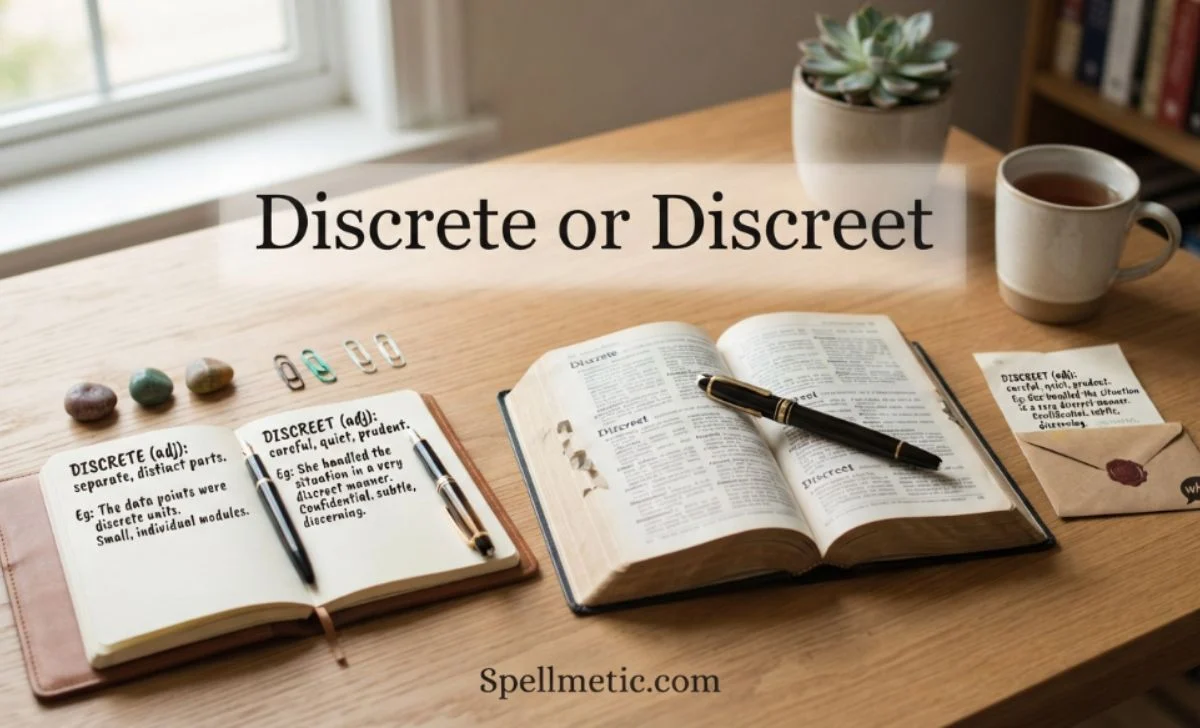
Discrete means separate, distinct, or individually identifiable. Discreet describes someone or something that is careful, tactful, private, or unlikely to attract attention.
For example, a researcher might divide data into discrete categories, while a coworker might ask for a discreet conversation about a sensitive matter.
The spelling difference is small, but the meaning changes completely. Once you connect discrete with separation and discreet with privacy or careful behavior, choosing the right word becomes much easier.
Discrete or Discreet: Quick Answer
Both discrete and discreet are correct English words, but they are used in different situations.
| Word | Meaning | Typical Use | Example |
|---|---|---|---|
| Discrete | Separate, distinct, or individual | Things, data, categories, systems | The survey uses five discrete categories. |
| Discreet | Careful, tactful, private, or unobtrusive | People, behavior, actions, situations | She made a discreet inquiry. |
A simple rule can help:
Separate = discrete
Careful or private = discreet
So, if you mean that something exists as a separate unit, choose discrete. If you mean that someone is being careful not to attract attention or reveal sensitive information, choose discreet.
What Does “Discrete” Mean?
Discrete is an adjective meaning separate, distinct, or individually distinguishable.
It is often used when things can be identified as separate units rather than forming one continuous whole.
Discrete in Everyday English
You might use discrete when talking about separate parts, groups, sections, or items.
- The report is divided into three discrete sections.
- The machine has several discrete components.
- Each department operates as a discrete unit.
- The program treats the two problems as discrete issues.
Here, the word has nothing to do with secrecy or being quiet. It simply means separate or distinct.
Discrete in Mathematics and Statistics
The word has an important technical meaning in mathematics, statistics, and data analysis.
A discrete variable has separate, countable values. For example, the number of employees in a company can be 50, 51, or 52, but not 51.6 employees.
By contrast, measurements such as height or temperature are generally treated as continuous variables because they can take values across a range.
This is why you may see terms such as:
- discrete data
- discrete variable
- discrete values
- discrete categories
- discrete mathematics
- discrete probability
The technical meaning still follows the central idea: separate, identifiable values or units.
Discrete in Technology
Discrete also appears frequently in technology.
For example, a discrete graphics card has its own dedicated hardware rather than relying on graphics processing integrated into the main processor.
You may also encounter phrases such as discrete components, discrete systems, and discrete signals in technical writing.
What Does “Discreet” Mean?
Discreet means careful in speech or behavior, especially when avoiding embarrassment, unwanted attention, or the disclosure of private information.
It can describe a person, action, conversation, request, location, or design.
Consider this sentence:
The manager asked for a discreet conversation.
The manager does not mean a conversation that is physically separate. The meaning is that the conversation should be handled privately and carefully.
Discreet When Describing a Person
A discreet person knows how to handle sensitive situations without unnecessarily revealing information or attracting attention.
For example:
Maria is discreet and never discusses confidential workplace matters with other employees.
Here, discreet describes Maria’s judgment and behavior.
Discreet When Describing an Action
The word can also describe something done quietly or unobtrusively.
- He discreetly checked his phone during the meeting.
- The receptionist made a discreet inquiry.
- She discreetly left the room.
- The photographer took a discreet position near the entrance.
The focus is on avoiding attention or handling something tactfully.
Discreet When Describing Things
Although discreet often describes behavior, it can also describe things designed to avoid attention.
For example:
The hotel offers discreet service for high-profile guests.
Or:
The product comes in discreet packaging.
In discreet packaging, the packaging is designed not to reveal or draw attention to what is inside.
Discrete vs. Discreet Examples
The easiest way to understand the difference is to compare the words in real situations.
Example 1: Separate Sections
The book is divided into six discrete chapters.
Each chapter is treated as a separate unit, so discrete is correct.
Example 2: Private Conversation
We need to have a discreet conversation about the complaint.
The conversation should be private and handled carefully, so discreet is correct.
Example 3: Data
The survey results were grouped into four discrete categories.
The categories are separate from one another.
Example 4: Sensitive Information
Please be discreet when discussing the client’s financial situation.
The instruction is about privacy and tact.
Example 5: Technology
The laptop includes a discrete graphics processor.
The graphics hardware is separate from the integrated processing system.
Example 6: Quiet Action
She discreetly placed the documents inside her folder.
The action was performed without drawing attention.
Example 7: Individual Components
The engineer tested each discrete component separately.
Each component is treated as an individual unit.
Example 8: Personal Matter
He asked his colleague to handle the matter discreetly.
The request concerns confidentiality and careful behavior.
Common Phrases With “Discrete”
You are likely to encounter discrete in academic, technical, business, and scientific writing.
Common combinations include:
- discrete data
- discrete variable
- discrete values
- discrete categories
- discrete units
- discrete components
- discrete systems
- discrete events
- discrete elements
- discrete mathematics
- discrete graphics
- discrete sections
For example:
The software processes each data point as a discrete value.
The data points are being treated as individual values.
Common Phrases With “Discreet”
Discreet is more closely associated with privacy, tact, restraint, and avoiding unnecessary attention.
Common combinations include:
- discreet person
- discreet conversation
- discreet inquiry
- discreet behavior
- discreet manner
- discreet service
- discreet location
- discreet packaging
- discreet request
- discreet appearance
For example:
The company provides discreet support for customers dealing with sensitive issues.
The service is intended to protect privacy and avoid unwanted attention.
Discrete vs. Continuous: An Important Distinction
If you study statistics or mathematics, you will often encounter discrete alongside continuous.
Discrete values are separate or countable.
Continuous values can vary across a range.
For example:
- Number of children in a family → discrete
- Number of books on a shelf → discrete
- Height of a person → continuous
- Temperature → continuous
You cannot normally have 2.5 children in a count of people, so the possible values are separate. Height, however, can be measured at increasingly precise levels.
This is why discrete variable is a standard technical term.
Are “Discrete” and “Discreet” Pronounced the Same?
Yes. Discrete and discreet are pronounced the same way in standard English: approximately /dɪˈskriːt/.
They are therefore often described as homophones: words that sound alike but have different spellings and meanings.
This explains why the confusion is so common. If you hear someone say the word, pronunciation alone will not tell you which spelling they mean. You need to understand the context.
Discreetly vs. Discretely
The same distinction appears in their adverb forms.
Discreetly means carefully, privately, or without attracting attention.
The assistant discreetly reminded him about the appointment.
Discretely means separately or individually.
The system stores the values discretely rather than as one continuous measurement.
A useful shortcut is:
discreetly = carefully/private
discretely = separately
Discrete vs. Discreet: Common Mistakes
Because the words sound identical, writers sometimes choose the spelling based on sound alone. That can produce sentences such as:
The employee handled the complaint discrete.
The intended meaning is careful and private, so the correct word is:
The employee handled the complaint discreetly.
Another common mistake is using discreet when referring to separate categories:
The survey contains five discreet categories.
If the categories are separate or distinct, the correct sentence is:
The survey contains five discrete categories.
The key is to look at the meaning rather than the pronunciation.
How to Remember the Difference
Here are two simple memory tricks.
Discrete = Separate
Think of the T in discrete as separating the two E’s.
discrE-T-E
The word is associated with things that are separate.
Discreet = Private
Think of discreet as being connected with keeping something quiet, private, or out of public attention.
So ask yourself:
Do I mean separate or private/careful?
If the answer is separate, use discrete.
If the answer is private, tactful, careful, or unobtrusive, use discreet.
Discrete and Discreet Word Forms
Knowing the related forms can prevent further confusion.
| Word | Related form | Meaning |
|---|---|---|
| discrete | discretely | separately or individually |
| discrete | discreteness | the quality of being separate |
| discreet | discreetly | carefully or unobtrusively |
| discreet | discreetness | the quality of being discreet |
| discretion | noun | careful judgment, especially about privacy |
| indiscreet | adjective | lacking discretion |
Notice the connection between discreet and discretion.
For example:
Good judgment requires discretion when dealing with confidential information.
The related adjective is discreet:
A discreet employee knows when not to share private information.
Where Did “Discrete” and “Discreet” Come From?
The similarity between the two spellings is not accidental. They share a historical connection with the Latin word discretus, associated with distinguishing or separating.
Over time, English developed different spellings and meanings. Today, discrete generally focuses on separation or distinctness, while discreet focuses on careful conduct, privacy, and avoiding unwanted attention.
The shared history helps explain why the words look and sound so similar even though their modern uses are different.
Which Word Should You Use?
Use discrete when you are talking about:
- separate things
- distinct categories
- individual units
- countable values
- data
- mathematical concepts
- technical components
- independent elements
Use discreet when you are talking about:
- privacy
- tact
- careful behavior
- confidential matters
- avoiding attention
- unobtrusive actions
- sensitive conversations
A quick test works in most situations:
Can you replace the word with “separate” or “distinct”?
Use discrete.
Can you replace it with “careful,” “private,” “tactful,” or “unobtrusive”?
Use discreet.
FAQs
1. What is the difference between discrete and discreet?
Discrete means separate or distinct, while discreet means careful, tactful, private, or unobtrusive.
2. Is discrete or discreet correct?
Both are correct. They are different words with different meanings, so the correct choice depends on the context.
3. Are discrete and discreet homophones?
Yes. They have the same standard pronunciation but different spellings and meanings.
4. How can I remember discrete vs. discreet?
Associate discrete with separate and discreet with private or careful. The T in “discrete” can also remind you of separation.
5. What does discrete mean in mathematics?
In mathematics and statistics, discrete generally refers to separate or countable values, such as the number of students in a classroom.
6. What does discreet mean when describing a person?
A discreet person behaves carefully and avoids revealing private information or attracting unnecessary attention.
7. Is it discreet or discrete information?
It depends on the intended meaning. Discrete information means information divided into separate units or categories. If you mean information that should be kept private, confidential information or a phrase involving discreet handling is usually clearer.
8. Is it discreet or discrete packaging?
Discreet packaging means packaging designed to avoid revealing its contents or attracting attention.
9. What is the difference between discreetly and discretely?
Discreetly means privately, carefully, or unobtrusively. Discretely means separately or individually.
10. What is the difference between discrete and continuous?
Discrete refers to separate or countable values, while continuous refers to values that can vary across a continuous range.
Conclusion
The difference between discrete and discreet comes down to meaning, not pronunciation.
Discrete means separate, distinct, or individually identifiable. You will often see it in phrases such as discrete data, discrete categories, discrete variables, and discrete components.
Discreet means careful, tactful, private, or unobtrusive. It commonly appears in phrases such as discreet conversation, discreet behavior, discreet service, and discreet packaging.
If you are unsure, use the simplest test: separate = discrete; private or careful = discreet. Once that distinction becomes familiar, the spelling choice becomes much easier—even when the two words sound exactly alike.