Have you ever written “on the premise” when you meant a physical location? Or wondered whether premises is simply the plural of premise?
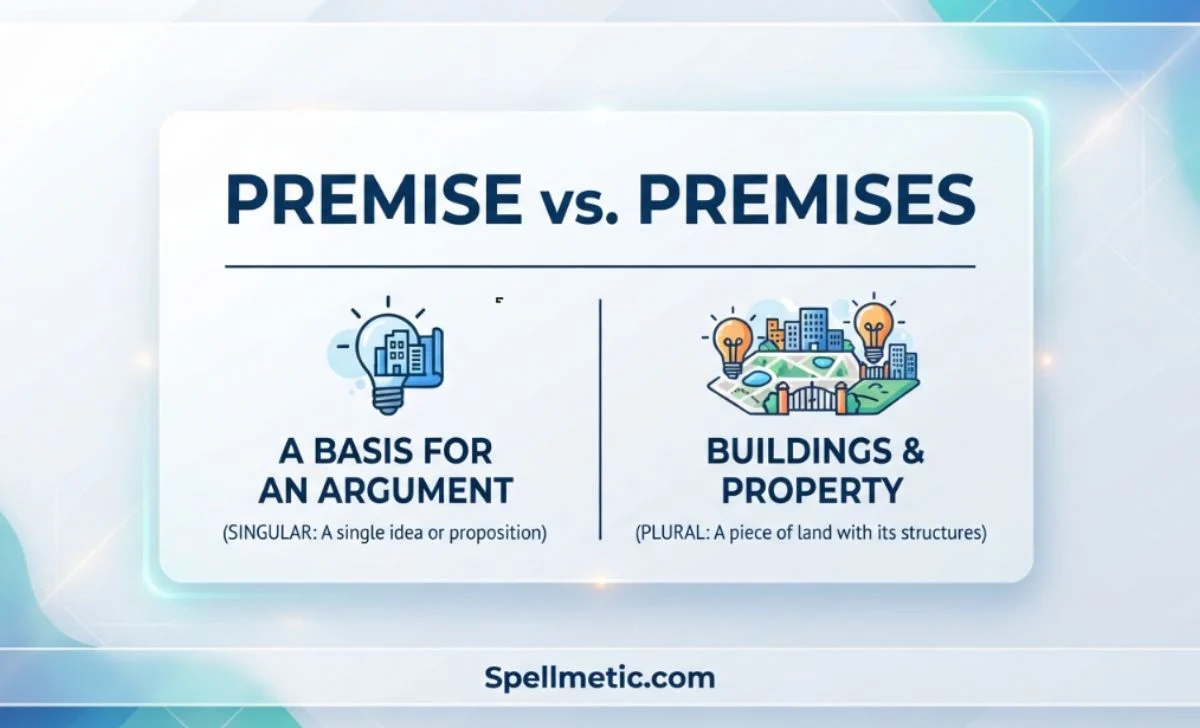
Both forms are correct, but they do not always mean the same thing. Premise usually refers to an idea, assumption, statement, or the basis of an argument. Premises can be its plural, but it can also mean a building, property, or place.
For example, you might discuss the premise of an argument, but a security guard may ask visitors to leave the premises.
Understanding this small difference can prevent awkward mistakes in essays, business writing, and everyday English.
This guide explains the meaning, grammar, pronunciation, logic, location usage, common phrases, synonyms, and real-life examples of premise and premises.
Premise or Premises: Quick Answer
The easiest way to understand the difference is to look at the context.
| Word | Meaning | Example |
|---|---|---|
| premise | An idea, assumption, or statement supporting an argument | The argument is based on a false premise. |
| premises | More than one premise | The argument has two premises. |
| premises | A building, property, or location | Smoking is not allowed on the premises. |
So, premise can be singular, while premises can be its plural. However, premises also has a separate meaning related to property or a physical location.
What Does Premise Mean?
Premise is a noun with several related meanings. The most common ones involve an idea, assumption, or starting point used to reach a conclusion.
Premise as an Assumption
A premise can be an idea that someone accepts as true when developing an argument or making a decision.
For example:
The plan was based on the premise that customers wanted faster delivery.
Here, the premise is the assumption about what customers want.
Premise in Logic
In logic, a premise is a statement used to support a conclusion.
For example:
All plants need water.
This rose is a plant.
Therefore, this rose needs water.
The first two statements are premises, and the final statement is the conclusion.
Premise of a Story or Movie
A premise can also mean the basic idea behind a story, movie, book, or television show.
For example:
The premise of the movie is simple: a scientist travels back in time to prevent a disaster.
In this sense, premise is close to basic idea, concept, or central idea.
Premise as a Verb
Premise can also be used as a verb, especially in formal writing.
The expression premised on means “based on.”
For example:
The policy is premised on equal access to education.
You may also see premised upon, although premised on is often the more natural choice.
What Does Premises Mean?
Premises has two important uses.
First, it can be the plural of premise when you are talking about more than one idea or statement in an argument.
Second, premises can refer to a property, building, or area of land and its buildings.
Premises as the Plural of Premise
If one statement is a premise, two or more statements are premises.
For example:
The argument has one strong premise.
But:
The argument has two strong premises.
This is normal plural grammar.
Premises as a Property or Location
When premises means a physical place, it can refer to a business, office, building, shop, house, or property.
For example:
Employees must wear identification badges on the premises.
Here, premises does not mean multiple assumptions. It means the physical property or location.
This is why you often see phrases such as business premises, commercial premises, and residential premises.
Premise vs. Premises: Key Difference
The simplest rule is:
Premise = an idea or statement.
Premises = multiple ideas or statements, OR a physical property/location.
Compare these examples:
- The argument has a weak premise.
- The argument has several premises.
- The company moved to larger premises.
- Visitors must remain on the premises.
The surrounding words tell you which meaning is intended.
Is Premises the Plural of Premise?
Yes. Premises is the regular plural form of premise when you mean more than one idea or statement.
For example:
The first premise is reasonable.
becomes:
The first two premises are reasonable.
However, premises also developed a separate noun use for a property or building. That is why the word can look plural even when it refers to one physical location.
For example:
The business operates from these premises.
The word premises refers to the entire property or place, not necessarily several separate buildings.
Premise or Premises for Location?
When you mean a physical location, property, or building, use premises.
For example:
- The company is moving to new premises.
- Visitors must leave the premises before 9 p.m.
- Security cameras cover the entire premises.
- Food is not permitted on the premises.
Using premise for this meaning is usually incorrect.
Business Premises
Business premises means the physical place where a business operates.
The restaurant has moved to larger business premises.
Commercial Premises
Commercial premises refers to property used for business or commercial activities.
The company is looking for suitable commercial premises.
Residential Premises
Residential premises refers to property used as a home.
Tenants must keep the residential premises clean.
Premises Address
In property or business contexts, a premises address is the address of the property where an organization or activity is located.
What Does Premises Name Mean?
The phrase “premises name” can refer to the name used to identify a property, building, business location, or other premises. Its exact meaning depends on the context in which it appears.
For example:
- Premises name: The name of a building or business location.
- Premises address: The physical address of the property.
- Business premises: The property where a business operates.
If a form asks for a premises name, it may be requesting the name of the building, business, or property associated with the address.
The word premises itself refers to a property, building, or location. It can also mean the plural of premise when discussing logical statements.
“On the Premise That” vs. “On the Premises”
This is one of the most common points of confusion.
On the Premise That
On the premise that means based on the assumption that.
We accepted the proposal on the premise that costs would remain stable.
The phrase is about an idea or assumption, not a physical place.
On the Premises
On the premises means at or within a particular property or location.
Employees are not allowed to smoke on the premises.
The phrase refers to a physical place.
Compare Them
The project was approved on the premise that funding would continue.
Here, premise means an assumption.
Visitors must remain on the premises.
Here, premises means the property.
That one extra s completely changes the meaning.
Premise in Logic: Major Premise, Minor Premise, and Conclusion
In traditional logic, an argument can contain a major premise, a minor premise, and a conclusion.
Consider this simple example:
All birds have feathers.
A robin is a bird.
Therefore, a robin has feathers.
The first statement is the major premise.
The second is the minor premise.
The final statement is the conclusion.
Together, the premises provide the reasoning used to reach the conclusion.
This is why you may see terms such as logical premise, argument, inference, reasoning, and conclusion when reading about premise in logic.
Premise in an Argument
A premise gives a reason for accepting a conclusion.
For example:
The roads are wet because it rained last night.
If this appears as part of a larger argument, information about the rain may serve as a premise supporting a conclusion about the roads.
A strong argument depends on relevant premises and sound reasoning. A conclusion does not automatically become true simply because an argument contains a premise.
Premise in Stories, Movies, and Books
In creative writing, a premise is the central idea on which a story is built.
For example:
The story has an interesting premise: every person wakes up with one year of their future memories.
You can talk about:
- the premise of a movie
- the premise of a novel
- the premise of a story
- the premise of a TV show
- the premise of a fictional world
In this context, premise is close to concept, central idea, or basic setup.
Premises in Business and Property
In business English, premises commonly refers to the physical place where an organization operates.
You may see it in formal contexts such as:
- business premises
- commercial premises
- office premises
- licensed premises
- residential premises
- industrial premises
For example:
The company installed new security equipment throughout its premises.
You may also hear:
Employees must not remove company property from the premises.
Here, the word refers to the organization’s physical site.
Common Phrases With Premise and Premises
On the Premise That
Used when something is based on an assumption.
The decision was made on the premise that demand would increase.
Based on the Premise That
Another formal way to express the same idea.
The proposal is based on the premise that online sales will continue to grow.
Premised On
Means based on an idea or assumption.
The entire strategy is premised on customer trust.
On the Premises
Means at or within a particular property.
Guests must remain on the premises after dark.
Leave the Premises
Means to leave a property or location.
The manager asked the visitors to leave the premises.
Enter the Premises
Means to go into a property or site.
Staff members must show their identification before entering the premises.
Premise or Premises Pronunciation
The two words sound different.
Premise is commonly pronounced like PREM-iss.
Premises, when it means property or multiple premises, is commonly pronounced like PREM-iss-iz.
The extra ending in premises makes it easy to hear that the word has more than one syllable.
If you are learning English, listening to both words in full sentences is more useful than memorizing pronunciation symbols alone.
Premise Synonyms
The best synonym depends on which meaning you have in mind.
Synonyms for Premise as an Idea
Useful alternatives include:
- assumption
- proposition
- supposition
- basis
- principle
- hypothesis
- concept
- starting point
For example:
The argument is based on an assumption.
can sometimes replace:
The argument is based on a premise.
However, these words are not identical in every context.
Synonyms for Premises as Property
Depending on the sentence, alternatives can include:
- property
- building
- site
- location
- grounds
- estate
- facility
For example:
The company has new premises.
could become:
The company has a new facility.
The best replacement depends on what exactly you mean by premises.
Common Mistakes With Premise and Premises
Mistake 1: Using Premise for a Location
Incorrect:
The store is located on the premise.
Better:
The store is located on the premises.
Mistake 2: Using Premises for One Logical Idea
Incorrect:
The main premises of his argument is weak.
Better:
The main premise of his argument is weak.
If there is only one idea or statement, use premise.
Mistake 3: Confusing “On the Premise That” With “On the Premises”
Incorrect for a location:
Customers cannot smoke on the premise.
Correct:
Customers cannot smoke on the premises.
But:
The decision was made on the premise that sales would increase.
Mistake 4: Assuming Premises Always Means Property
Not always. Premises can simply be the plural of premise.
The two premises support the conclusion.
Here, it means two logical statements.
Mistake 5: Treating Premises as a Simple Spelling Variation
Premise and premises are related, but context matters. One extra letter can signal a different grammatical form and, in many sentences, a completely different meaning.
Premise or Premises Examples
| Context | Correct Word | Example |
|---|---|---|
| One logical idea | premise | The premise is difficult to prove. |
| Several logical ideas | premises | The argument has three premises. |
| Business location | premises | The company moved to new premises. |
| Physical property | premises | Security guards protect the premises. |
| Story concept | premise | The movie has an unusual premise. |
| Assumption | premise | The plan rests on a simple premise. |
| Location phrase | premises | Visitors must remain on the premises. |
| Assumption phrase | premise | The plan was based on the premise that demand would rise. |
Premise or Premises: British vs. American English
The basic distinction is the same in British and American English.
Premise can refer to an idea, assumption, logical statement, or story concept.
Premises can be the plural of premise or refer to a property or location.
The word premises is especially common in formal business, legal, and property contexts, such as business premises and licensed premises.
There is no need to change the spelling simply because you are writing for a British or American audience.
How to Remember the Difference
Use this simple memory trick:
Premise = idea.
Premises = ideas or place.
Think:
Premise → one idea
Premises → multiple ideas
Premises → property
So if you are talking about a shop, office, school, house, or business location, premises is normally the word you need.
If you are talking about an argument, assumption, movie, or story idea, premise is usually correct when there is one central idea.
FAQs
1. What is the difference between premise and premises?
Premise usually means an idea, assumption, or statement supporting an argument. Premises can be its plural or can mean a building, property, or physical location.
2. Is premises the plural of premise?
Yes. Premises is the plural of premise when you are talking about more than one logical statement or idea.
3. Which is correct for a location, premise or premises?
Use premises for a physical location, building, or property.
The company operates from new premises.
4. What does premise mean in logic?
A premise is a statement that provides support for a conclusion in an argument. An argument may contain one or more premises.
5. What does premises mean in real estate?
In property contexts, premises refers to a building, land, or property and its associated area.
6. Is “on the premise” correct?
It can be correct when followed by an idea or assumption, as in “on the premise that prices will fall.” For a physical location, use “on the premises.”
7. Is “on the premises” correct?
Yes. On the premises means at or within a particular property or location.
8. What is the plural of premise?
The plural is premises.
9. What is a synonym for premise?
Depending on the context, synonyms include assumption, proposition, basis, supposition, hypothesis, and concept.
10. What is a synonym for premises?
When premises means property, possible alternatives include property, building, site, location, grounds, and facility.
11. How do you pronounce premise and premises?
Premise is commonly pronounced PREM-iss, while premises is commonly pronounced PREM-iss-iz.
12. Can premise refer to a movie or story?
Yes. A premise can be the central idea or basic setup of a movie, novel, story, or television show.
13. What does “premised on” mean?
Premised on means based on an assumption or idea.
The policy is premised on equal access.
14. What are the major and minor premises?
In a traditional logical argument, the major premise is a general statement, while the minor premise applies that general idea to a specific case. Together, they support a conclusion.
15. Is premises singular or plural when it means property?
Premises has a plural form and normally takes plural grammar when it means a property or location.
The premises are secure.
Conclusion
The difference between premise and premises becomes much easier once you focus on meaning rather than spelling.
Use premise for one idea, assumption, logical statement, or story concept. Use premises for more than one logical premise or for a physical property or location.
That is why we say “the premise of an argument” but “the company’s premises.”Remember the simple rule: premise = idea; premises = ideas or place.
Once you learn phrases such as “on the premise that” and “on the premises,” the distinction becomes much clearer in essays, business English, academic writing, and everyday communication.