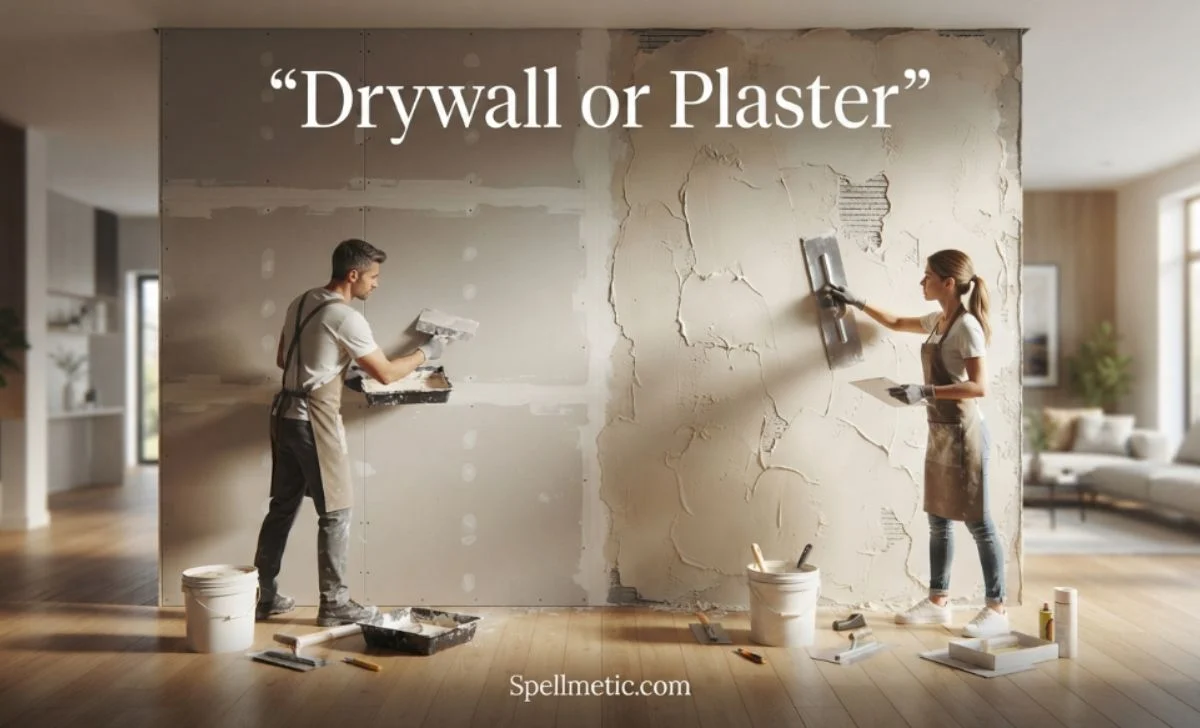
When choosing between drywall or plaster, the answer is not simply that one material is better than the other.
Both can create attractive, durable interior walls and ceilings, but they are built differently and suit different situations.
Drywall is the standard choice for much of modern residential construction because panels can be installed quickly, finished efficiently, and repaired without highly specialized plastering skills.
Plaster, meanwhile, remains valuable for its hard surface, traditional appearance, decorative possibilities, and role in historic homes.
The difference becomes especially important when renovating an older property. A wall that looks like ordinary drywall may actually be traditional plaster over wood lath.
Removing it unnecessarily can mean losing original building fabric that could have been repaired.
This guide explains drywall vs plaster, how to tell which one you have, how their costs and repairs compare, when plaster makes more sense, and when drywall is the practical choice.
Drywall or Plaster: Quick Answer
For most new construction, budget renovations, and projects where speed and easy repairs matter, drywall is usually the more practical choice.
Plaster can be the better option when you want a harder, traditional finish, custom decorative work, curved surfaces, or when an existing historic plaster system is still in good condition.
The right choice depends on the complete wall system, not just the surface material. Framing, insulation, fasteners, board type, plaster system, and workmanship all affect the final performance.
Choose drywall if you want:
- Faster installation
- Generally lower labor requirements
- Easier patching and repairs
- A practical solution for new construction
- Specialized boards for moisture, impact, sound, or fire requirements
- A system that is widely available
Choose plaster if you want:
- A traditional or premium wall finish
- A dense, hard surface
- Decorative moldings or unusual shapes
- A finish suited to historic interiors
- To preserve existing sound plaster rather than remove it
What Is Drywall?
Drywall, also called gypsum board, wallboard, or plasterboard in many countries, is a factory-made panel with a gypsum core and facing material.
The panels are attached to wood or metal studs and then finished at the joints. A typical installation involves hanging the panels, applying drywall tape and joint compound, sanding or finishing the joints, and preparing the surface for paint or another decoration.
Sheetrock is a brand name commonly used in the United States for gypsum drywall, rather than a completely different material.
Modern drywall systems are available in different formulations for specific requirements. Depending on the system, boards can be designed for improved fire, moisture, impact, or sound performance.
That is important because saying “drywall is weak” or “drywall is poor for soundproofing” is too broad. The performance of a wall depends on the entire assembly.
What Is Plaster?
Plaster is a wet-applied wall and ceiling finish. Traditional plaster was commonly applied over wood lath, although plaster can also be installed over metal lath, masonry, gypsum bases, and other approved substrates.
In a traditional three-coat system, plaster is built up in layers rather than simply attaching finished panels to studs. Wood lath provides a base that allows wet plaster to form mechanical “keys” through the gaps and hold to the wall.
There is also more than one type of plaster. Modern construction can involve gypsum plaster, lime plaster, veneer plaster, and other plaster systems. USG, for example, lists conventional gypsum plaster systems designed for different applications and levels of abuse.
So, plaster vs drywall is not always a comparison between two single products. The exact plaster system and drywall assembly matter.
Drywall vs Plaster: Key Differences
| Feature | Drywall | Plaster |
|---|---|---|
| Installation | Generally faster | More labor-intensive |
| Labor | Widely available installers | Requires skilled plastering |
| Repairs | Usually easier | Can require specialist matching |
| Surface | Smooth, consistent finish | Dense, hand-finished appearance |
| Durability | Good, depending on board/system | Often very hard and impact-resistant |
| Decorative work | Possible with additional materials | Excellent for shaped and ornamental work |
| Sound control | Depends heavily on wall assembly | Dense plaster can reduce sound transmission |
| Fire performance | Specialized systems available | Plaster can provide strong fire performance |
| Cost | Often more economical | Often higher labor cost |
| Historic homes | Usually a replacement material | Often original and worth preserving |
| DIY work | More accessible | More difficult |
| Speed | Major advantage | Major disadvantage |
USG’s technical guidance describes conventional plaster as a high-performance, monolithic and abuse-resistant finish, while drywall systems became attractive largely because of their speed and cost advantages.
How to Tell If Your Walls Are Drywall or Plaster
This is one of the most useful questions to answer before drilling, repairing, or remodeling a wall.
No single quick test is perfect, particularly in houses that have been renovated. However, several clues together can give you a reliable indication.
Check the age of the home
Older houses are more likely to contain traditional plaster. In the United States, plaster was the dominant interior wall finish for decades, while drywall became increasingly important as modern construction methods developed. The National Park Service notes that plaster was the dominant interior finish until around the 1940s.
Home age is a clue, not proof. An older house may have been remodeled with drywall, while a newer renovation may contain preserved plaster.
Tap the wall
Gently knock on the surface.
A drywall wall often sounds relatively hollow because of the cavity behind the panel. Traditional plaster can sound denser and more solid.
However, framing, insulation, masonry, and wall thickness can change the sound, so don’t identify the wall based on this test alone.
Look for seams
Drywall is installed in panels, so seams may sometimes become visible under certain lighting or where joints have moved.
A well-finished drywall surface can hide those seams almost completely, so their absence does not prove that the wall is plaster.
Examine cracks
Traditional plaster can develop characteristic cracks, including hairline and stress cracks. Large cracks or areas where plaster has detached from its lath or substrate require more careful inspection.
The National Park Service specifically recommends evaluating the condition of historic plaster before deciding to replace it because apparently damaged plaster may still be repairable.
Check an unfinished area
An electrical box opening, unfinished closet, attic, basement, or another accessible location can reveal what lies behind the surface.
If you see wood lath with plaster attached to it, you have a traditional plaster system.
If you see a manufactured gypsum panel attached to framing, you have drywall.
Drywall or Plaster Cost: Which Is Cheaper?
In many modern residential projects, drywall is cheaper to install than traditional plaster, particularly when speed and labor are important.
That does not mean plaster is always expensive or drywall is always inexpensive. The final price depends on:
- Wall and ceiling area
- Local labor rates
- Material choice
- Number of coats
- Surface preparation
- Wall height and complexity
- Decorative details
- Repair requirements
- Finish level
- Whether the project is new construction or renovation
Plaster also requires skilled workmanship. The National Park Service describes traditional plastering as a specialized craft that often requires an experienced plasterer and specialized tools.
Is it cheaper to plaster or use drywall?
For a typical modern wall where both systems are installed from scratch, drywall will often be the more economical option.
But if an older home already has sound plaster, tearing it out simply to install drywall can create unnecessary demolition, disposal, framing, trim, and finishing costs.
In other words, replacement cost and installation cost are not the same thing.
Drywall vs Plaster Installation
How drywall is installed
A typical drywall project involves:
- Preparing the framing
- Measuring and cutting panels
- Attaching gypsum boards
- Applying joint tape
- Applying joint compound
- Sanding or finishing the joints
- Priming and painting
Plasterboard systems can also receive a plaster skim coat. In Europe, plasterboard is widely used for partitions and wall linings, and plaster skimming is an established finishing technique.
How plaster is installed
Traditional plastering is more involved. Depending on the system, the installer may work over lath or another suitable base and build the finish through multiple coats.
The material has to be mixed, applied, shaped, and allowed to cure appropriately. This is why plastering is more dependent on craftsmanship.
For a homeowner, the practical difference is simple: drywall is generally faster to install, while plaster requires more specialized skill and time.
Which Is More Durable: Drywall or Plaster?
Plaster generally has an advantage when you are comparing the hardness of the finished surface.
A properly installed conventional plaster system can produce a dense, abuse-resistant surface. Some modern gypsum plaster products are specifically designed for high-abuse environments and provide strong indentation and penetration resistance.
Drywall, however, should not be treated as one uniform product. Specialized boards and complete wall assemblies can significantly improve impact, fire, moisture, and acoustic performance.
For an ordinary family home, the practical question is not simply “Which material lasts longer?” It is whether the selected wall system is appropriate for the room and expected use.
Drywall or Plaster for Repairs
This is where drywall often wins for everyday homeowners.
Drywall repairs
Small holes, nail damage, and localized dents can usually be patched with suitable materials. Larger damaged sections can be cut out and replaced with new drywall.
The biggest challenge is often matching the existing texture and paint rather than replacing the panel itself.
Plaster repairs
Plaster repairs can be more complicated because the damaged area may involve multiple layers, lath, loose keys, or separation from the substrate.
A simple hairline crack may need a relatively small repair, while detached or badly deteriorated plaster can require professional stabilization.
Historic plaster should not automatically be demolished. The National Park Service documents projects where centuries-old plaster was stabilized and repaired rather than replaced.
Soundproofing, Fire Resistance, and Insulation
These subjects are often oversimplified in drywall-versus-plaster articles.
Is plaster better for soundproofing?
Dense plaster can help reduce sound transmission, but the whole wall assembly matters.
Framing, insulation, board layers, air gaps, sealing, and connections can have a major effect on acoustic performance. Modern drywall systems can also be engineered for sound reduction.
Is plaster more fire resistant?
Plaster can provide strong fire performance, but a wall should not be labeled “fireproof” simply because it has plaster.
Fire resistance is determined by the tested and approved wall or ceiling assembly, including the materials, thickness, framing, joints, and installation.
Does drywall provide better insulation?
Drywall itself is not the same thing as wall insulation. Thermal performance comes largely from the complete wall assembly, including insulation, framing, air control, and other layers.
Why Did Drywall Replace Plaster?
Drywall became popular because it solved several practical construction problems.
Traditional wet plaster required multiple stages, skilled labor, and drying time. Manufactured gypsum panels offered a faster way to create walls and ceilings.
USG’s historical account explains that gypsum board development made it possible to install wall panels much faster, while later drywall systems benefited from standardized production and installation.
The result was a major shift toward drywall because speed, labor efficiency, standardization, and cost became increasingly important in modern construction.
That does not mean plaster became obsolete. It simply became less dominant for ordinary wall construction.
Why Do Some Homes Still Use Plaster?
Plaster remains relevant because it offers qualities that homeowners and designers still value.
It can create a hard, smooth or textured surface, accommodate curves and decorative work, and preserve the character of older buildings.
For historic properties, the decision is even more important. The National Park Service recommends preserving and repairing historic plaster where possible because the material can contribute to the architectural character and history of a building.
A real-life example is the National Park Service’s preservation work at historic properties where original plaster more than 170 years old was repaired and stabilized rather than simply replaced.
What Do Europeans Use Instead of Drywall?
This question is based on a misconception.
Europeans do not use one universal material instead of drywall. Plasterboard is widely used across Europe, along with gypsum plaster, plaster finishes, masonry, and other interior wall systems.
Eurogypsum reports that plasterboard is used for partitions and wall and ceiling linings across European construction, while gypsum-based plaster is also widely used.
In the UK and Ireland, plaster skimming over plasterboard is a familiar finishing method. That means a wall can technically involve both a drywall-like board and a wet plaster finish.
So “Europe uses plaster instead of drywall” is not an accurate generalization.
Why Do Americans Not Plaster Walls?
Americans certainly still use plaster, but drywall became the more practical choice for much mainstream residential construction.
The reasons include faster installation, standardized gypsum panels, easier repairs, widespread contractor familiarity, and lower labor requirements.
This is less about Americans disliking plaster and more about how construction methods evolved.
Can You Put Plaster on Regular Drywall?
Yes, depending on the plaster system and the manufacturer’s requirements.
Veneer plaster systems are specifically designed to create a plaster finish over appropriate gypsum bases. Some plasterboard products are manufactured to receive plaster or a ready-mixed finish.
However, you should not assume that any plaster product can simply be spread over any drywall surface. The substrate, preparation, primer or bonding requirements, board type, and plaster system must be compatible.
Can You Put Drywall Over Plaster?
It can be done, but whether it is a good idea depends on the condition of the existing wall.
Drywall over plaster may make sense when the existing surface is badly deteriorated or when a renovation requires a new wall system. But it can also:
- Reduce room dimensions slightly
- Affect door and window trim
- Change electrical box depth
- Create additional weight
- Hide problems instead of solving them
- Add unnecessary layers if the plaster is still sound
If historic plaster is stable, repair may be preferable to covering or removing it.
Can a House Have Both Drywall and Plaster?
Absolutely.
A house can contain both materials because of additions, remodeling, partial repairs, room conversions, or previous owners replacing damaged sections.
For example, an older home might have original plaster in the living room but drywall in a remodeled kitchen. A repaired wall may also contain drywall beside older plaster.
This is why how to tell if it’s drywall or plaster should be treated as an identification problem rather than something determined solely by the home’s age.
Drywall or Plaster for Different Situations
| Situation | Usually the better choice | Why |
|---|---|---|
| New construction | Drywall | Faster and practical |
| Budget renovation | Drywall | Usually lower installation cost |
| Quick remodeling | Drywall | Faster finishing |
| Easy future repairs | Drywall | Simpler patching |
| Historic home with sound plaster | Preserve plaster | Protects original character |
| Decorative curves | Plaster | Excellent for shaped finishes |
| Premium traditional finish | Plaster | Dense, hand-finished appearance |
| Existing damaged plaster | Depends | Assess repair before replacement |
| High-abuse area | Depends | Specify the correct complete system |
| Sound-control priority | Depends | Wall assembly is critical |
| DIY project | Drywall | More accessible to beginners |
Pros and Cons of Drywall
Advantages of drywall
- Fast installation
- Generally economical
- Easy to find
- Easier repairs
- Suitable for new construction
- Available in specialized performance boards
- Works with wood and metal framing
- Can be painted, textured, or wallpapered
Disadvantages of drywall
- Standard panels can dent or damage under impact
- Joint finishing requires care
- Moisture requires the correct board and system
- Poor installation can leave visible joints
- Some high-performance assemblies can cost more than basic drywall
Pros and Cons of Plaster
Advantages of plaster
- Hard, dense surface
- Traditional appearance
- Strong decorative potential
- Suitable for curved and irregular surfaces
- Can provide excellent durability
- Valuable in historic interiors
- Can contribute to sound and fire performance as part of an appropriate assembly
Disadvantages of plaster
- Usually more labor-intensive
- Skilled plasterers can be harder to find
- Repairs can be more specialized
- Installation takes longer
- Some plaster systems cost more
- Matching an old finish can require craftsmanship
Drywall or Plaster: Which Should You Choose?
For a typical new residential wall, drywall is usually the sensible choice. It offers a good balance of cost, speed, availability, and repairability.
For an older home with sound original plaster, the better decision may be to keep and repair what is already there rather than automatically replacing it.
If your priority is a traditional appearance, hard finish, decorative work, or historic authenticity, plaster deserves serious consideration.
The most useful rule is:
Choose drywall for practicality. Choose plaster when the specific performance, appearance, craftsmanship, or historic value justifies it.
And before replacing an existing wall, identify what you already have. A homeowner who assumes an old wall is drywall could remove a repairable plaster system unnecessarily.
FAQs
1. Is it better to plaster or drywall?
Neither is universally better. Drywall is usually better for speed, cost, and easy repairs, while plaster can be better for traditional finishes, durability, decorative work, and historic preservation.
2. How can you tell if a wall is drywall or plaster?
Look at several clues together: home age, wall sound when tapped, visible seams, surface condition, thickness, and an accessible opening. Wood lath behind the surface is a strong sign of traditional plaster.
3. Why do people use plaster instead of drywall?
People choose plaster for its hard surface, traditional appearance, decorative possibilities, custom shapes, and historic character. Some plaster systems are also valued for durability and acoustic performance.
4. Why are plaster walls no longer commonly used?
Drywall became more common because factory-made panels made wall construction faster, more standardized, and generally less labor-intensive. Plaster remains in use, especially for restoration and specialized finishes.
5. What are the downsides of plaster walls?
The main disadvantages are higher labor requirements, slower installation, greater dependence on skilled workmanship, and potentially more complicated repairs.
6. What do Europeans use instead of drywall?
There is no single European substitute. Plasterboard is widely used across Europe, along with gypsum plaster and other wall systems. In some regions, plaster skimming over plasterboard is common.
7. Why do Americans not plaster walls?
Americans do use plaster, but drywall became dominant in mainstream construction because it is faster to install, widely available, and generally easier to repair and finish.
8. Is it cheaper to plaster or use drywall?
Drywall is generally cheaper for many new wall installations because it requires less specialized labor and can be installed quickly. Local labor rates, finish quality, project size, and existing wall conditions can change the calculation.
9. Can you put plaster on regular drywall?
Yes, with a compatible plaster or veneer plaster system and the correct substrate preparation. Always follow the requirements of the specific plaster and board system rather than applying an incompatible material directly.
10. What are the main differences between plaster and drywall?
Drywall is a manufactured gypsum panel attached to framing and finished at its joints. Plaster is a wet-applied finish built over a suitable base. Drywall generally offers speed and easier repairs, while plaster offers a dense, traditional finish and strong decorative potential.
Conclusion
The choice between drywall or plaster depends less on which material is “best” in general and more on what your particular wall, house, budget, and project require.
Drywall has become the standard practical solution for many modern homes because it is fast, versatile, widely available, and relatively straightforward to repair.
Specialized drywall systems can also be designed for specific fire, moisture, impact, and acoustic requirements.
Plaster remains a valuable building finish. Its dense surface, craftsmanship, decorative flexibility, and historic importance make it especially relevant in older homes and higher-end restoration work.
The National Park Service’s preservation guidance makes an important point: historic plaster can often be repaired rather than automatically removed.
So if you’re building a new wall, drywall will often be the practical winner. If you’re renovating an older property with original plaster, stop before tearing it out.
First determine its condition and whether repair can preserve something that is difficult to reproduce.
Read More…