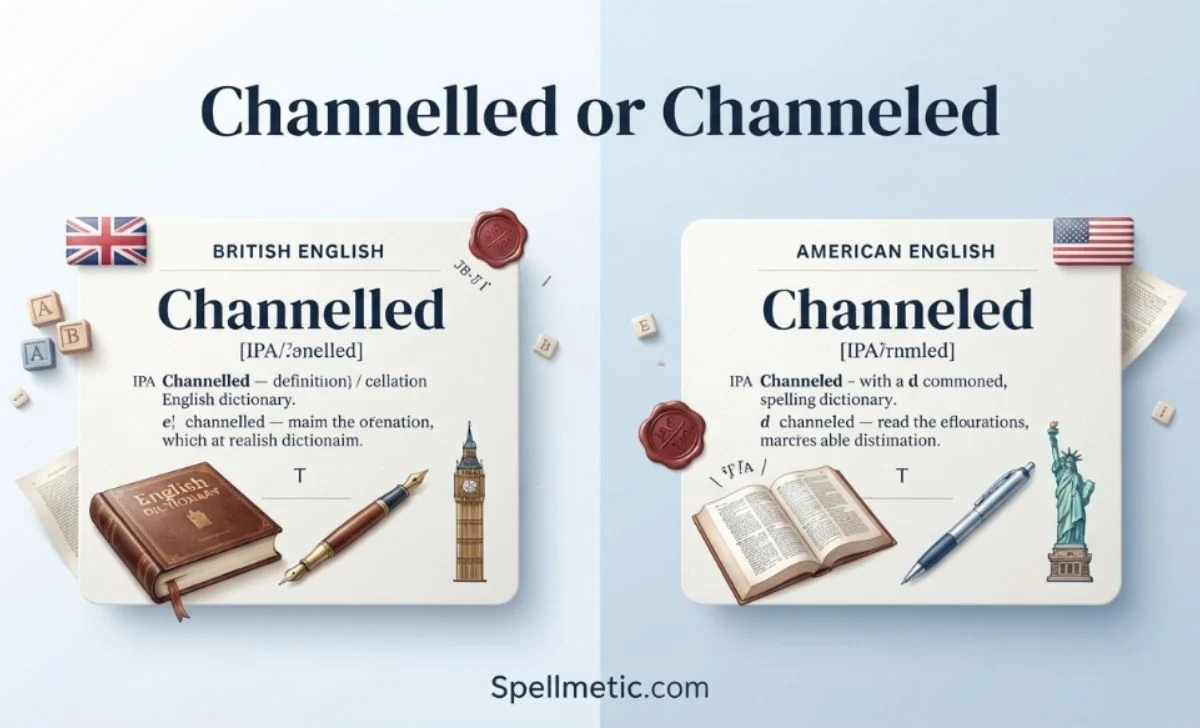
If you have ever wondered whether channelled or channeled is the correct spelling, the short answer is: both are correct. The difference is mainly based on the variety of English you are using.
Channelled is the spelling traditionally preferred in British English, while channeled is the standard American English spelling.
They are forms of the verb channel, and they carry the same basic meaning: to direct, guide, transfer, or focus something toward a particular person, place, or purpose.
The difference also appears in the -ing form: British English uses channelling, while American English usually uses channeling.
This guide explains the meaning, spelling difference, grammar, common expressions such as channelled through and channelled into, useful synonyms, real-life examples, and the best spelling to choose in different situations.
Quick Answer
Channelled and channeled are both correct spellings.
| Spelling | Main usage | Example |
|---|---|---|
| channelled | British English | She channelled her energy into training. |
| channeled | American English | She channeled her energy into training. |
The meaning does not change. The main difference is the spelling convention used in British and American English.
Cambridge Dictionary and Merriam-Webster both recognize the relevant forms of channel, supporting the distinction between the regional spellings.
The simple rule
- UK English: channelled
- US English: channeled
- UK English: channelling
- US English: channeling
So, if you are writing for an American audience, channeled is normally the better choice. If your publication follows British English, use channelled.
What Does Channelled or Channeled Mean?
Channelled or channeled means directed, guided, transferred, or focused toward a particular destination, purpose, or outlet.
The exact meaning depends on the context.
For example:
The company channelled more money into research.
Here, channelled means directed or allocated.
Another example is:
She channelled her frustration into painting.
In this sentence, the word means that she used or redirected her emotional energy toward a productive activity.
The verb can also describe something being passed through a particular route or system:
The funds were channelled through a central organization.
In this case, the money was directed or transferred through that organization.
Common meanings of channelled or channeled
The word can describe:
- directing money or resources
- focusing energy or attention
- expressing emotions through an activity
- transferring information
- guiding something through a route or system
- directing efforts toward a goal
- conveying something through an intermediary
Because the word has several related senses, the best synonym depends on the sentence.
Channelled vs Channeled: British and American Spelling
The difference comes from the spelling conventions used in different varieties of English.
British English commonly doubles the final l before certain endings, while American English often keeps a single l in these forms.
| Word form | British English | American English |
|---|---|---|
| Base verb | channel | channel |
| Past tense | channelled | channeled |
| Past participle | channelled | channeled |
| Present participle | channelling | channeling |
The pronunciation and basic meaning remain the same.
For example:
British English:
The artist channelled her emotions into the new collection.
American English:
The artist channeled her emotions into the new collection.
There is no difference in meaning between these two sentences.
Why does British English use “ll”?
The extra l follows a broader British spelling pattern found in words such as:
- travelled / traveled
- labelled / labeled
- cancelled / canceled
- modelled / modeled
- channelled / channeled
This does not mean that British speakers pronounce the word differently. It is primarily a difference in written spelling.
How to Use Channelled or Channeled in a Sentence
The verb channel is especially common when talking about resources, emotions, effort, energy, communication, and money.
1. Money and resources
The government channelled additional funds into public transport.
The company channeled its resources toward product development.
Here, the word means directed or allocated.
2. Energy and effort
He channelled his energy into preparing for the competition.
She channeled her enthusiasm into building a new business.
In these examples, the word describes directing effort toward a particular goal.
3. Emotions
She channelled her anger into writing.
He channeled his disappointment into improving his performance.
This use is common in everyday conversation, journalism, coaching, and personal-development writing.
4. Creativity
The designer channelled her childhood memories into the collection.
The musician channeled his experiences into a powerful song.
Here, channelled means using experiences or feelings as a source of creative expression.
5. Information or communication
The report was channelled through the appropriate department.
This means the information was passed through or directed via that department.
What Does “Channelled Through” Mean?
Channelled through generally means directed, transferred, or passed through a particular person, organization, system, route, or medium.
The structure is:
channelled + through + route, system, person, or organization
For example:
The financial assistance was channelled through local agencies.
The money was directed through those agencies before reaching its destination.
More examples:
- The information was channelled through the company’s communications team.
- Donations were channelled through an established charity.
- The complaint was channelled through the correct department.
- The water was channelled through a narrow pipe.
The context determines whether channelled through means physically directed or transferred through an organizational system.
What Does “Channelled Into” Mean?
Channelled into means directed toward a particular activity, purpose, place, or result.
The structure is:
channelled + something + into + purpose
For example:
She channelled her frustration into exercise.
Her frustration was redirected into a physical activity.
Other natural examples include:
- The company channelled its profits into research.
- He channelled his energy into studying.
- The organization channelled donations into emergency relief.
- She channelled her creativity into designing furniture.
- The athlete channelled his determination into training.
This expression is particularly useful when describing how someone turns energy, emotions, money, or resources toward a specific outcome.
Channelled, Channeled, Channeling, or Channelling?
The spelling difference continues when -ing is added.
| Form | British English | American English |
|---|---|---|
| Past tense | channelled | channeled |
| Past participle | channelled | channeled |
| -ing form | channelling | channeling |
For example:
British:
She is channelling her creativity into a new project.
American:
She is channeling her creativity into a new project.
Again, the meaning is identical.
The important thing is consistency. If the rest of your article follows British English, channelled and channelling will usually fit better. If you are following American English, use channeled and channeling.
Channelled or Channeled Synonyms
There is no single synonym that works perfectly in every sentence. Choose the replacement according to the intended meaning.
When channel means “direct”
- directed
- guided
- steered
- aimed
- focused
She channelled her attention toward the problem.
Possible replacement: She directed her attention toward the problem.
When channel means “transfer”
- conveyed
- transmitted
- passed
- transferred
- routed
The message was channelled through the official system.
Possible replacement: The message was routed through the official system.
When channel means “focus”
- concentrated
- focused
- applied
- devoted
He channelled his energy into training.
Possible replacement: He focused his energy on training.
When channel means “funnel”
- funnelled
- routed
- directed
- sent
The funds were channelled into education.
Possible replacement: The funds were directed into education.
The right synonym therefore depends on whether the sentence is about direction, communication, resources, emotion, or concentration.
Common Mistakes With Channelled and Channeled
Mistake 1: Thinking one spelling is wrong
Neither spelling is automatically incorrect.
The choice depends on the English variety being used.
Mistake 2: Mixing regional spellings
A document can look inconsistent if it uses British and American spelling conventions randomly.
For example, using channelled in one paragraph and canceled in another may create an inconsistent style if your publication otherwise follows American English.
Choose one regional style and stick with it.
Mistake 3: Assuming the extra “l” changes the meaning
It does not.
Channelled and channeled have the same meaning.
Mistake 4: Confusing “through” and “into”
These expressions are related but not identical.
Channelled through emphasizes the route or intermediary:
The payment was channelled through the bank.
Channelled into emphasizes the destination or purpose:
The money was channelled into education.
Understanding this distinction makes your writing more precise.
Which Spelling Should You Use?
Your audience should determine the spelling.
Use “channeled” for American English
If your readers are primarily in the United States, channeled is the natural choice.
The organization channeled its resources into community programs.
Use “channelled” for British English
For British English writing, channelled is generally preferred.
The organization channelled its resources into community programmes.
What about international websites?
If your website serves an international audience, either spelling can work. The most important point is consistency.
For example, a site following American English should consistently use forms such as:
- channeled
- channeling
- traveled
- labeled
- canceled
A site following British English can use:
- channelled
- channelling
- travelled
- labelled
- cancelled
If a company, university, publisher, or client has a house style, follow that preference.
Is “Channelled” a Spelling Mistake?
No. Channelled is a legitimate spelling.
Likewise, channeled is not a misspelling simply because it has one fewer l.
The difference reflects regional spelling conventions. This is similar to other British-American pairs such as travelled/traveled and labelled/labeled.
When proofreading, therefore, do not automatically change channelled to channeled or vice versa. First identify which English variety the document is intended to use.
Channelled or Channeled: Real-Life Usage
You will commonly see these forms in professional, financial, creative, educational, and everyday contexts.
Business
The company channelled additional investment into technology.
Finance
The funds were channelled through regional financial institutions.
Education
She channelled her efforts into completing her degree.
Sports
The player channelled his frustration into a stronger second-half performance.
Creative work
The writer channelled personal experiences into the novel.
Everyday conversation
Instead of getting angry, he channelled his energy into cleaning the house.
These examples show why channel is such a flexible verb: it can describe both physical movement and abstract ideas such as emotions, attention, money, and effort.
FAQs
1. Is channelled or channeled correct?
Both are correct. Channelled is generally preferred in British English, while channeled is generally preferred in American English.
2. Is channelled British spelling?
Yes. Channelled is the usual British English spelling of the past tense and past participle of channel.
3. Is channeled American spelling?
Yes. Channeled is the standard spelling commonly used in American English.
4. Do channelled and channeled have the same meaning?
Yes. They have the same meaning and function as forms of the verb channel. The difference is primarily regional spelling.
5. What does channelled mean?
It generally means directed, guided, transferred, or focused toward a particular person, place, route, or purpose.
6. What does channelled through mean?
Channelled through means something was directed or passed through a particular route, system, person, or organization.
7. What does channelled into mean?
Channelled into means directing something such as money, energy, effort, or emotion toward a particular purpose or activity.
8. Is channeling or channelling correct?
Both are correct regional forms. Channeling is generally used in American English, while channelling is generally used in British English.
9. How do you use channeled in a sentence?
For example: She channeled her frustration into exercise. Here, channeled means that she redirected her frustration toward a productive activity.
10. Should I use channelled or channeled in academic writing?
Use the form required by your institution, publisher, or style guide. If no specific preference exists, choose the English variety appropriate for your intended audience and remain consistent.
Final Verdict
Channelled and channeled are both correct. The difference is mainly a matter of regional spelling rather than meaning.
If you are writing in American English, choose channeled. If you are writing in British English, choose channelled. The same pattern appears in the -ing form: channeling in American English and channelling in British English.
The verb itself has several useful meanings. You can channel money into a project, channel energy into training, channel emotions into creative work, or channel information through a system. Understanding these contexts is more useful than simply memorizing the extra l.
For clear, professional writing, the best approach is simple: identify your target variety of English, choose the appropriate spelling, and use it consistently throughout your writing.
Read More Blogs:
- Premise or Premises: Meaning, Difference, Grammar & Examples
- Afterward or Afterwards? The Answer Depends on Your Audience
- Timeframe or Time Frame: How to Use It in Professional Writing
- Discrete vs. Discreet: Why These Words Are So Easy to Confuse
- LongHorn or Outback: Which Steakhouse Is Better in 2026?