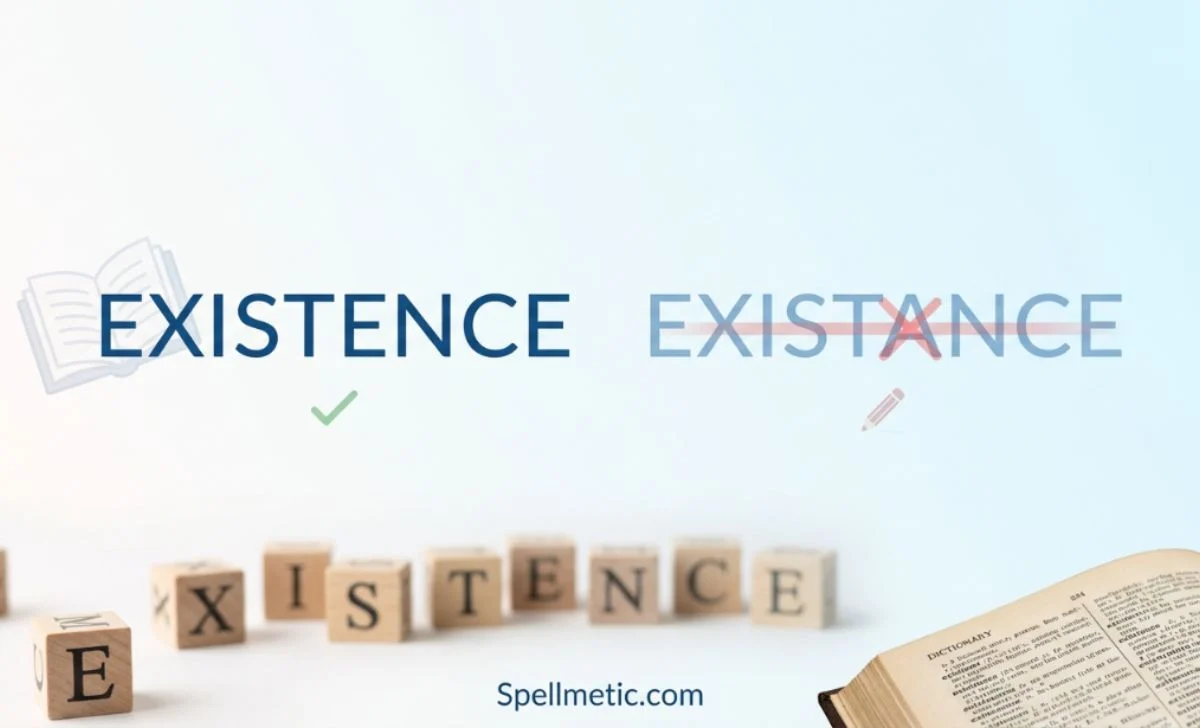
If you are unsure whether to write existence or existance, the answer is straightforward: existence is the correct spelling in standard English. Existance is a common misspelling.
The confusion is understandable because English uses both -ence and -ance endings in many nouns.
When you hear the word spoken, the final vowel is not always clear enough to tell you which ending to write. That can make existance look reasonable even though it is not the standard form.
The correct word comes from exist and is spelled:
exist + ence = existence
Understanding the word family, meaning, pronunciation, and common phrases makes the spelling much easier to remember.
Quick Answer
Existence is correct.
Existance is incorrect in standard English and should be treated as a misspelling.
| Spelling | Status | Meaning |
|---|---|---|
| existence | Correct | The state or fact of existing |
| existance | Incorrect | A misspelling of existence |
Example:
The researchers found evidence of the species’ existence.
Not:
The researchers found evidence of the species’ existance.
A simple way to remember it is:
EXIST + ENCE = EXISTENCE
Why Is “Existence” the Correct Spelling?
Existence is the established noun formed around the idea of exist. It refers to the state or fact of being real, living, or present.
Oxford lists existence as a noun meaning the state or fact of being real, living, or present. It also uses the word for a particular way of living.
The important spelling pattern is:
exist → existence
The ending is -ence, not -ance.
This is why these forms are different:
- exist → existence
- persist → persistence
- insist → insistence
- resist → resistance
The spelling of a related noun is not always predictable from pronunciation alone. Learning the established word form is therefore more reliable than trying to spell it only by sound.
Why Do People Spell “Existence” as “Existance”?
The error usually comes from a combination of pronunciation and familiar spelling patterns.
English has many common nouns ending in -ance, including:
- importance
- attendance
- appearance
- acceptance
- performance
Because -ance is so familiar, it can feel natural to write existance after recognizing the beginning of the word.
There is also a pronunciation issue. Existence is commonly pronounced /ɪɡˈzɪstəns/, and the final syllables do not strongly signal whether the written ending should be -ence or -ance. Cambridge gives this pronunciation for both British and American English.
So the mistake is easy to understand, but the standard spelling remains:
existence
What Does Existence Mean?
Existence is a noun that means the state or fact of existing.
In simple English, it describes the fact that someone or something is real, is present, or continues to be. Cambridge gives this as the basic meaning and also recognizes existence as a way of life.
For example:
- Scientists are investigating the existence of life on other planets.
- The company has been in existence for more than 50 years.
- Nobody questioned the existence of the problem.
The word can apply to physical objects, people, organizations, conditions, ideas, and abstract concepts.
Existence as the Fact of Being Real
This is the most common meaning.
Existence can refer to whether something actually exists or is real.
For example:
The evidence supports the existence of an ancient settlement.
Here, the focus is on whether the settlement actually existed.
Existence as a Way of Life
The word can also describe someone’s particular way or condition of living.
For example:
After moving to the countryside, she enjoyed a quieter existence.
This use often appears when describing a difficult, simple, isolated, peaceful, or unusual life. Oxford and Cambridge both recognize this sense.
Existence vs. Exist: What’s the Difference?
The main difference is grammatical.
Exist is a verb.
Existence is a noun.
| Word | Part of Speech | Meaning | Example |
|---|---|---|---|
| exist | Verb | To be real or present | Does life exist elsewhere? |
| existence | Noun | The state or fact of existing | Scientists studied the existence of life. |
Compare these sentences:
Does this species exist?
Here, exist tells us that something is real or present.
Scientists confirmed the existence of this species.
Here, existence names the fact that the species exists.
A useful rule is:
Something exists. The fact that it exists is its existence.
Oxford defines exist as being real or present in a place or situation.
Existence vs. Existent
These words are related, but they have different grammatical roles.
Existence is a noun.
Existent is usually an adjective meaning existing or real, and it is relatively formal.
For example:
The report provides evidence of its existence.
The species is still existent in the region.
In ordinary writing, existing is often more natural than existent.
| Word | Function | Example |
|---|---|---|
| exist | Verb | The tradition still exists. |
| existence | Noun | The tradition’s existence is documented. |
| existent | Adjective | The remaining examples are existent in nature. |
| existing | Adjective/participle | Existing records support the claim. |
Oxford labels existent as a formal adjective meaning existing or real.
Existence vs. Nonexistence
Nonexistence is the opposite of existence.
It refers to the fact or state of not existing or not being real. Oxford lists it as the opposite of existence.
| Word | Meaning |
|---|---|
| existence | The state of existing |
| nonexistence | The state of not existing |
For example:
The evidence supports the existence of the settlement.
The evidence does not support the existence of the settlement.
In more formal writing, you might encounter:
The researchers examined the possible existence or nonexistence of the phenomenon.
In everyday English, however, does not exist is often more natural than nonexistence.
Existence Word Family
Learning the word family is one of the easiest ways to avoid spelling mistakes.
| Word | Part of Speech | Meaning |
|---|---|---|
| exist | Verb | To be real or present |
| exists | Verb | Present-tense form of exist |
| existed | Verb | Past form of exist |
| existing | Adjective/participle | Currently present or continuing |
| existence | Noun | The state or fact of existing |
| existent | Adjective | Existing or real |
| existential | Adjective | Related to existence, especially human existence |
For example:
- The problem exists.
- The problem existed before the new policy.
- The existing system needs improvement.
- Researchers questioned the existence of the problem.
The shared exist- beginning gives you a useful spelling anchor. Oxford’s entry for exist lists forms such as exists, existed, and existing.
How to Pronounce “Existence”
The standard pronunciation is commonly represented as:
/ɪɡˈzɪstəns/
A simple pronunciation guide is:
ig-ZIS-tuhns
The main stress falls on the second syllable.
The pronunciation is similar in British and American English, although accents can produce small differences. The spelling does not change between the two varieties. Cambridge provides UK and US pronunciations for the word.
If you are unsure how to spell the ending after hearing the word, do not rely on pronunciation alone. Remember:
exist + ence = existence
Is Existence Spelled Differently in British and American English?
No.
Both British English and American English use:
existence
There is no standard British spelling existance and no separate American spelling of the word.
| Variety | Correct Spelling |
|---|---|
| British English | existence |
| American English | existence |
Cambridge provides the same written form in its British and American dictionary entries.
So whether you are writing a school assignment in the UK, a business email in the United States, or an article for an international audience, use existence.
Examples of Existence in Sentences
The meaning becomes clearer when you see the word in different contexts.
Everyday Examples
- The old theater is still in existence.
- Nobody doubted the existence of the problem.
- The village’s existence depends on tourism.
- She preferred a quiet existence away from the city.
- The organization has been in existence for decades.
Academic Examples
- The study examined evidence for the existence of a relationship between the variables.
- Historical records confirm the existence of the settlement.
- The researchers questioned the existence of a reliable connection between the two factors.
- The paper discusses the continued existence of traditional practices.
Scientific Examples
- Scientists continue to investigate the possible existence of life beyond Earth.
- The experiment provided evidence supporting the existence of the particle.
- Researchers are looking for evidence of the existence of water beneath the surface.
- The discovery raised questions about the existence of similar species.
Philosophical Examples
- Philosophers have debated the meaning of human existence for centuries.
- The book explores questions about consciousness and existence.
- The nature of human existence remains a central philosophical question.
These examples show that the word works in everyday conversation as well as academic, scientific, professional, and philosophical writing.
Common Phrases With Existence
Certain expressions occur frequently with existence. Learning them can improve both vocabulary and natural word usage.
In Existence
In existence means currently existing or still present.
Only three original copies remain in existence.
Come Into Existence
Come into existence means to begin to exist.
The organization came into existence after the merger.
Cambridge and Oxford both give this as a common usage pattern.
The Existence of
This structure refers directly to the fact that someone or something exists.
The researchers confirmed the existence of the previously unknown species.
Bring Into Existence
Bring into existence means to cause something to exist or begin.
The agreement helped bring a new institution into existence.
Prove the Existence of
This means to establish through evidence, reasoning, or demonstration that something exists.
The experiment was designed to prove the existence of the proposed effect.
Question the Existence of
This means to doubt whether something exists or is real.
The researchers questioned the existence of a meaningful connection.
Acknowledge the Existence of
This means to recognize that something exists.
The company finally acknowledged the existence of the security problem.
Continue in Existence
This means to remain present or active over time.
The organization has continued in existence despite several financial difficulties.
Existence Synonyms
The best synonym depends on what you mean.
| Synonym | Best Used When You Mean |
|---|---|
| being | the state of being |
| reality | the condition of being real |
| presence | being present somewhere |
| life | living or one’s manner of living |
| survival | continuing to live or remain |
| continuation | remaining in existence over time |
| actuality | something being real rather than imagined |
For example, presence can replace existence when you are talking about something being physically or visibly present:
The presence of security cameras made the staff feel safer.
But it would sound unnatural to replace every use of existence with presence. Choosing a synonym depends on the exact meaning.
Common Misspellings of Existence
Existance is the most obvious spelling mistake, but learners may also produce other forms.
Common incorrect forms include:
- existance
- existense
- existince
- exsistence
- exsistance
- excitence
The correct form is always:
existence
One useful habit is to check the middle and ending separately:
E-X-I-S-T-E-N-C-E
The sequence -ence is the part most likely to cause trouble.
Is “Existance” Ever Correct?
In standard modern English, existance is not the accepted spelling of the noun.
You may still see it online because people make spelling mistakes, type quickly, or publish content without careful editing. Its appearance in a search result, social media post, comment, or informal document does not make it a standard alternative spelling.
For formal writing, use:
existence
This applies to:
- school assignments
- resumes and cover letters
- business emails
- academic papers
- reports
- websites
- professional documents
How to Remember the Spelling of Existence
You do not need a complicated spelling rule.
Use the “Exist + Ence” Trick
Break the word into:
EXIST + ENCE
Then combine them:
EXISTENCE
The beginning is exactly the same as the verb exist.
Think:
exist → existence
Not:
exist → existance
Use the Word Family
Keep these forms together:
exist → existing → existence → existent
The shared exist- pattern gives you a strong visual reminder.
Remember “-ence”
If the ending is what you usually forget, write the word as:
exist-ENCE
That small visual cue can prevent the common -ance mistake.
Existence in Academic and Professional Writing
Existence is common in formal writing because it allows writers to focus on whether something is present, real, established, or supported by evidence.
For example:
The study investigated the existence of a relationship between sleep and memory.
This is grammatically correct. But sometimes a direct verb produces cleaner writing:
The study investigated whether sleep affects memory.
Both sentences communicate a similar idea, but the second is more direct.
Another example:
The report provides evidence of the existence of fraud.
A more direct version could be:
The report provides evidence that fraud occurred.
The lesson is not to avoid existence. Use it when the noun is useful and the fact of existing is the focus.
Existence and Existential: What’s the Difference?
These words are related but are not interchangeable.
Existence is a noun referring to the state or fact of existing.
Existential is an adjective related to existence, particularly questions concerning human life, identity, freedom, meaning, or being.
For example:
- The philosopher examined human existence.
- The student faced an existential question about the meaning of life.
You may also encounter existentialism, the philosophical movement concerned with questions about human existence and individual experience.
This distinction is useful because searching for the meaning of existence can lead into broader vocabulary such as existential, existentialism, and existential crisis.
What Is the Difference Between Existence and Being?
Existence and being can overlap, but they are not always interchangeable.
Existence usually emphasizes the fact or state of existing.
Being can refer to existence itself, but it can also mean a living person or creature.
For example:
The existence of life on another planet remains uncertain.
Here, existence focuses on whether life is present.
Every human being deserves respect.
Here, being refers to a person.
This is why context matters when choosing a synonym.
FAQs
1. Is it existence or existance?
Existence is the correct spelling. Existance is a misspelling.
2. Is “existance” a word?
Existance is not the standard English spelling of the noun. Use existence instead.
3. How do you spell existence?
It is spelled:
E-X-I-S-T-E-N-C-E
A useful breakdown is exist + ence.
4. What does existence mean?
Existence means the state or fact of existing. It can also describe a particular way or condition of living.
5. Is existence a noun?
Yes. Existence is a noun. It names the state or fact of existing.
6. How do you pronounce existence?
It is commonly pronounced /ɪɡˈzɪstəns/, roughly ig-ZIS-tuhns.
7. What is the difference between exist and existence?
Exist is a verb meaning to be real or present. Existence is the noun describing the state or fact of existing.
8. Is existence the same in British and American English?
Yes. Existence is the standard spelling in both British and American English. The spelling does not change between the two varieties.
9. What are some synonyms for existence?
Depending on context, synonyms include being, reality, presence, life, survival, continuation, and actuality.
10. What is the easiest way to remember the spelling of existence?
Remember:
EXIST + ENCE = EXISTENCE
The noun keeps the spelling of the verb exist and ends in -ence.
Conclusion
The correct spelling is existence, not existance. The word is a noun that refers to the state or fact of existing, being real, being present, or, in some contexts, a particular way of living.
The easiest way to remember the spelling is to connect it with its word family:
exist → existing → existence
When you are writing an essay, report, email, article, or professional document, choose existence. If you see existance, treat it as a spelling error rather than an alternative form.
Once you remember exist + ence, the difference becomes much easier to spot, and you will be less likely to make the same mistake again.