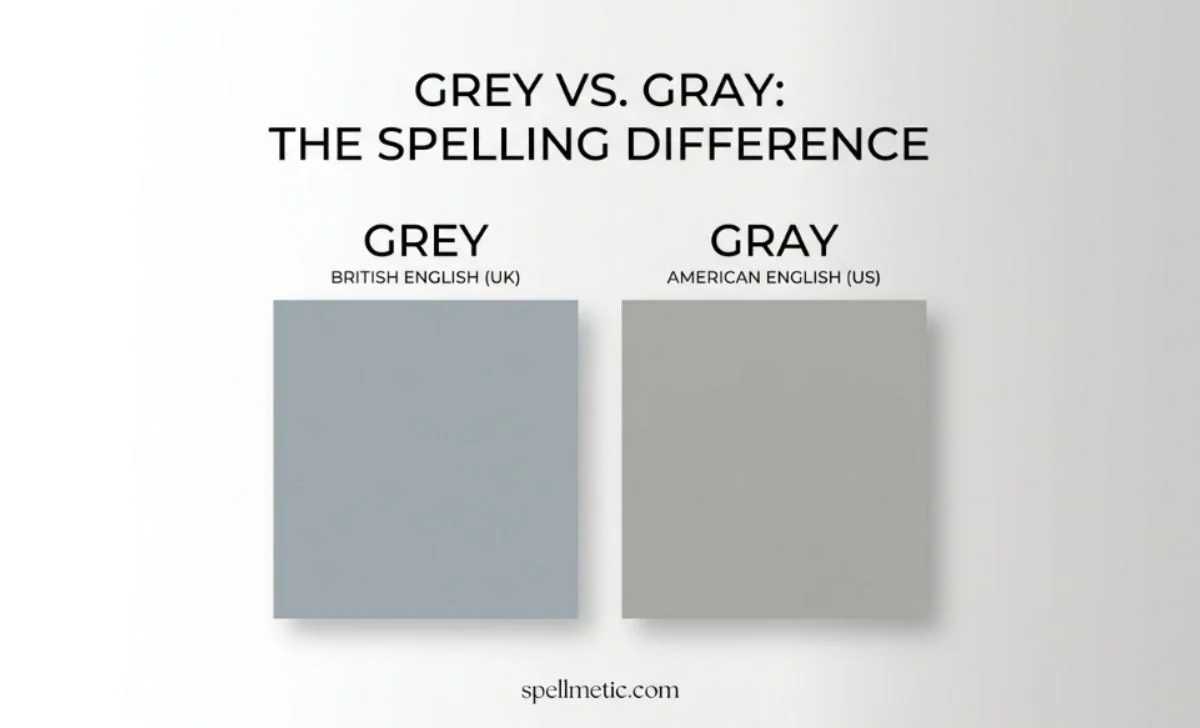
If you have ever wondered whether the color should be written as grey or gray, you are not alone. Both spellings are correct, but the preferred form depends mainly on the variety of English you are using.
Gray is the standard spelling in American English, while grey is more common in British English and is also widely used in other varieties of English.
The two words have the same meaning and pronunciation. The difference is primarily a matter of spelling convention, not color or definition.
For example, an American writer might say, “She wore a gray coat,” while a British writer would normally write, “She wore a grey coat.”
This small spelling difference becomes important in essays, websites, professional writing, and international communication. Once you know which English variety you are following, choosing the right form is straightforward.
Grey or Gray: Quick Answer
Gray and grey both refer to the color between black and white.
- Gray → preferred in American English
- Grey → preferred in British English
- Pronunciation → the same: /ɡreɪ/
- Meaning → the same
- Grammar → both can function as a noun, adjective, or verb
| Spelling | Common usage | Example |
|---|---|---|
| gray | American English | He bought a gray shirt. |
| grey | British English | He bought a grey shirt. |
So, neither spelling is simply “wrong.” The best choice depends on your audience, location, or chosen style of English.
What Is the Difference Between Grey and Gray?
There is no difference in the basic meaning of grey and gray. Both describe a color produced by a mixture of black and white or a color that resembles it.
The main distinction is regional spelling.
American English generally favors gray, whereas British English generally favors grey. The same distinction appears in several related forms, such as graying/greying and grayed/greyed.
For example:
The old building has a gray roof.
In British English, the same sentence would normally be:
The old building has a grey roof.
The meaning does not change.
Do Gray and Grey Have Different Pronunciations?
No. In standard English, both are pronounced /ɡreɪ/, which sounds like “gray.”
The difference is therefore visible in writing rather than something you normally hear in conversation.
Gray vs. Grey in American and British English
Regional spelling is the easiest way to decide which form to use.
Gray in American English
Gray is the usual spelling in the United States.
You will commonly see it in phrases such as:
- gray hair
- gray eyes
- gray sky
- gray jacket
- gray paint
- gray matter
- gray area
For example:
The sky turned gray just before the storm.
My grandfather has gray hair.
American dictionaries such as Merriam-Webster recognize gray as the standard American spelling.
Grey in British English
Grey is the usual spelling in British English.
Examples include:
- grey hair
- grey eyes
- grey sky
- grey jacket
- grey paint
- grey matter
- grey area
For example:
The sky turned grey before the rain started.
She was wearing a grey jumper.
The spelling grey is also common in other English-speaking regions, although usage can vary depending on the country and context.
What About Canadian, Australian, and New Zealand English?
English spelling is not divided into only two perfectly separate systems.
Grey is widely used in British, Australian, and New Zealand English, while Canadian English also commonly uses grey. However, individual words, organizations, style guides, and proper names can create exceptions.
For this reason, it is better to think of gray vs. grey as a regional preference rather than an absolute rule for every English-speaking country.
Is Gray or Grey the Correct Spelling?
Both are correct spellings.
The important question is not whether gray or grey is universally correct. Instead, ask which English variety your writing follows.
If you are writing for a U.S. audience, gray is usually the natural choice.
If you are writing for a British audience, grey is usually the natural choice.
What matters most in formal writing is consistency. Switching randomly between American and British spelling can make your writing look poorly edited.
Gray and Grey as a Noun, Adjective, and Verb
The word is not limited to describing a color.
Gray or Grey as a Noun
When referring to the color itself, it can function as a noun.
Gray is one of my favorite colors.
British English:
Grey is one of my favorite colours.
Here, gray/grey names the color.
Gray or Grey as an Adjective
It can describe something that has the color.
He bought a gray car.
She wore a grey dress.
This is probably the most common use of the word.
Gray or Grey as a Verb
The word can also describe hair becoming gray.
His hair began to gray in his forties.
In British English:
His hair began to grey in his forties.
This use is less common for beginners, but it is completely standard.
Grey or Gray in Example Sentences
Seeing both forms in natural situations makes the distinction easier to remember.
American English
The house has a gray roof.
She noticed a few gray hairs in the mirror.
A gray cloud covered the sun.
The designer chose gray paint for the living room.
The report discusses a gray area in the law.
British English
The house has a grey roof.
She noticed a few grey hairs in the mirror.
A grey cloud covered the sun.
The designer chose grey paint for the living room.
The report discusses a grey area in the law.
Notice that the meaning and grammar stay the same. Only the regional spelling changes.
Gray Area or Grey Area?
The expression gray area or grey area refers to something that is unclear, uncertain, or not easily classified as right or wrong.
American English generally uses:
gray area
British English generally uses:
grey area
For example:
The rules leave a gray area concerning freelance work.
A British writer would normally use:
The rules leave a grey area concerning freelance work.
The expression has nothing specifically to do with the physical color. It is an idiomatic use of the word.
Graying or Greying? Grayed or Greyed?
The regional spelling difference continues in related forms.
| American English | British English |
|---|---|
| gray | grey |
| graying | greying |
| grayed | greyed |
| grayer | greyer |
| grayest | greyest |
| grayish | greyish |
For example:
American English:
His hair is graying.
British English:
His hair is greying.
Likewise:
The old photograph has grayed with age.
and:
The old photograph has greyed with age.
The important point is that the spelling pattern normally follows the English variety being used.
When You Should Not Change Gray to Grey
The American/British spelling rule is useful, but it does not mean you should change every occurrence automatically.
Some words and names have an established spelling that should be preserved.
Proper Names
Consider Earl Grey, the famous tea. Its established name contains Grey, even when it appears in American writing.
Similarly, a person’s name, company name, title, or other official name should normally remain exactly as officially written.
For example, if a British character is named Christian Grey, changing the name to “Christian Gray” would be incorrect.
The same principle applies to titles such as Grey’s Anatomy.
Established Words
Some compounds have their own established spelling and should not be changed simply because you prefer American or British English.
For example:
- greyhound
- grayling
The spelling of an individual word must be considered on its own rather than mechanically applying the gray/grey rule.
Gray Matter or Grey Matter?
Both forms can be found, depending on the English variety.
Gray matter is the common American spelling, while grey matter is common in British English.
The term refers to tissue in the brain and spinal cord that contains many neuronal cell bodies.
For example:
The study examined changes in gray matter.
A British publication may write:
The study examined changes in grey matter.
The scientific subject is the same; the spelling reflects regional convention.
Where Did Gray and Grey Come From?
The two spellings have a shared history.
Both trace back to the Old English word grǣg, meaning the color gray or grey. Over time, English developed different spelling conventions, and both gray and grey became established forms.
The modern regional preference developed gradually rather than because one spelling was created as an American invention.
This is why calling one form a “misspelling” of the other is misleading. They are established English variants with a long history of use.
How to Remember Gray vs. Grey
A simple memory trick is:
GrAy → AmericA
Both contain A.
And:
GrEy → England
Both contain E.
It is only a mnemonic, not an official spelling rule, but it can be useful when you are writing quickly.
If you are writing for an American audience, think gray.
If you are following British English, think grey.
Which Spelling Should You Use?
The easiest way to choose is to consider your audience.
For American English
Use gray.
The walls are painted gray.
For British English
Use grey.
The walls are painted grey.
For Academic or Professional Writing
Follow the required style guide or the English variety used by your institution, publisher, or organization.
If a university asks for American English, use gray. If a publication follows British English, use grey.
For Websites and Blogs
Choose the spelling that matches your target audience.
For a U.S.-focused website, gray will usually feel more natural. For a UK-focused website, grey is the better choice.
More importantly, don’t switch unnecessarily between the two.
For Brand Names and Proper Names
Always check the official spelling.
A proper name should not be changed just to make it fit your preferred regional English.
Common Mistakes With Gray and Grey
Treating Grey as an American spelling mistake
It is not automatically a mistake. Grey is a standard English spelling, although gray is preferred in American English.
Treating Gray as incorrect British English
British English normally prefers grey, but gray is not an invented or meaningless form. It is the established American variant.
Mixing Both Forms Without a Reason
A document that uses gray in one paragraph and grey in another can look inconsistent.
Choose the appropriate variety and stay with it.
Changing Proper Names
Don’t change Earl Grey or a person’s surname just because you are writing in American English.
Assuming the Pronunciation Is Different
Both forms are normally pronounced /ɡreɪ/.
The spelling changes; the standard pronunciation does not.
FAQs
1:Is gray or grey the correct spelling?
Both are correct. Gray is preferred in American English, while grey is preferred in British English and is common in several other varieties of English.
2:Is grey British or American?
Grey is traditionally associated with British English. American English generally prefers gray.
3:Is gray American English?
Yes. Gray is the standard and more common spelling in American English.
4:Do gray and grey mean the same thing?
Yes. They have the same basic meaning and refer to the same color.
5:Is grey wrong in American English?
No. It is a recognized English spelling, but gray is the normal American preference.
6:Is gray wrong in British English?
No. However, grey is the usual British spelling.
7:Is it gray area or grey area?
Both are correct depending on the English variety. Gray area is preferred in American English, while grey area is preferred in British English.
8:Is it graying or greying?
Both forms are used. Graying follows American English, while greying follows British English.
9:Is Earl Grey spelled with grey?
Yes. Earl Grey is the established name of the tea, so its official spelling should be preserved regardless of the English variety being used.
Conclusion
So, should you write grey or gray color?
The answer is simple: both spellings are correct, but they belong to different regional spelling preferences.
Use gray when following American English. Use grey when following British English. The words have the same meaning and standard pronunciation, and neither spelling represents a different color.
The same regional distinction appears in related expressions such as gray area/grey area, graying/greying, and grayed/greyed.
However, don’t apply the rule mechanically to proper names or established words. Names such as Earl Grey should retain their official spelling.
If you’re writing for a specific audience, the best approach is to choose one English variety and use it consistently. That small detail can make your writing feel much more polished and natural.