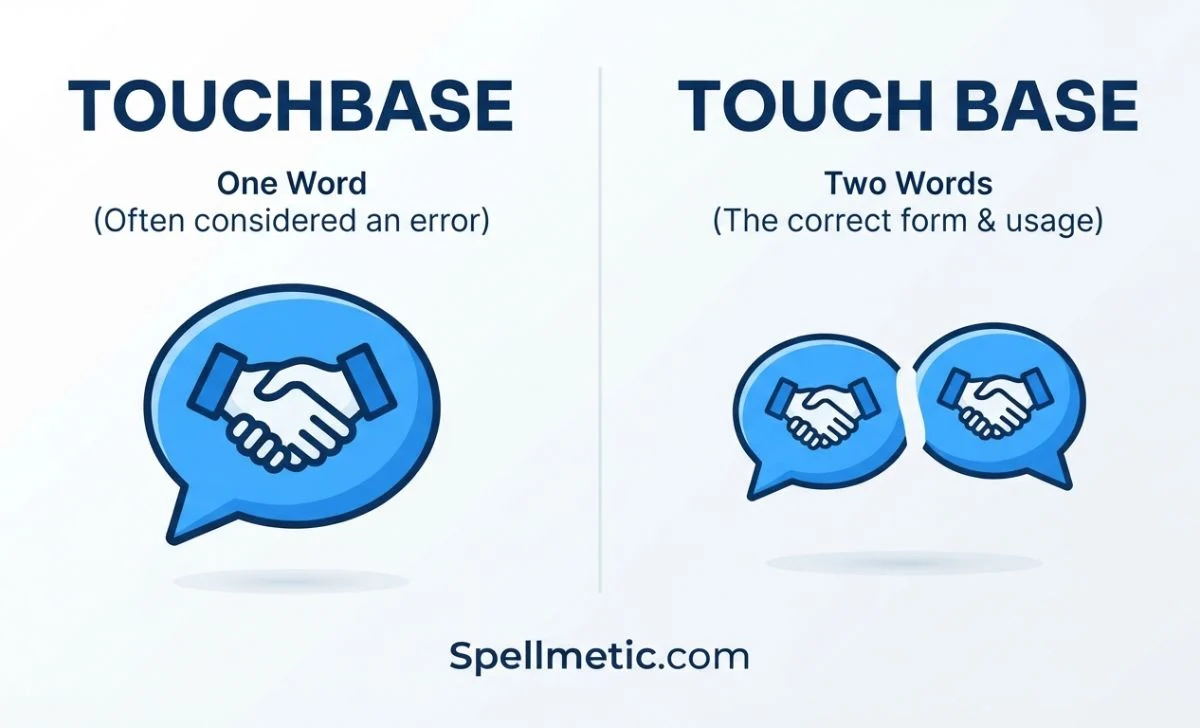
If you are wondering whether to write touchbase or touch base, the correct form is touch base. The phrase is always written as two separate words when used in standard English.
Touchbase is a common mistake caused by joining the two words together. Although the expression is frequently used in workplace emails and everyday communication, it does not become a single word.
The phrase touch base means to contact someone, usually for a short conversation, update, check-in, or discussion.
For example, if a colleague says, “Let’s touch base tomorrow,” they simply mean that they want to talk or communicate tomorrow.
This guide explains the meaning, grammar, correct usage, examples, common mistakes, alternatives, and British and American English usage of touch base.
Quick Answer
Touch base is the correct form.
Touchbase is not the standard spelling of the phrase.
| Form | Correct? | Example |
|---|---|---|
| touch base | Correct | Let’s touch base tomorrow. |
| touchbase | Incorrect | Let’s touchbase tomorrow. |
The easiest rule to remember is:
Touch base = two words
What Does “Touch Base” Mean?
Touch base is an idiomatic expression that means to contact or communicate with someone, usually briefly.
It can mean checking on progress, sharing information, discussing something, or simply reconnecting.
For example:
I’ll touch base with Sarah after the meeting.
This means the speaker plans to contact Sarah after the meeting.
You might also say:
Can we touch base about the new schedule?
Here, the speaker is asking for a conversation about the schedule.
The expression does not necessarily mean having a formal meeting. It can refer to an email, phone call, message, or short conversation depending on the context.
Why Is “Touchbase” Incorrect?
The mistake happens because people often treat familiar phrases as single words.
However, touch base is an established two-word expression. The words should not be joined together when you use the phrase in ordinary English.
Correct:
I’ll touch base with you later.
Incorrect:
I’ll touchbase with you later.
You may occasionally see touchbase online as part of a username, brand name, company name, or product name. That is different from using the expression in a normal English sentence.
Is “Touch Base” a Verb?
Yes. Touch base works as a verb phrase.
The word touch changes according to the tense, while base normally remains singular.
Present Tense
I touch base with my manager every Friday.
Past Tense
I touched base with my manager yesterday.
The past tense of touch base is touched base.
For example:
I touched base with my manager yesterday.
The word touch changes to touched, while base remains singular.
Future Tense
I’ll touch base with the client tomorrow.
Present Continuous
I’m touching base with the design team this afternoon.
Notice that the expression remains touch base, not touch bases.
Touch Base in a Sentence
Here are some natural examples:
- I’ll touch base with you tomorrow.
- Let’s touch base after lunch.
- She touched base with her manager yesterday.
- We should touch base before making a final decision.
- Can I touch base with you about the schedule?
- I’m going to touch base with the marketing team.
- He promised to touch base once he had more information.
- Let’s touch base next week and review the results.
- I wanted to touch base about your application.
- We can touch base later if anything changes.
These examples show that the phrase can fit naturally into both professional and everyday conversations.
What Does Touch Base Mean in Business?
Touch base in business means to contact someone for a short conversation, update, check-in, or discussion.
It is commonly used when coworkers, managers, clients, or business partners want to communicate about a project, task, or issue.
In a meeting, touch base usually means having a short discussion to share updates, check progress, or discuss a specific issue.
For example:
Let’s touch base during the meeting about the new schedule.
It does not necessarily mean having a separate meeting. It can simply mean taking a few minutes to communicate about an important topic.
For example:
I wanted to touch base about the project timeline.
This means the speaker wants to discuss or check on the project timeline.
Another example is:
Let’s touch base after the client meeting.
Here, touch base suggests having a short conversation after the meeting.
The phrase is common in workplace emails, meetings, project updates, and professional conversations. However, contact, discuss, or communicate with may sound more direct in highly formal writing.
Touch Base vs. Contact
Touch base and contact can have similar meanings, but they have different tones.
Contact is neutral and direct:
I’ll contact you tomorrow.
Touch base is more conversational:
I’ll touch base with you tomorrow.
For formal business writing, contact may sometimes sound more precise. In a friendly workplace email, however, touch base can sound natural and approachable.
Touch Base vs. Follow Up
These phrases are related, but they are not identical.
Touch base usually means making contact or checking in:
I’ll touch base with you next week.
Follow up usually means taking further action after an earlier conversation, request, or event:
I’ll follow up on your application next week.
You can also use both in the same context:
I’ll touch base next week and follow up on the remaining issues.
The right choice depends on what you want to communicate.
Touch Base Synonyms
Touch base has several synonyms, depending on what you want to say.
Common alternatives include:
- Contact — to communicate with someone.
- Check in — to ask for an update or see how someone is doing.
- Follow up — to take further action after an earlier conversation or request.
- Connect — to communicate or establish contact.
- Speak with — to have a conversation with someone.
- Get in touch — to contact someone.
For example:
I’ll touch base with you tomorrow.
You could also say:
I’ll check in with you tomorrow.
Or:
I’ll contact you tomorrow.
The best synonym depends on the context and how formal or specific you want your sentence to sound.
Is “Touch Base” Formal or Informal?
Touch base is standard English, but it has a conversational feel.
It is particularly common in:
- workplace emails
- business conversations
- project management
- client communication
- team meetings
- networking
- everyday conversations
For highly formal writing, you might choose contact, discuss, or communicate with instead.
For example:
I would like to discuss the proposal with you.
This sounds more formal than:
I’d like to touch base about the proposal.
Both can be correct; the context determines which sounds better.
Is “Touchbase” Ever Correct?
When you mean the ordinary English expression, touchbase is not the standard form.
Use:
touch base
not:
touchbase
However, a company, application, website, or product might deliberately use Touchbase as a name. In that situation, it is a proper name rather than the standard English phrase.
So if you are writing an email or article and mean “communicate briefly,” keep the phrase as two words.
Common Mistakes With “Touch Base”
Writing “Touchbase”
Incorrect:
I’ll touchbase with you tomorrow.
Correct:
I’ll touch base with you tomorrow.
Writing “Touched Bases”
Another common mistake is adding s to base.
Incorrect:
I touched bases with the client.
Correct:
I touched base with the client.
The standard idiom uses singular base.
Using “Touch Base” When You Need Specificity
Sometimes touch base is too vague.
For example:
I’ll touch base with you soon.
The reader does not know whether you mean an email, call, meeting, or message.
If the exact action matters, be more specific:
I’ll email you tomorrow with the updated figures.
This is often clearer in professional communication.
Alternatives to “Touch Base”
You can replace touch base with different expressions depending on the context.
Common alternatives include:
- contact
- check in
- follow up
- connect
- speak with
- talk to
- get in touch
- discuss
- communicate with
For example:
I’ll touch base with you tomorrow.
You could also say:
I’ll check in with you tomorrow.
Or:
I’ll contact you tomorrow.
The best choice depends on how formal and specific you want your sentence to be.
Touch Base in British and American English
There is no spelling difference between British and American English.
Both use:
touch base
For example:
I’ll touch base with you tomorrow.
The phrase is widely understood in both varieties and is particularly common in modern professional communication.
Where Does “Touch Base” Come From?
The expression is generally associated with baseball, where players need to touch a base during a game.
The phrase later developed a figurative meaning related to making contact or checking in with someone.
Today, touch base is an established English idiom. Its modern meaning has little to do with literally touching a baseball base.
Touchbase or Touch Base: Final Comparison
| Expression | Status | Meaning |
|---|---|---|
| touch base | Correct | Contact or communicate briefly |
| touchbase | Incorrect as the standard phrase | No standard idiomatic use |
| touched base | Correct | Past form of touch base |
| touching base | Correct | -ing form of touch base |
| touch bases | Incorrect for the idiom | Not the standard form |
The main rule is simple: touch base stays as two words.
FAQs
1:Is it touchbase or touch base?
Touch base is correct. It is written as two separate words. Touchbase is not the standard spelling of the English phrase.
2:What does “touch base” mean?
Touch base means to contact someone, usually for a brief conversation, update, check-in, or discussion.
3:Is “touch base” one word?
No. The standard expression is touch base, written as two words.
4:Is “touch base” formal English?
It is standard English, but it has a conversational tone. It is particularly common in workplace and business communication.
5:Can I say “touched base”?
Yes. Touched base is the correct past-tense form.
I touched base with the team yesterday.
6:Should I say “touch bases” or “touch base”?
Use touch base when you mean the idiom.
I’ll touch base with you tomorrow.
7:What is another way to say “touch base”?
Depending on the context, you can use contact, check in, follow up, connect, speak with, or get in touch.
8:Can “touch base” be used in emails?
Yes. It is widely used in professional emails when referring to a short conversation, update, or check-in.
Conclusion
When deciding between touchbase or touch base, the correct form is touch base. The phrase should be written as two separate words.
It means to contact someone, usually to share an update, check progress, discuss an issue, or reconnect.
Although it is especially common in workplace and business communication, it can also be used in everyday conversations.
Remember the related forms:
touch base
touched base
touching base
Avoid joining the words into touchbase, and do not normally change base to bases when using the idiom.
If you want your writing to sound clear and natural, the rule is easy:
Touch base = Correct
Touchbase = Incorrect
Read More Blogs:
- Anyway or Anyways: Which Version Fits Your Sentence?
- Loose or Lose? How to Choose the Right Word
- Aluminum or Aluminium: Why the US and UK Spell It Differently
- Skillset or Skill Set: What Modern English Prefers
- Rain or Shine: Why This Phrase Means More Than Weather