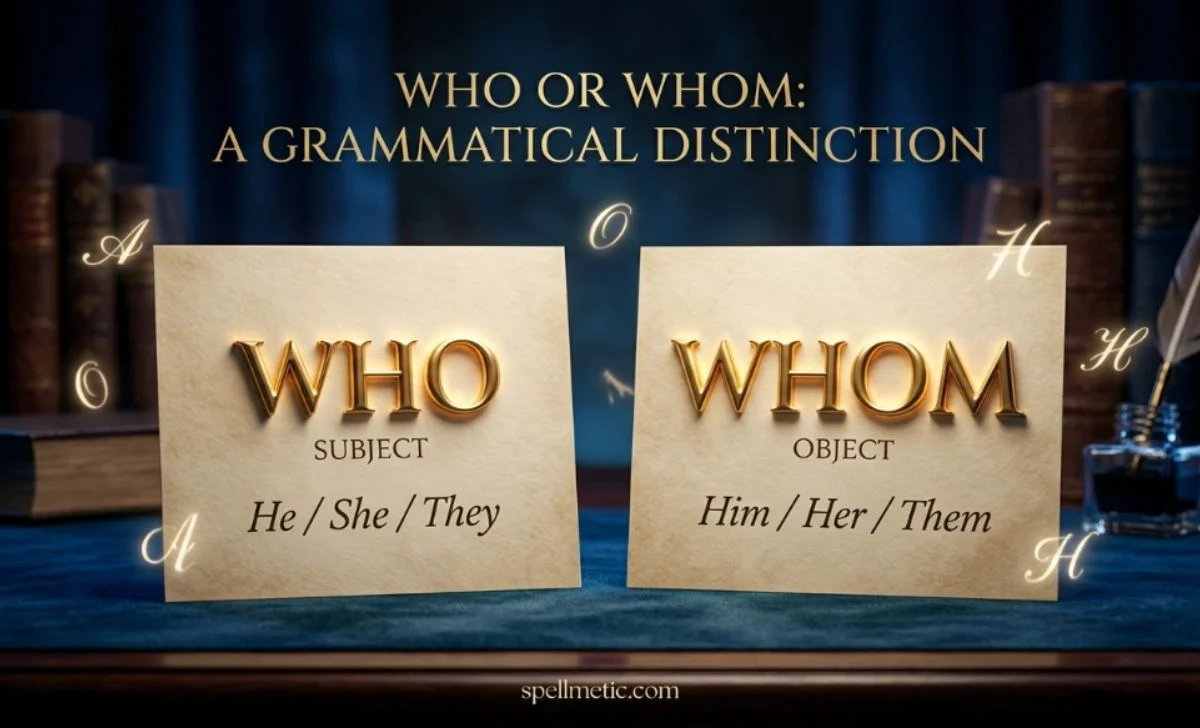
Who and whom are easy to confuse because both refer to people, but they don’t perform the same grammatical job.
The difference becomes clear once you look at what the person is doing in a sentence.
Use who when the person is the subject—the one performing an action.
Who sent the message?
Use whom when the person is the object—the one receiving an action or following a preposition in traditional grammar.
Whom did you invite?
There is one important modern-English detail: who is now very common in places where traditional grammar would use whom, particularly in conversation.
So the choice isn’t simply about memorizing a rule. It also depends on the sentence, the level of formality, and the style of English you’re using.
Who or Whom: The Short Answer
The basic distinction is:
Who = subject
Whom = object
Compare:
Who called the doctor?
The person represented by who performed the action.
Whom did the doctor call?
The person represented by whom received the action.
A quick substitution test can make the choice easier:
- he / she / they → who
- him / her / them → whom
This works in most situations.
The Grammar Behind Who and Whom
The difference comes from case.
Who is the subjective form, while whom is the objective form.
Think about these familiar pronoun pairs:
| Subject | Object |
|---|---|
| I | me |
| he | him |
| she | her |
| they | them |
| we | us |
| who | whom |
You wouldn’t normally say:
Him wrote the article.
You say:
He wrote the article.
Likewise, traditional grammar distinguishes between:
Who wrote the article?
and:
Whom did you interview?
The first asks about the person performing the action. The second asks about the person receiving it.
A Reliable Trick: Replace It With He or Him
When you’re stuck, forget the sentence for a moment and answer it with a personal pronoun.
Example: Who?
Who opened the door?
Possible answer:
She opened the door.
Because she is correct, who is the right choice.
Example: Whom?
Whom did you see at the station?
Possible answer:
I saw him at the station.
Because him is correct, whom is the traditional choice.
Try the Same Test With They and Them
Who/whom is responsible for the project?
Answer:
They are responsible.
So:
Who is responsible for the project?
Now consider:
Who/whom did the manager select?
Answer:
The manager selected them.
Therefore, traditional grammar gives:
Whom did the manager select?
This test is usually more useful than trying to memorize long grammar definitions.
Who Works When the Person Does the Action
If the unknown person is the subject of the verb, choose who.
Who broke the vase?
Who prepared this meal?
Who owns this company?
Who wants to join us?
Who knows the answer?
In each example, the person represented by who is doing something:
- who broke
- who prepared
- who owns
- who wants
- who knows
That’s why who is used.
Whom Works When the Person Receives the Action
If another person performs the action and the unknown person receives it, traditional grammar uses whom.
Whom did you hire?
You hired her.
Whom did they invite?
They invited him.
Whom are you helping?
You are helping them.
Whom did she blame?
She blamed him.
The object is the person affected by the action.
Why “Whom” Sounds More Formal
You may have noticed that whom sounds more formal than who in many sentences.
For example:
Whom did you speak to?
This sounds formal or somewhat old-fashioned to many speakers.
A normal conversational version would be:
Who did you speak to?
Both communicate the same basic idea.
English has gradually moved toward using who more broadly, especially when a sentence sounds awkward with whom. As a result, native speakers often use who in everyday questions even when traditional grammar would identify the word as an object.
That doesn’t make whom useless. It simply means that modern usage is more flexible.
Who or Whom in Everyday Questions?
This is where traditional grammar and modern usage often meet.
Consider:
Who did you call?
Most English speakers would find this completely natural.
Traditional grammar would prefer:
Whom did you call?
The second version is more formal, but the first is extremely common in modern English.
Another example:
Who are you going with?
This is natural conversational English.
A more formal construction is:
With whom are you going?
The choice depends heavily on tone and context.
Who and Whom After Prepositions
Whom traditionally follows a preposition.
Common combinations include:
- to whom
- with whom
- for whom
- from whom
- by whom
- about whom
Examples:
To whom did you send the letter?
With whom did you discuss the issue?
For whom was the package intended?
From whom did you receive the information?
These forms are grammatically formal and are still useful in professional, academic, legal, and official writing.
However, everyday English often moves the preposition to the end:
Who did you send the letter to?
Who did you discuss the issue with?
Who was the package intended for?
These sentences are natural in modern conversation.
Who or Whom in Relative Clauses
The same subject-object distinction appears in relative clauses.
Compare these sentences:
She is the teacher who helped me.
Here, who performs the action of helping.
Now compare:
She is the teacher whom I thanked.
Here, I performed the action, and the teacher received it.
So the traditional rule is:
Who = subject of the relative clause
Whom = object of the relative clause
Another Example
I met a writer who lives in London.
The writer lives in London.
I met a writer whom my editor recommended.
The editor recommended the writer.
In the second sentence, whom is the object of recommended.
When “Who” Is More Natural Than “Whom”
Modern English doesn’t require you to use whom simply because a grammar book says the person is technically an object.
For example:
Who did you invite?
is perfectly natural in ordinary conversation.
Similarly:
Who should I call?
is much more common in everyday speech than:
Whom should I call?
The latter is grammatically traditional and more formal.
For casual messages, conversations, and most everyday communication, who will often sound more natural.
When “Whom” Is the Better Choice
There are situations where whom can make your writing more polished and appropriately formal.
Use it when:
- a formal tone is required
- it follows a preposition
- you’re writing an official document
- a traditional grammatical distinction matters
- you’re using a fixed formal expression
For example:
To whom it may concern
is a well-established formal phrase.
Likewise:
The applicant, whom we interviewed last week, has accepted the position.
This is a natural formal construction.
Who vs. Whom in Professional Writing
The right choice depends on the sentence.
Informal
Who should I email about the problem?
More formal
Whom should I contact about the problem?
Very formal
To whom should I address my correspondence?
These aren’t three completely different meanings. They represent different levels of formality.
For professional writing, don’t force whom into every sentence. Use it where it sounds appropriate and grammatically fits.
Who, Whom, and Whose Are Not the Same
These three words are sometimes mixed up because they all relate to people.
Who
Used for a person as the subject:
Who is waiting outside?
Whom
Used traditionally for a person as an object:
Whom did you meet?
Whose
Used to show possession:
Whose phone is this?
Compare:
Who called?
Whom did you call?
Whose phone did you call from?
Each word has a different grammatical function.
Common Who vs. Whom Mistakes
Mistake 1: Using Whom for the Subject
Incorrect:
Whom is coming to the party?
Correct:
Who is coming to the party?
The person is performing the action of coming.
Mistake 2: Assuming Who Is Always Correct
In casual English, who works in many object constructions. But formal grammar still recognizes whom.
For example:
To whom did you speak?
is a standard formal construction.
Mistake 3: Choosing by Sentence Position
The first word in a question isn’t automatically who, and the last word isn’t automatically whom.
Look at its grammatical role instead.
Mistake 4: Using Whom to Sound More Intelligent
Replacing every who with whom can actually create grammatical mistakes.
For example:
Whom wrote this report?
is wrong because the person performed the action.
Mistake 5: Ignoring the Tone
A sentence can be grammatically traditional but sound unnecessarily formal in casual conversation.
With whom are you going to the movies?
is grammatical, but:
Who are you going to the movies with?
sounds much more natural in everyday speech.
Who or Whom: Side-by-Side Examples
| Sentence | Best traditional choice | Why |
|---|---|---|
| ___ called you? | Who | Subject |
| ___ did you call? | Whom | Object |
| ___ wrote the book? | Who | Subject |
| ___ did you invite? | Whom | Object |
| ___ should I contact? | Whom | Object in formal grammar |
| ___ is waiting outside? | Who | Subject |
| To ___ should I send it? | Whom | Follows preposition |
| ___ did she speak to? | Whom | Object in traditional grammar |
In modern informal English, who is also widely used in several of the object examples.
How to Choose Between Who and Whom Quickly
When you’re writing and don’t have time to analyze the whole sentence, use this three-step method.
Step 1: Find the Verb
Identify the main action.
Who/whom interviewed the candidate?
The verb is interviewed.
Step 2: Ask Who Performed the Action
The unknown person performed the interview.
So:
Who interviewed the candidate?
Step 3: Test He or Him
If you can answer with he/she/they, choose who.
If you can answer with him/her/them, traditional grammar points to whom.
For example:
Who/whom did you interview?
Answer:
I interviewed her.
Therefore:
Whom did you interview?
This method works in most ordinary cases.
Who or Whom: Which One Should You Use?
There isn’t one answer for every situation.
Use Who When:
- the person is the subject
- the person performs the action
- you’re speaking casually
- you’re writing an informal message
- modern conversational English sounds more natural with who
Use Whom When:
- the person is the object in traditional grammar
- it follows a preposition in formal writing
- the context is official or highly formal
- you want to maintain a traditional grammatical distinction
The most important thing is to understand the structure rather than treating whom as a “more correct” version of who.
FAQs
1:Is “who” or “whom” correct?
Both are correct. Who traditionally functions as a subject, while whom functions as an object.
2:Is it “Who did you call?” or “Whom did you call?”
Whom did you call? follows traditional formal grammar. Who did you call? is extremely common and natural in modern English, especially in conversation.
3:Is “whom” outdated?
No. It is less common than who in everyday speech, but it remains standard and useful in formal writing and certain grammatical constructions.
4:Who should I contact or whom should I contact?
Whom should I contact? is the traditional formal construction because the person is the object of contact. Who should I contact? is widely used in modern English.
5:Is “to whom” correct?
Yes. To whom is a standard formal construction.
To whom should I send the documents?
6:Can I use “who” after a preposition?
In everyday English, yes. Many speakers naturally say:
Who are you talking to?
Traditional formal grammar would use:
Whom are you talking to?
or:
With whom are you talking?
7:What is the easiest test for who and whom?
Use the he/him test. If the answer is he, she, or they, choose who. If the answer is him, her, or them, traditional grammar calls for whom.
Why does whom sound so formal?
English speakers increasingly use who in object positions, especially in conversation. As a result, whom has become more strongly associated with formal, careful, or traditional writing.
Final Takeaway
The difference between who and whom is easier than it first appears.
Who is traditionally used for the person doing the action:
Who sent the email?
Whom is traditionally used for the person receiving the action:
Whom did you email?
When you’re unsure, use the he/him test. If he, she, or they works, choose who. If him, her, or them works, choose whom.
At the same time, remember that English usage has changed. In everyday conversation, who is widely accepted in places where traditional grammar would use whom. You don’t need to force whom into every sentence.
For formal writing, however, understanding the traditional distinction is still valuable—especially with constructions such as to whom, with whom, and for whom.
Once you learn to recognize the subject and object of a sentence, choosing between the two becomes much more natural.