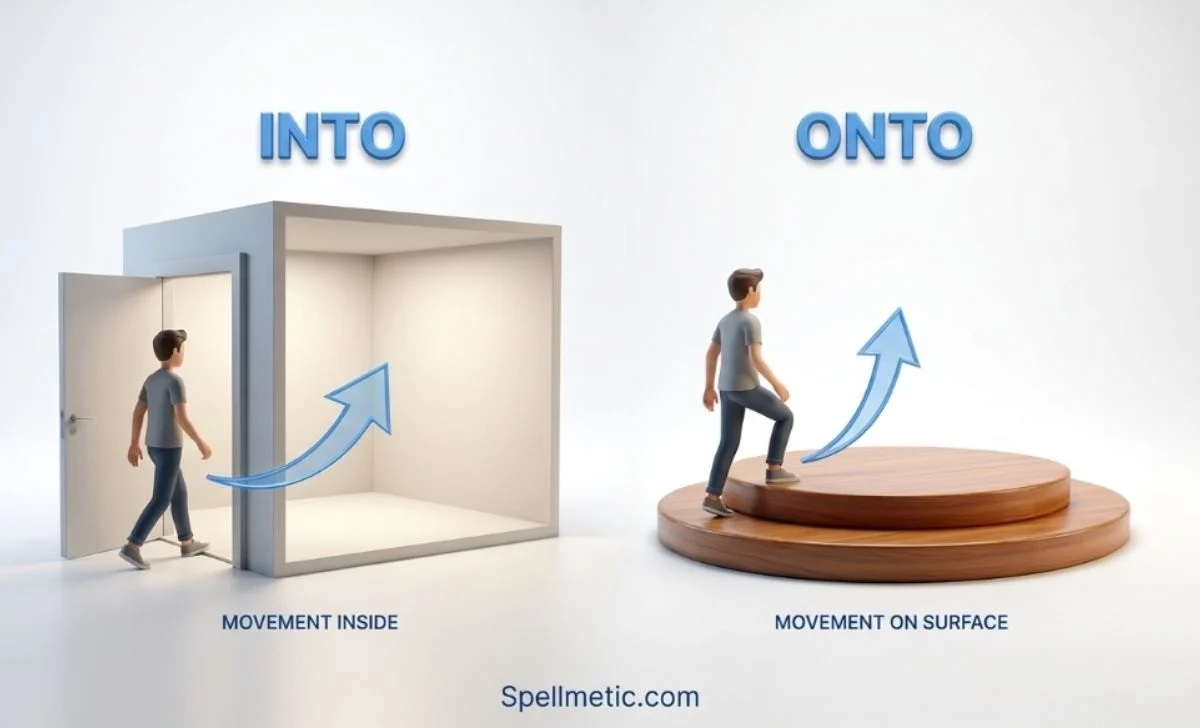
If you are unsure whether to write “into” or “onto,” the easiest way to decide is to look at the destination.
Into usually describes movement from outside to the inside of something, while onto describes movement to a position on a surface.
For example, you walk into a room, but you step onto a stage. You put milk into a glass, but you put a book onto a table.
The confusion becomes greater when phrases such as in to and on to are involved. These look almost identical but can have different grammatical functions.
There are also cases where into and onto have figurative meanings that go beyond physical movement.
This guide explains the difference clearly, with practical examples and the common situations where English learners often hesitate.
Onto or Into: Quick Answer
The basic distinction is:
- Into = movement toward or inside an enclosed space, container, situation, or state.
- Onto = movement toward and onto a surface or position.
Compare:
- She walked into the room.
- She stepped onto the platform.
- Pour the water into the bottle.
- Put the phone onto the desk.
A useful memory trick is:
Into → inside
Onto → on a surface
However, this is only the starting point. Both words have other meanings, so context matters.
What Does “Into” Mean?
Into is a preposition commonly used to show movement from outside to the inside of something. It can also describe a change, involvement, interest, or contact.
Into for Movement Inside
Use into when someone or something moves from an outside position to an interior space.
- The children ran into the house.
- He walked into the kitchen.
- She put the clothes into the suitcase.
- The dog jumped into the car.
Notice the difference between position and movement:
- The dog is in the car.
- The dog jumped into the car.
Into for Change or Transformation
Beyond physical movement, into can also show that something changes from one form, state, or condition to another.
The old building was transformed into a hotel.
The caterpillar changed into a butterfly.
The small business grew into a successful company.
The discussion turned into an argument.
- The caterpillar changed into a butterfly.
- The small business grew into a successful company.
- The discussion turned into an argument.
- The old building was transformed into a hotel.
Here, into does not mean physically entering an enclosed space. It shows a change of state, form, or condition.
Into for Interest or Involvement
In everyday English, into can indicate interest or involvement.
- I’m really into photography.
- She’s into classical music.
- He’s getting into fitness.
- They are into outdoor activities.
This usage is especially common in conversational English.
Into for Contact or Collision
Into can also indicate that something moves forcefully against another object.
- The car crashed into a wall.
- The ball flew into the window.
- He accidentally walked into the door.
The object doesn’t necessarily enter the wall or door. Instead, into expresses movement toward and contact with it.
What Does “Onto” Mean?
Onto is a standard English preposition. It generally describes movement to a position on a surface.
Onto for Movement to a Surface
Use onto when someone or something moves from one position to a surface.
- The cat jumped onto the sofa.
- She stepped onto the stage.
- The child climbed onto the bed.
- The athlete ran onto the field.
Compare:
The cat is on the sofa.
The cat jumped onto the sofa.
Using “Onto” for Movement to a Surface
Use onto when a person or object moves from one position and ends up on a surface.
The cat jumped onto the sofa.
She put the keys onto the table.
The child climbed onto the bed.
He placed the files onto the desk.
- Put the keys onto the table.
- He placed the documents onto the desk.
- She transferred the files onto a USB drive.
In many everyday sentences, on can also sound natural, particularly in American English. The choice can depend on the verb and the emphasis on movement.
Figurative Uses of Onto
Onto can have meanings that aren’t literally about a physical surface.
For example:
- The detective knew he was onto something.
- She realized that the reporter was onto her plan.
In these sentences, onto means becoming aware of, discovering, or suspecting something.
Into vs. Onto: Side-by-Side Comparison
| Feature | Into | Onto |
|---|---|---|
| Basic idea | Movement inside | Movement to a surface |
| Main relationship | Interior | Surface or position |
| Example | Walk into the room | Walk onto the stage |
| Position equivalent | in | on |
| Common use | Entering a place | Stepping or placing on something |
| Other meanings | Change, interest, collision | Awareness, figurative discovery |
The simplest question to ask is:
Where does the movement end?
If it ends inside, choose into.
If it ends on a surface, choose onto.
Into vs. In: What’s the Difference?
This is one of the most common preposition mistakes.
In normally describes a location or position.
Into normally describes movement toward the inside.
Compare:
- The students are in the classroom.
- The students walked into the classroom.
- The keys are in the drawer.
- She put the keys into the drawer.
- The dog is in the garden.
- The dog ran into the garden.
A quick test is to ask whether the sentence describes where something is or where it is moving.
On vs. Onto: What’s the Difference?
The same principle applies to on and onto.
On usually describes position.
Onto emphasizes movement to a surface or position.
Compare:
- The book is on the table.
- She placed the book onto the table.
- The bird is on the roof.
- The bird flew onto the roof.
- He is on the platform.
- He stepped onto the platform.
In informal English, speakers sometimes use on where onto could emphasize movement. The important thing is understanding the intended relationship.
Into vs. In To: One Word or Two?
This distinction causes a lot of confusion because into and in to sound similar.
When “Into” Is One Word
Use into when it functions as a preposition showing movement, change, or another relationship.
- She walked into the office.
- Pour the juice into the glass.
- The company changed into a new business model.
- He is into jazz.
When “In To” Is Two Words
Use in to when in and to belong to separate parts of the sentence.
- She came in to ask a question.
- He went in to see the doctor.
- The suspect turned himself in to the police.
A useful approach is not to decide based only on pronunciation. Look at the grammatical role of each word.
Compare:
She walked into the room.
Here, into connects the movement with the destination.
She came in to speak with the manager.
Here, in relates to coming inside, while to speak introduces purpose.
Onto vs. On To: One Word or Two?
The same issue occurs with onto and on to.
When “Onto” Is One Word
Use onto when it functions as a preposition meaning movement to a surface or position.
- The child climbed onto the chair.
- The bird landed onto the branch.
- He stepped onto the stage.
When “On To” Is Two Words
Use on to when on and to perform separate grammatical jobs.
- Let’s move on to the next question.
- She went on to become a successful writer.
- The teacher moved on to another topic.
This is why “onto” and “on to” cannot always be treated as interchangeable spellings.
Common Mistakes With Into and Onto
Mistake 1: Using “onto” for an enclosed space
Incorrect:
- She walked onto the room.
Correct:
- She walked into the room.
A room has an interior, so into is the natural choice.
Mistake 2: Using “into” for a surface
Incorrect:
- The cat jumped into the table.
Correct:
- The cat jumped onto the table.
The cat moves to the surface of the table.
Mistake 3: Confusing “in” with “into”
Compare:
- The children are in the pool.
- The children jumped into the pool.
The first sentence describes location. The second describes movement.
Mistake 4: Automatically combining “on” and “to”
Not every on to should become onto.
- Let’s move on to the next chapter.
Here, on to expresses progression, not physical movement onto a surface.
Into or Onto: Real-Life Examples
Seeing the words in different contexts makes the distinction much easier.
Home
- She went into the bedroom.
- He climbed onto the bed.
- Put the milk into the refrigerator.
- Place the plates onto the table.
School
- The students walked into the classroom.
- The actor stepped onto the stage.
- She put her notebook into her backpack.
- He placed the project onto the teacher’s desk.
Work
- The manager walked into the meeting room.
- The presenter stepped onto the platform.
- The company expanded into a new market.
- The discussion moved on to another subject.
While Traveling
- We got into the car.
- We got onto the bus.
- The passengers walked into the terminal.
- The cyclist moved onto the main road.
Abstract Situations
- She got into trouble.
- He became into? ❌
- He became interested in photography.
- He is really into photography.
- The conversation turned into an argument.
- The detective realized he was onto something.
These examples show why meaning and context are more important than memorizing a single rule.
Onto or Into in a Sentence
Here are some contrasting examples:
- The boy ran into the house.
- The boy climbed onto the roof.
- She poured water into the bottle.
- She placed the bottle onto the counter.
- The dog jumped into the pool.
- The cat jumped onto the sofa.
- He walked into the office.
- He stepped onto the stage.
- The company moved into a new market.
- The speaker moved on to the next topic.
The pattern becomes clearer when the examples are placed side by side.
When Should You Use “Into”?
Use into when the meaning involves:
- entering an interior space
- putting something inside a container
- movement toward an enclosed area
- changing from one state or form to another
- collision or contact
- involvement or interest
Examples include walk into, put into, turn into, crash into, and get into.
When Should You Use “Onto”?
Use onto when the meaning involves:
- movement to a surface
- stepping or climbing onto something
- placing something on a surface
- movement to a particular position
- certain figurative meanings
Examples include jump onto, step onto, climb onto, and place onto.
Is “Onto” Grammatically Correct?
Yes. Onto is grammatically correct and is a standard English preposition.
For example:
- The child climbed onto the chair.
- The bird flew onto the roof.
- She stepped onto the platform.
However, don’t assume that onto should replace every occurrence of on to. When on and to have separate grammatical functions, the two-word form is appropriate.
Is “Into” Grammatically Correct?
Yes. Into is also a standard English preposition.
It is used in sentences such as:
- He walked into the room.
- She put the letter into the envelope.
- The discussion turned into an argument.
- They moved into a new house.
It can describe physical movement as well as abstract relationships such as transformation and involvement.
A Simple Way to Remember the Difference
Think about the destination:
Inside something → INTO
She walked into the store.
On a surface → ONTO
She walked onto the platform.
Then compare their position words:
in → into
on → onto
- The phone is in the bag. → She put the phone into the bag.
- The phone is on the desk. → She put the phone onto the desk.
Finally, remember that in to and on to can be separate constructions. Don’t combine them simply because the words sound similar.
FAQs
1. When should I use “onto”?
Use onto when something moves to a position on a surface or sometimes to a particular position. For example, “The cat jumped onto the sofa.”
2. What is the difference between “upon” and “into”?
Upon generally means “on” or “immediately after,” depending on context, while into commonly expresses movement inside, change, or movement toward something. For example, “The book is upon the table” and “She walked into the room.”
3. What is the difference between “over” and “onto”?
Over generally describes a position or movement above or across something, while onto describes movement to a position on a surface. For example, “The bird flew over the house” versus “The bird landed onto the roof.”
4. What’s the difference between “into” and “in”?
In usually describes a position or location, while into generally describes movement toward or inside that location. Compare “She is in the room” with “She walked into the room.”
5. Is “onto” grammatically correct?
Yes. Onto is a standard English preposition. It commonly indicates movement to a surface or position.
6. Is “onto” a preposition?
Yes. Onto is commonly used as a preposition, especially to indicate movement toward and onto a surface.
7. What does “onto” mean?
Onto generally means moving to a position on something. For example, “The child climbed onto the chair.” It can also have figurative meanings, such as being aware of something suspicious.
8. When should we use “into”?
Use into when you want to express movement inside something, a change into another state, contact or collision, or involvement in something.
9. Which is correct: “move into” or “move in to”?
Both can be correct, but they have different grammatical structures. Move into means move inside or to a new place, while move in to is used when in and to perform separate functions.
10. What is the difference between “into” and “onto”?
Into generally shows movement inside or toward an interior, while onto generally shows movement to a surface or position. “She walked into the building” and “She stepped onto the stage” illustrate the basic difference.
Final Verdict
The simplest distinction is easy to remember:
Into = movement inside
Onto = movement to a surface
So you walk into a room, get into a car, or pour water into a glass. You step onto a stage, climb onto a roof, or put a book onto a desk.
But good English usage goes beyond that basic rule. Into can describe transformation, collision, interest, and involvement, while onto can have figurative meanings.
And when you encounter in to or on to, check whether the words are functioning separately before combining them.
Once you focus on where the movement ends and what the sentence means, choosing between these easily confused prepositions becomes much more straightforward.