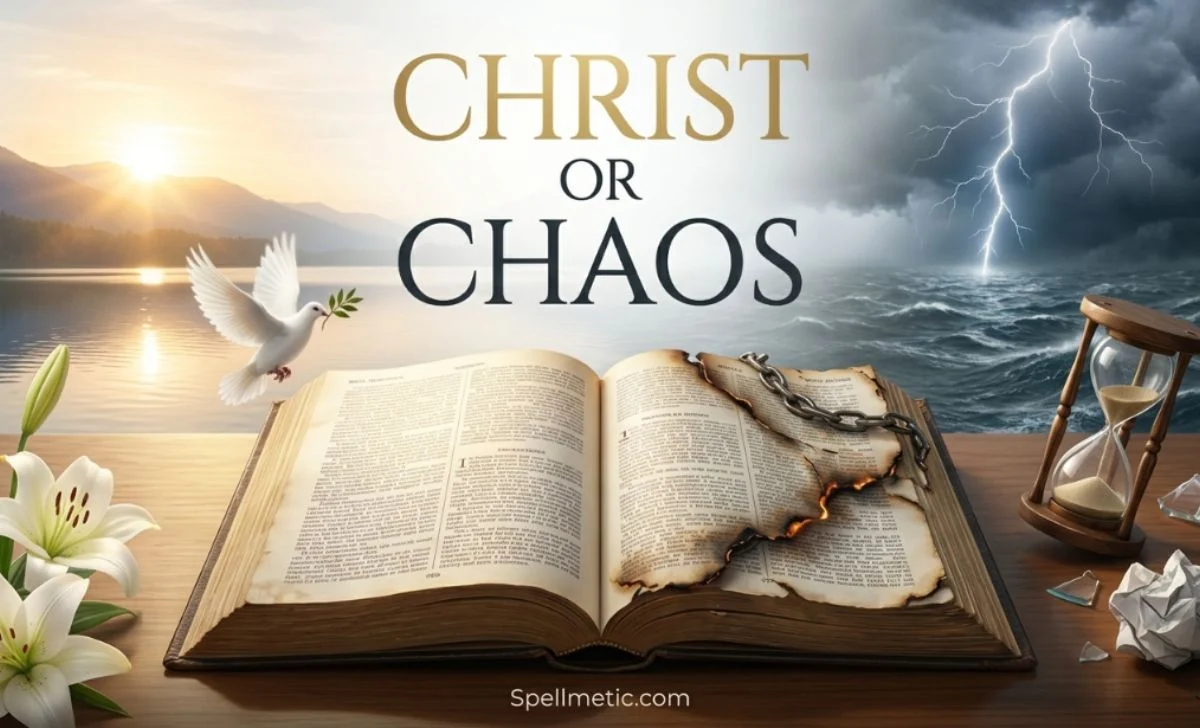
Christ or Chaos is a Christian phrase that presents a contrast between a life centered on Jesus Christ and one marked by disorder, confusion, or a lack of spiritual direction.
The phrase is used in discussions about Christianity, morality, truth, purpose, culture, and worldview.
It is important to know that “Christ or Chaos” is not a direct Bible verse or a quotation from Jesus.
Instead, it is a later Christian expression built around biblical themes such as creation, order, sin, redemption, peace, and God’s authority.
The phrase can also refer to several specific works and uses. These include Dan DeWitt’s book Christ or Chaos, Christian sermons and videos, Thomas A.
Droleskey’s Catholic commentary, and Christian clothing featuring the slogan.
Quick Answer
Christ or Chaos generally means a contrast between Christ-centered truth, purpose, morality, and spiritual order and a condition of confusion, disorder, or life without a clear foundation.
The phrase is often used as a Christian worldview statement. It suggests that people must consider what ultimately gives life meaning, establishes moral values, and provides direction.
However, the exact meaning depends on the context. In a biblical discussion, “chaos” may refer to disorder or brokenness.
Apologetics, it can describe the philosophical problem of finding meaning and morality without God. In other cases, it may simply be a Christian slogan used on a shirt, sermon, or video.
What Does “Christ or Chaos” Mean?
The word Christ refers to Jesus Christ and, within Christianity, to His role as Lord, Savior, and the center of the Christian faith.
The word chaos generally means disorder, confusion, instability, or a lack of structure.
Put together, Christ or Chaos creates a strong contrast:
- Christ — truth and faith
- Christ — purpose and hope
- Christ — moral direction
- Christ — peace and reconciliation
- Chaos — confusion and disorder
- Chaos — uncertainty and instability
For example, a Christian might use the phrase when discussing a society struggling with conflict, moral disagreement, or loss of purpose. The intended message is that faith in Christ offers a framework for understanding those problems.
The phrase is therefore better understood as a worldview statement than as a simple dictionary definition.
Is “Christ or Chaos” in the Bible?
No. “Christ or Chaos” does not appear in the Bible as a direct quotation or verse.
The ideas behind the phrase, however, connect with several biblical themes.
Genesis begins with a world described as formless and empty, followed by God’s work of creation and ordering. Scripture also repeatedly discusses peace, wisdom, righteousness, sin, redemption, and restoration.
Because of these themes, Christians sometimes use “Christ or Chaos” as a concise expression for the contrast between God’s order and the brokenness of life apart from Him.
Still, it is important not to present the slogan itself as biblical wording. Saying that the phrase is inspired by biblical themes is more accurate.
What Is the Biblical Meaning of Chaos?
The biblical meaning of chaos depends on the passage being discussed. In everyday English, chaos means complete disorder or confusion. Biblical discussions can use related ideas when talking about creation, darkness, disorder, human brokenness, or opposition to God’s purposes.
Genesis 1:2 is often brought into this discussion because it describes the earth as formless and empty, with darkness over the deep. God then begins bringing structure and distinction to creation.
The Bible also presents a world affected by sin and brokenness. People experience suffering, conflict, injustice, fear, and death. Christian teaching connects these realities with humanity’s fallen condition while also pointing toward redemption.
Therefore, “chaos” in Christian discussions can refer to:
- disorder
- confusion
- darkness
- human brokenness
- moral disorder
- spiritual separation
- a lack of direction
These meanings should not be treated as interchangeable in every biblical passage. Context still matters.
Chaos and Creation in Genesis
Genesis 1 presents God as the creator who brings distinction and structure to creation.
Light is separated from darkness, waters are divided, dry land appears, and living things are brought forth. The narrative presents creation as purposeful rather than meaningless.
This is one reason Christians connect God with order and purpose when explaining the phrase “Christ or Chaos.”
Chaos, Sin, and a Broken World
Christianity does not teach that becoming a believer removes every form of disorder from life.
A Christian can still experience grief, financial problems, broken relationships, illness, injustice, and uncertainty. The difference is that Christian faith provides a framework for understanding suffering and responding to it.
The hope is not that Christians will never encounter chaos, but that God remains sovereign and redemption is possible even in a broken world.
How Does God Bring Order Out of Chaos?
The Bible presents God’s ordering work in several ways.
Creation is the first major example. God brings the created world into existence and gives it structure.
Human life is also given moral direction through God’s commands and covenant relationship.
Christ’s redemptive work becomes central to Christian teaching about reconciliation between God and humanity.
Finally, Scripture points toward new creation, where restoration reaches its fullest expression.
A simple way to understand the biblical pattern is:
Creation → Order → Brokenness → Redemption → Restoration
Consider a real-life example. Someone may lose a job and suddenly feel that everything has become uncertain. Christianity does not promise an immediate new job. Instead, faith can provide a way to approach the situation through prayer, wise decisions, community support, perseverance, and hope.
That is the practical sense in which Christians may talk about God bringing order out of chaos.
What Did Jesus Say About Chaos?
Jesus did not use the exact phrase “Christ or Chaos.”
His teachings, however, repeatedly addressed fear, anxiety, conflict, suffering, temptation, forgiveness, and peace.
The Gospels also describe Jesus calming a storm while His disciples were afraid. The account is frequently used in Christian teaching to illustrate trust in Christ during frightening circumstances.
Jesus also taught His followers to love others, forgive, seek God’s kingdom, and trust God rather than allowing fear to control their lives.
So when Christians connect Jesus with the idea of bringing order to chaos, they are generally drawing a theological conclusion from His teachings and actions, rather than quoting a statement in which Jesus used the phrase itself.
Where Did the Phrase “Christ or Chaos” Come From?
The expression has a history that predates modern websites, social media, and Christian merchandise.
One important influence is Dorothy Sayers, whose famous work Creed or Chaos? addressed the importance of Christian doctrine and its consequences for human life.
The expression “Christ or chaos” later became associated with Peter Marshall, who served as Chaplain of the United States Senate. A 1947 quotation attributed to Marshall used the phrase while discussing the direction of society.
This history helps explain why the phrase appears in different Christian contexts today.
It is also important not to assume that every modern use comes from one single source. Christian writers, ministries, and publishers have used the expression in different ways.
Dorothy Sayers and “Creed or Chaos?”
Dorothy Sayers is relevant because of her work “Creed or Chaos?”
Her argument was concerned with the practical consequences of Christian doctrine. She challenged the idea that Christian belief was merely a collection of abstract religious statements with no connection to everyday life.
This makes her work an important historical comparison when researching Christ or Chaos.
The two phrases are not identical, but they share a concern with what happens when people lose a coherent framework for understanding life, morality, and human purpose.
Peter Marshall and “Christ or Chaos”
Peter Marshall was a Scottish-American preacher who became Chaplain of the United States Senate.
His use of “Christ or chaos” helped popularize the expression in a public and cultural context during the 1940s.
The phrase was particularly powerful because it presented Christianity not simply as a private religious belief but as something connected with the direction of society.
This historical usage is one reason the keyword can lead searchers toward material that is quite different from Dan DeWitt’s later book.
Christ or Chaos as a Christian Worldview
A worldview is a broad framework through which people understand reality, knowledge, morality, human nature, and purpose.
This is where the phrase becomes more philosophical.
Christian apologetics often asks questions such as:
- Why does anything exist?
- Does human life have objective meaning?
- Where does morality come from?
- Is there a basis for human dignity?
- How should we understand suffering?
- Can reason and faith work together?
Dan DeWitt’s Christ or Chaos explores several of these questions through a Christian apologetics framework.
The Christian answer is that God provides the ultimate foundation for meaning, morality, and purpose. Other worldviews, including atheistic and naturalistic perspectives, approach these questions differently.
These are philosophical and worldview debates, so they should not be presented as though every question has one universally accepted interpretation.
Christ, Meaning, and Purpose
Christianity teaches that human beings are created by God and therefore have value and purpose.
That belief influences Christian ideas about:
- human dignity
- morality
- responsibility
- love
- justice
- forgiveness
- suffering
- hope
- eternal life
For someone asking whether life has meaning beyond personal success or pleasure, this is an important reason the phrase Christ or Chaos resonates within Christian apologetics.
Christ or Chaos by Dan DeWitt
One of the most significant search meanings for this keyword is Dan DeWitt’s book Christ or Chaos.
Published by Crossway in 2016, the 144-page book uses an accessible narrative to explore Christianity, atheism, worldview questions, and human existence. Crossway describes the story as following a college student named Thomas as he wrestles with questions surrounding Christianity and atheism.
The book explores subjects including:
- reality
- the cosmos
- God
- transcendence
- meaning
- morality
- suffering
- hope
It is particularly relevant for readers interested in Christian apologetics and questions about whether Christianity provides a coherent explanation of human existence.
So if someone searches for “Christ or Chaos book” or “Christ or Chaos Dan DeWitt,” they may be looking for this specific work rather than asking about the phrase generally.
Christ or Chaos and Thomas A. Droleskey
There is another distinct use of the phrase associated with Thomas A. Droleskey and Catholic commentary.
Historical records identify Christ or Chaos as the title of Droleskey’s Catholic commentary publication.
This is separate from Dan DeWitt’s Crossway book. The two should not be treated as the same publication simply because they share the title.
This distinction is useful for readers who encounter “Christ or Chaos Droleskey” in search results.
Christ or Chaos Sermons and YouTube
The phrase is also used for Christian sermons, podcasts, and online videos.
In these contexts, the title may focus on spiritual confusion, cultural change, biblical truth, discipleship, or the authority of Christ.
For example, Apologia Studios has used “Christ or Chaos” as the title of Christian media content.
Because several ministries can use the same phrase, a search for “Christ or Chaos YouTube” does not necessarily refer to one official video.
What Does a “Christ or Chaos” Shirt Mean?
A Christ or Chaos shirt generally uses the phrase as a public expression of Christian belief.
The slogan appears on Christian T-shirts, hoodies, stickers, and other merchandise. Some Christian retailers currently organize products around the phrase.
On clothing, the intended message is usually straightforward: the wearer is identifying with Christ-centered faith rather than spiritual or moral disorder.
The exact design can add its own meaning, so a shirt should not automatically be treated as representing every Christian interpretation of the phrase.
Christ or Chaos vs. Creed or Chaos
Although these phrases are related, they are not identical.
| Phrase | Main context | Basic idea |
|---|---|---|
| Christ or Chaos | Christian worldview and later Christian usage | Christ contrasted with disorder or competing worldviews |
| Creed or Chaos | Associated with Dorothy Sayers | Christian doctrine contrasted with a loss of coherent belief |
The historical connection is useful because it explains why both phrases sometimes appear in discussions of Christianity, culture, and social order.
Common Misunderstandings About Christ or Chaos
It is not a Bible verse
The phrase is a later Christian expression rather than a quotation from Scripture.
It is not only a book
Dan DeWitt’s book is one important use, but the phrase also appears in sermons, commentary, historical writing, and apparel.
Dan DeWitt and Thomas Droleskey wrote different works
Both are associated with the phrase, but their works belong to different Christian contexts.
Chaos does not always mean literal destruction
Depending on the context, it can refer to confusion, disorder, brokenness, instability, or a lack of coherent meaning.
The phrase should not replace biblical context
A slogan can summarize an idea, but individual Bible passages should still be interpreted according to their context.
FAQs
1. What is the biblical meaning of chaos?
The biblical idea of chaos can involve disorder, formlessness, darkness, confusion, or brokenness depending on the passage. Genesis 1 presents God bringing structure and distinction to creation.
2. How does God bring order out of chaos?
The Bible presents God bringing order through creation, His sovereign rule, redemption, and ultimately the restoration associated with Christ and the new creation.
3. What is the spiritual meaning of chaos?
Spiritually, chaos can describe confusion, fear, instability, sin, or a lack of direction. Christian teaching contrasts these conditions with God’s truth, peace, wisdom, and purpose.
4. What did Jesus say about chaos?
Jesus did not use the phrase “Christ or Chaos.” His teachings addressed fear, suffering, conflict, trust, forgiveness, peace, and God’s kingdom.
5. Is “Christ or Chaos” a Bible verse?
No. “Christ or Chaos” is not a Bible verse. It is a later Christian expression based on ideas found throughout Scripture.
6. Who wrote Christ or Chaos?
Dan DeWitt wrote Christ or Chaos, published by Crossway in 2016. The book explores Christianity, atheism, worldview questions, and human meaning.
7. What is Christ or Chaos by Dan DeWitt about?
The book examines Christianity and atheism through questions about reality, God, morality, meaning, suffering, and hope. It presents these issues through an accessible narrative rather than a purely academic format.
8. What does a Christ or Chaos shirt mean?
A Christ or Chaos shirt generally communicates a Christian message that places Christ-centered faith, truth, purpose, and morality in contrast with disorder or spiritual confusion.
9. What is the difference between Christ or Chaos and Creed or Chaos?
“Creed or Chaos” is particularly associated with Dorothy Sayers, while “Christ or Chaos” has been used by later Christian writers, speakers, and organizations. The phrases overlap in their concern with Christian belief and social order.
10. Is Christ or Chaos associated with Thomas Droleskey?
Yes. Thomas A. Droleskey used Christ or Chaos as the title of a Catholic commentary publication. This is separate from Dan DeWitt’s book.
Final Thoughts
Christ or Chaos is a phrase about more than disorder versus religion. It is commonly used to raise larger questions about truth, morality, purpose, human dignity, faith, and the direction of society.
Its meaning becomes clearer when its different uses are separated. Biblically, the phrase draws on themes of creation, order, sin, redemption, peace, and restoration.
Historically, it has connections with Christian thinkers and public figures such as Dorothy Sayers and Peter Marshall.
In modern usage, it can refer to Dan DeWitt’s apologetics book, Thomas Droleskey’s Catholic commentary, Christian sermons, YouTube content, or religious apparel.
Most importantly, “Christ or Chaos” should not be presented as a direct biblical quotation. It is a later expression that Christians use to summarize a particular worldview:
The belief that Christ provides the ultimate foundation for truth, meaning, morality, and hope.
Understanding that distinction makes the phrase easier to interpret—whether you encountered it in a Bible discussion, a book, a sermon, a search result, or on a Christian shirt.
Read More Blogs: