When talking about damaged clothes, paper, fabric, or other materials, you may hear both rips and tears.
This can make it difficult to know whether there is a real difference between the two words or whether they can be used interchangeably.
The good news is that rip and tear are very closely related. Both can describe material being pulled or separated, leaving a damaged opening.
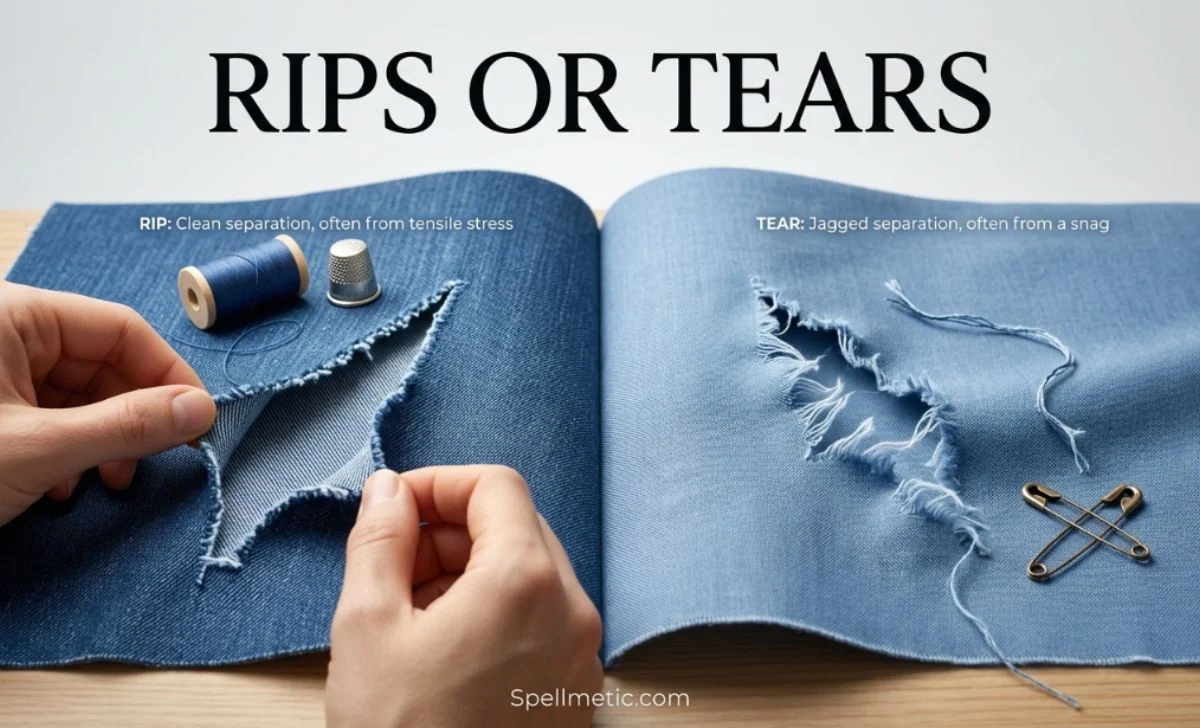
However, they can create slightly different impressions depending on the situation. Rip often suggests a quick, forceful action, while tear is the broader and more general word.
Merriam-Webster similarly explains that tear can imply pulling something apart by force, while rip often suggests a rapid motion along a line or joint.
There is another important point: tear has a completely different meaning when it refers to crying. In that meaning, it is pronounced differently.
Quick Answer
Rips and tears can both refer to damaged or split areas in cloth, paper, or similar materials.
- Rip often suggests a quick or forceful separation.
- Tear is a more general word for pulling or splitting something apart.
- A rip is usually the damaged opening itself.
- A tear can also mean a drop of liquid from the eye.
- Ripped is the past tense of rip.
- Tore is the past tense of tear when tear means to rip.
For example:
- There is a rip in my jeans.
- There is a tear in my jeans.
- I ripped my shirt on a nail.
- I tore my shirt on a nail.
So, in many clothing situations, rips or tears are both correct.
What Does “Rips or Tears” Mean?
The phrase “rips or tears” refers to damaged areas where fabric, paper, or another material has been pulled apart or split.
For example:
The jacket has no rips or tears.
This means the jacket is not damaged by any visible splits or openings.
The phrase is common in descriptions of clothing, furniture, bags, upholstery, curtains, books, paper, and other physical materials.
The two words are often used together because they overlap in meaning but can describe slightly different types or impressions of damage.
Rip vs. Tear: What Is the Difference?
The main difference is one of emphasis, rather than a strict rule.
Rip
Rip often suggests that something is pulled apart quickly, suddenly, or forcefully.
Examples:
- I ripped my jeans on a fence.
- She ripped the paper in half.
- The dog ripped the cushion.
- He ripped open the package.
Cambridge defines rip as pulling something apart or tearing it violently and quickly.
Tear
Tear is a broader word. It can describe something being pulled apart or damaged without emphasizing the speed of the action.
Examples:
- I tore my shirt.
- She tore the letter into pieces.
- There is a tear in the curtain.
- The fabric tore when I pulled it.
Merriam-Webster notes that tear can mean separating something forcibly and leaving jagged edges.
Simple Rule
you are describing the damage, both words often work:
- a rip in my shirt
- a tear in my shirt
If you are describing a quick, forceful action, rip can sound more natural:
- He ripped the paper.
- She ripped open the package.
If you simply mean that something became damaged or split, tear is often natural:
- My shirt tore.
- The fabric tore at the seam.
Rips or Tears in Clothing
Rips or tears in clothing are openings or damaged sections caused by pulling, snagging, stretching, or contact with a sharp object.
Both expressions are natural:
- There is a rip in my jeans.
- There is a tear in my jeans.
- My jacket has several rips.
- My jacket has several tears.
In everyday English, rip can sound particularly natural when talking about jeans, shirts, jackets, and other clothing that has been damaged suddenly.
For example:
My jeans got a rip when I caught them on the fence.
You could also say:
My jeans got a tear when I caught them on the fence.
Neither sentence is grammatically wrong.
Cambridge gives clothing examples such as trousers ripping while bending down and a shirt ripping on a nail.
What Does “No Rips or Tears” Mean?
“No rips or tears” means that an item has no visible splits, holes, or damaged sections caused by tearing.
You may see this phrase in:
- clothing descriptions
- secondhand clothing listings
- furniture descriptions
- book listings
- fabric descriptions
- bag and luggage descriptions
For example:
This jacket is in excellent condition with no rips or tears.
This tells the buyer that the material is not visibly damaged.
The phrase uses both words because “rips or tears” is a familiar combination that broadly covers this type of physical damage.
Is “Rips or Tears” Correct English?
Yes. “Rips or tears” is correct English.
The two words can function as plural nouns when they refer to damaged areas.
For example:
Check the shirt for rips or tears.
Here, rips and tears are nouns.
They can also appear as verbs:
The fabric rips easily.
The fabric tears easily.
The correct choice depends on the sentence and the intended emphasis.
Rips and Tears or Tares?
The correct spelling is “rips and tears”, not “rips and tares,” when you are talking about damaged material.
Tare is a different English word. It can have meanings related to the weight of a container or, in some contexts, a plant.
So:
- rips and tears = damaged or split material
- tares = a different word with a different meaning
Do not replace tears with tares simply because they may sound similar in some contexts.
Tear as in Rip: Pronunciation
One reason tear can be confusing is that it has two different pronunciations and meanings.
When tear means to rip or pull something apart, it is pronounced like “tair”:
tear = /ter/ in common American pronunciation.
Example:
Be careful not to tear the paper.
When tear means a drop that comes from your eye, it has a different pronunciation:
tear = /tɪr/
Example:
A tear rolled down her cheek.
So these two sentences use the same spelling but different meanings and pronunciations:
- Tear the paper. → to rip
- A tear fell from his eye. → liquid from the eye
Merriam-Webster lists these as separate meanings, and its pronunciation entries distinguish the two forms.
Tear vs. Tear: Rip vs. Cry
The word tear has two major everyday meanings that learners should keep separate.
Tear = Rip
This is the verb:
Don’t tear the page.
Past tense:
She tore the page.
Past participle:
The page has been torn.
Notice that the past tense is tore, not “teared.”
Tear = Crying Drop
This is the noun:
A tear appeared in his eye.
Plural:
She wiped away her tears.
This meaning is connected with crying or the liquid produced by the eyes.
Understanding the pronunciation and context makes the difference much easier to recognize.
Ripping and Tearing: Common Word Forms
Here are the most useful forms:
| Word | Meaning | Example |
|---|---|---|
| rip | pull apart quickly or forcefully | Don’t rip the paper. |
| rips | present-tense form or plural noun | The shirt has two rips. |
| ripped | past tense/past participle | I ripped my jeans. |
| ripping | -ing form | The paper is ripping. |
| tear | pull apart | Don’t tear the page. |
| tears | present-tense form or plural noun | There are tears in the fabric. |
| tore | past tense of tear | She tore her sleeve. |
| torn | past participle | The sleeve is torn. |
| tearing | -ing form | The fabric is tearing. |
The spelling ripped and ripping follows the normal doubling pattern because rip is a short stressed word ending in a consonant. Merriam-Webster lists ripped and ripping as the standard forms.
Rips or Tears: Which Word Should You Use?
Use rip when you want to emphasize a quick, sudden, or forceful action.
The child ripped the wrapping paper.
Use tear when you want a more general description of pulling or splitting.
I accidentally tore the page.
For a damaged area, either noun can often work:
There is a rip in my shirt.
There is a tear in my shirt.
The best choice depends on the context and the style of English you are using. There is no universal rule saying that one word must always be used for clothing.
Rips or Tears Synonyms
Depending on the context, several words can describe similar kinds of damage.
Common synonyms
- split
- shred
- rend
- rupture
- slash
- cut
- laceration
- hole
- opening
- damage
However, these are not perfect replacements in every sentence.
For example, split often suggests something separating along a line, while shred can suggest being torn into smaller pieces. Slash usually involves cutting with something sharp.
Merriam-Webster lists tear, rend, shred, cut, split, break, slash, and several other words among related terms for rip.
Common Mistakes With Rip and Tear
1. Using “teared” for the past tense
Incorrect:
I teared my shirt.
Correct:
I tore my shirt.
When tear means “rip,” its past tense is tore and its past participle is torn.
2. Confusing “tear” with “tears”
The sentence determines the meaning:
There is a tear in my shirt.
Here, tear means a damaged opening.
There were tears in her eyes.
Here, tears means drops of liquid from the eyes.
3. Writing “tares” instead of “tears”
When talking about damaged clothing, use tears, not tares.
Correct:
The trousers have several tears.
4. Assuming rip and tear are completely different
They overlap considerably. A shirt can have either a rip or a tear.
Examples of Rips and Tears in Everyday English
- My jeans have a small rip near the pocket.
- There is a tear in the sleeve.
- I ripped my jacket on a nail.
- She accidentally tore the page.
- The old fabric is tearing easily.
- Check the bag for rips or tears.
- The shirt has no rips or tears.
- The dog ripped the cushion.
- The curtain has a large tear.
- Be careful not to tear the wrapping paper.
These examples show why both words are useful and why context matters more than trying to create a strict either-or rule.
FAQs
1. What is the difference between rips and tears?
Both describe material being pulled or split apart. Rip often emphasizes a quick or forceful action, while tear is broader.
2. Are rips and tears the same thing?
They can describe the same type of physical damage, especially in clothing, paper, and fabric. The difference is usually one of emphasis and usage.
3. Is it a rip or a tear in clothing?
Both are correct. You can say “a rip in my shirt” or “a tear in my shirt.”
4. What does “no rips or tears” mean?
It means an item has no visible areas where its material has been split, pulled apart, or damaged.
5. What is the pronunciation of tear as in rip?
When tear means “rip,” it is pronounced /ter/ in common American English. It is different from tear meaning a drop from the eye.
6. What is the past tense of rip?
The past tense of rip is ripped.
I ripped my shirt.
7. What is the past tense of tear?
When tear means “rip,” its past tense is tore.
She tore her dress.
Its past participle is torn.
Her dress was torn.
8. Is “rips and tears” correct?
Yes. “Rips and tears” is a common and correct phrase for different forms of physical damage to material.
9. Is “rips and tares” correct?
No, not when you mean damaged clothing or fabric. The correct phrase is “rips and tears.” Tares is a different word.
10. Does tear have two meanings?
Yes. Tear can mean to pull something apart, and tear can also mean a drop of liquid from the eye. These meanings have different pronunciations.
Conclusion
Rips or tears are both correct expressions when discussing damaged clothing, fabric, paper, and similar materials.
Although the words overlap, rip often suggests a quick or forceful action, while tear is a broader term for pulling or splitting something apart. Both “a rip in my shirt” and “a tear in my shirt” are natural English.
The biggest point to remember is that tear has another completely different meaning related to crying.
When it means “to rip,” its past tense is tore and its past participle is torn. When it refers to liquid from the eye, its pronunciation changes.
For everyday English, phrases such as “rips or tears,” “no rips or tears,” “rips and tears,” and “a tear in the fabric” are all useful.
Once you understand the context, choosing between rip and tear becomes much easier.
Read More Blogs: