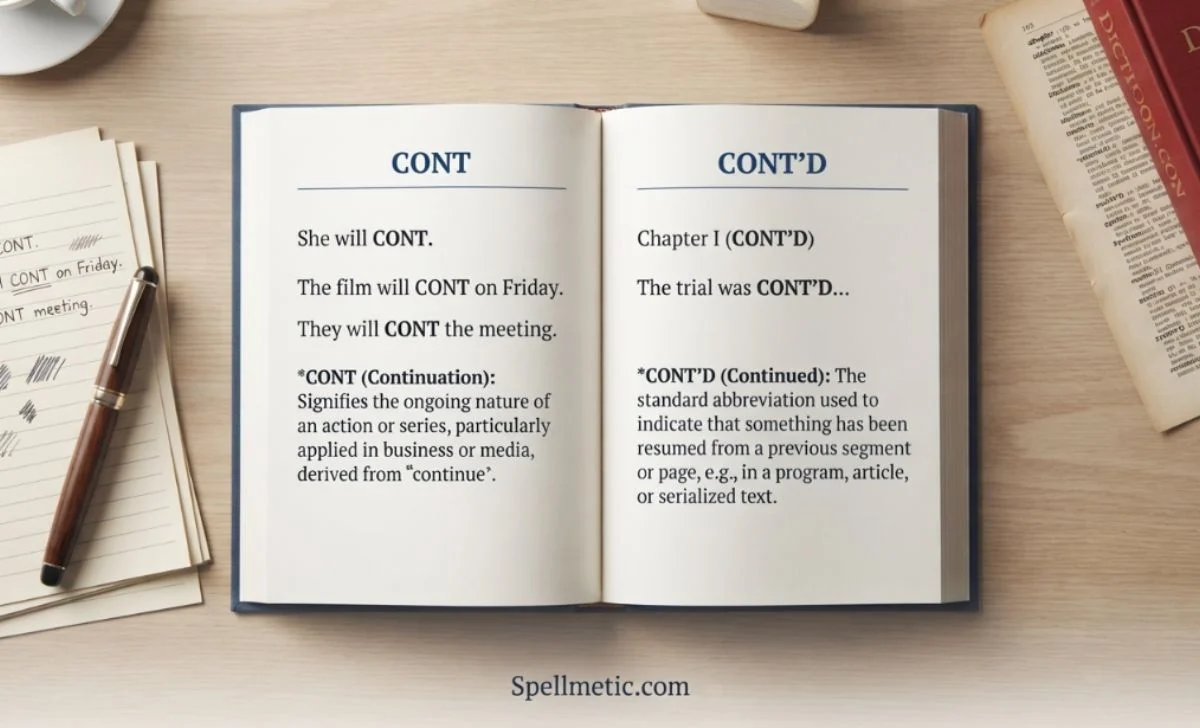
If you have seen con’t, cont’d, cont., or contd, you may have wondered whether they all mean the same thing—and which form you should actually use.
The short answer is that cont., contd, and cont’d are established shortened forms of continued, although their preferred use can depend on the context and style being followed.
Con’t does appear in some real-world documents, but it is not the form to choose for polished general English when a standard alternative is available.
That distinction matters because continued is shortened differently in ordinary documents, publishing, and screenplays.
A business report might use cont., while a screenplay commonly uses (CONT’D) beside a character’s name.
In this guide, you’ll learn what each form means, how cont. differs from cont’d, whether con’t is actually correct, what CONT’D means in a screenplay or presentation, and when writing the full word continued is the clearest choice.
Quick Answer
For most standard writing, cont. and contd are established abbreviations for continued, while cont’d is also a recognized shortened form.
Merriam-Webster lists cont’d as an abbreviation of continued, and Cambridge lists cont. and contd as written abbreviations for the same word.
| Form | Meaning | Best practical use |
|---|---|---|
| cont. | continued | Documents, reports, tables, page references |
| contd | continued | Abbreviated headings and space-limited contexts |
| cont’d | continued | Screenplays, publishing, and other established editorial contexts |
| con’t | intended to mean continued | Best avoided in polished general writing |
| continued | continued | Clearest choice when space is not limited |
So, if you are writing a normal business document and need a short form, cont. is a safe choice.
If you are formatting a screenplay, CONT’D is a familiar convention. If there is enough space, simply writing continued removes the ambiguity altogether.
What Does “Continued” Mean?
Continued means that something carries on rather than ending. In documents, it can tell readers that an article, table, discussion, or other material carries over to another page or section.
For example:
Sales Report — continued
Or:
Continued on page 7
Cambridge specifically gives cont. as the written abbreviation for continued and notes its use to show that a document continues on another page.
The related noun continuation refers to something that continues or follows from something else.
Simple examples
- The article is continued on page 12.
- The article is cont. on page 12.
- The next section is a continuation of the previous discussion.
What Is the Short Form of Continue?
There is no single standard abbreviation for the verb continue itself. The forms cont., contd, and cont’d are commonly used for continued, especially when something carries on from a previous page, section, slide, or line.
If you mean continued, common shortened forms include cont., contd, and cont’d.
For example:
Chapter 2 (cont.)
means “Chapter 2, continued.”
What Does Cont. Mean?
Cont. is a standard written abbreviation of continued. It is particularly useful where space is limited, such as tables, page headings, captions, reports, and printed documents.
For example:
Table 3 (cont.)
or:
Financial Results (cont. on page 8)
Merriam-Webster also lists cont as an abbreviation that can mean continued, although cont. is commonly seen with a period in traditional abbreviation styles.
Cambridge’s Business English entry describes cont. as a written abbreviation for continued used on a letter or document to indicate that more material appears on the next page.
When is cont. useful?
It works especially well when:
- a heading continues onto another page;
- a table is split across pages;
- a report needs a short continuation label;
- space is limited;
- readers already understand the abbreviation.
Is Cont a Word in English?
Cont can appear in English dictionaries as an abbreviation, but it is not normally used as a regular standalone word in everyday writing.
In the context of this article, cont. or cont can represent continued. However, cont can also have other meanings depending on the context, so readers should not automatically assume it means “continued.”
For formal or general writing, use continued when clarity matters, or use an established abbreviation such as cont. when space is limited.
Is Cont a Word in Chat?
In chat and text messages, cont may be used informally to mean continued, especially when someone is indicating that more information is coming.
For example:
I’ll explain the rest in my next message, cont.
However, cont is not a common everyday chat abbreviation for everyone. In casual messaging, writing continued, more to come, or simply finishing the thought in another message can be clearer.
The meaning also depends on context because cont can represent different words or abbreviations.
What Does Cont’d Mean?
Cont’d is another established shortened form of continued. Merriam-Webster has a dedicated entry for cont’d and defines it as an abbreviation of continued, with contd listed as a variant.
The apostrophe signals omitted letters, which is why cont’d looks different from the simple truncated form cont.
You may see it in examples such as:
Chapter 4 (cont’d)
or:
SARAH (CONT’D)
The second example is especially common in screenplay formatting.
Is cont’d formal?
It can be perfectly appropriate when it matches the convention of the publication or format. It should not automatically be labeled “wrong” simply because cont. is also widely used.
The important point is context and consistency.
How Do You Pronounce Cont’d?
Cont’d is pronounced like “continued,” not as separate letters such as “cont dash d.” The apostrophe shows that letters have been omitted from the full word.
For example:
- cont’d → “continued”
- CONT’D → “continued”
- Chapter 4 (cont’d) → read as “Chapter 4, continued.”
The pronunciation stays the same whether cont’d appears in a document, presentation, or screenplay.
Is Con’t Correct?
This is where the issue becomes more nuanced.
Con’t can be found in real-world documents and informal usage with the intended meaning continued. Historical and technical documents also contain examples of CON’T being used for continued.
However, that does not make it the best choice for modern polished general writing.
If you are preparing:
- a business report,
- an academic assignment,
- a professional document,
- published content,
- a formal presentation,
there is little reason to choose con’t when cont., contd, cont’d, or the full word continued is available.
So the practical rule is:
You may encounter con’t, but don’t choose it as your default standard form.
This is more accurate than claiming that the form has never been used.
Why does con’t look unusual?
Writers may create con’t by analogy with familiar contractions such as:
- can’t
- don’t
- won’t
- isn’t
But continued is not normally shortened that way in standard editorial practice. The established dictionary forms give you better alternatives. Cambridge recognizes cont. and contd, while Merriam-Webster recognizes cont’d.
Cont. vs Cont’d: What’s the Difference?
Both forms communicate continued, but they are formed and used somewhat differently.
| Feature | Cont. | Cont’d |
|---|---|---|
| Full word | continued | continued |
| Form | Shortened abbreviation | Apostrophe-based shortened form |
| Meaning | Continued | Continued |
| Common context | Documents, tables, reports | Screenplays, publishing, editorial contexts |
| Example | Table 2 (cont.) | JAMES (CONT’D) |
| Main advantage | Compact and familiar | Fits established continuation conventions |
Neither should be treated as universally superior.
The better choice depends on the type of document and the style guide or formatting convention you are following.
Cont. vs Cont’d vs Contd vs Con’t
Seeing all four together makes the distinction easier.
| Form | Status | Practical recommendation |
|---|---|---|
| cont. | Established abbreviation | Excellent general-purpose choice |
| contd | Established abbreviation | Use when consistent with the chosen style |
| cont’d | Established shortened form | Especially familiar in screenwriting and publishing |
| con’t | Found in real-world usage | Avoid as your default in polished writing |
Cambridge explicitly lists contd as a written abbreviation for continued, while Merriam-Webster lists cont’d and gives contd as a variant.
This is why a simple “one is correct and everything else is wrong” answer can be misleading.
Is Cont a Scrabble Word?
No, “cont” is not accepted as a playable word in standard Scrabble word lists. If you are playing Scrabble and need a valid word, you should use an accepted alternative based on what you mean.
In writing, “cont.” can be used as an abbreviation for continued, but abbreviations are generally not valid Scrabble words.
When Should You Use Cont.?
Business Writing
For a report, memo, or business document, cont. is a compact and familiar option.
Example:
Quarterly Sales Summary (cont.)
Or:
Project Costs (cont. on page 6)
Academic Writing
In an academic document, clarity should come before saving a few characters.
If a table continues onto another page:
Table 4 (cont.)
But in normal prose, writing continued may be more readable.
Tables and Charts
Abbreviations are particularly useful when a table has limited space.
For example:
Table 2. Employee Benefits (cont.)
The Australian Government’s Style Manual specifically notes cont as an abbreviation for continued and says abbreviations can be useful in tables or charts where space is limited. It also recommends avoiding unnecessary abbreviations in general content for readability.
Letters and Documents
If a printed document continues onto another page, you may see:
Smith & Associates — cont.
or:
Cont. on next page
Cambridge specifically identifies this type of use.
When Should You Use Cont’d?
Screenplays
This is one of the clearest situations for CONT’D.
For example:
MAYA
I thought you left.(She looks toward the door.)
MAYA (CONT’D)
But you’re still here.
In screenplay formatting, CONT’D indicates that the character’s dialogue continues. StudioBinder explains that CONT’D is placed next to the character’s name when the speech continues on the next page or after an action line interrupts the dialogue.
You may also see:
- (CONT’D)
- (cont’d)
- (CONT’D)
The exact capitalization and formatting can depend on screenplay software or house style.
Publishing
Books, magazines, and other editorial material may use cont’d where a continuation marker is needed.
For example:
The History of Printing, cont’d
The important point is to follow the publication’s style rather than mixing several forms randomly.
Journalism
Continuation markers have traditionally been useful when an article or feature moves from one page to another, particularly in space-conscious layouts.
What Does CONT’D Mean in a Screenplay?
In a screenplay, CONT’D means continued and normally indicates that the same character continues speaking.
For example:
DAVID
We have to leave before midnight.DAVID (CONT’D)
Otherwise, we’ll miss the last train.
Screenplay formatting can also use MORE at the bottom of a page when dialogue continues onto the following page. StudioBinder explains that MORE and CONT’D work together in this page-break situation, while CONT’D can also be used when dialogue resumes after an action description.
Do not confuse CONT’D with CONTINUOUS. In screenplay terminology, continuous can have a different function in scene headings or sluglines.
What Does Cont’d Mean in PowerPoint?
If you searched for “cont’d meaning in PPT” or “continued short form in presentation,” the answer is straightforward: cont’d can mean that the same topic, heading, or material continues on another slide.
For example:
Market Analysis (Cont’d)
Slide 1:
Market Analysis
Slide 2:
Market Analysis (Cont’d)
That said, PowerPoint does not require you to use cont’d. In many presentations, a more descriptive slide title is easier to understand.
For example:
Less helpful:
Marketing Strategy (Cont’d)
More informative:
Marketing Strategy: Customer Acquisition
Use cont’d when the continuation relationship matters. Otherwise, a specific heading often improves navigation.
How Do You Abbreviate “Continued on the Next Page”?
Several forms can communicate the same idea:
Continued on next page
Cont. on next page
Cont. on page 7
Continued on page 7
The full version is usually clearest when space allows.
For a table, a compact label can work well:
Table 5 (cont.)
The Australian Government Style Manual makes a similar distinction: abbreviations can be useful where space is restricted, but the full word is more helpful where there is room.
Does Cont’d Need an Apostrophe?
Yes, cont’d contains an apostrophe because it represents a shortened form with omitted letters.
Compare:
- cont’d
- can’t
- don’t
- we’re
However, don’t assume every abbreviation needs an apostrophe. cont. and contd are different forms.
That is why these should not be treated as interchangeable spellings:
cont.
contd
cont’d
They are different abbreviation styles for the same underlying word.
Does Cont. Need a Period?
Cont. is commonly written with a period, particularly in traditional American English abbreviation styles.
However, punctuation conventions vary among style systems. For example, the Australian Government Style Manual generally advises against full stops after most abbreviations and gives cont as an example of an abbreviation for continued.
So if you’re following a particular style guide, follow that guide consistently.
For ordinary general-purpose writing, cont. remains a familiar and readily understood form.
What About Contd Without a Period?
Contd is not simply a typo.
Cambridge has a dictionary entry for contd and defines it as a written abbreviation for continued, with cont. given as an alternative.
Merriam-Webster likewise lists contd as a variant of cont’d.
So you may encounter:
cont.
contd
cont’d
The choice can depend on the publication, country, editorial style, and available space.
British vs American English
The basic meaning does not change between British and American English: these forms are used to indicate that something is continued.
What can change is the punctuation and editorial preference for abbreviations.
For example, one style may prefer:
cont.
while another may use:
cont
or:
contd
This is one reason it is better to follow the style guide governing your document rather than assuming there is one punctuation rule for every English-speaking publication.
What Do Dictionaries Say About Continued Abbreviations?
The dictionary evidence is useful because it shows why the answer is more nuanced than simply choosing one form.
Cambridge Dictionary
Cambridge defines cont. as a written abbreviation for continued and also lists contd as another form.
Merriam-Webster
Merriam-Webster has separate entries showing that cont can mean continued and that cont’d is an abbreviation of continued.
Style Guidance
The Australian Government Style Manual uses cont as an example of an abbreviation for continued. It also emphasizes that abbreviations should be limited when they reduce readability, while recognizing their usefulness in space-limited tables and charts.
The takeaway is important: dictionary recognition and style preference are not always the same thing. A form can be recognized while a particular publication still prefers another form.
Common Mistakes With Continued Abbreviations
1. Treating con’t as the default form
Even though con’t appears in real documents, it is not the best default for polished general English.
Use cont., contd, cont’d, or continued, depending on context.
2. Mixing styles
Don’t write:
Table 2 (cont.)
and later:
Table 3 (CONT’D)
unless there is a genuine formatting reason.
Consistency makes a document look professionally edited.
3. Using an abbreviation when the full word is clearer
If you have plenty of space, there is often no advantage to shortening the word.
Instead of:
Discussion (cont.)
you can write:
Discussion continued
4. Assuming every “cont” means continued
Cont can have other meanings depending on context. Merriam-Webster, for example, lists meanings including containing, contents, continent, continental, continued, and control.
Context therefore matters.
Real-Life Examples
Business report
Operating Expenses (cont.)
Academic table
Table 3. Participant Characteristics (cont.)
Magazine article
The Future of Work, cont’d
PowerPoint presentation
Customer Growth (Cont’d)
Screenplay
JAMES (CONT’D)
We need to talk before you go.
Full-word version
Appendix A — continued
These examples show why there isn’t a single form that has to be used everywhere.
Should You Write “Continued” Instead?
Often, yes.
If your document has enough room, continued is immediately understandable and does not require the reader to interpret an abbreviation.
This is especially useful in:
- public-facing webpages,
- instructional material,
- accessibility-focused content,
- documents for general audiences,
- headings where clarity matters more than space.
The Australian Government Style Manual similarly warns that abbreviations can hinder understanding and recommends limiting them where possible.
So the most reader-friendly option is often simply:
Continued on page 7
rather than:
Cont. on p. 7
Quick Decision Guide
If you’re unsure which form to use, this rule will usually get you close:
| Your situation | Best choice |
|---|---|
| General clarity | continued |
| Business document | cont. |
| Report or table | cont. |
| Space-limited heading | cont. / contd, according to style |
| Screenplay | CONT’D |
| Publishing | Follow house style; cont’d may be used |
| PowerPoint | continued or Cont’d, depending on the heading |
| Formal public-facing content | Prefer continued when space allows |
| Unsure about con’t | Choose cont. or write continued |
FAQs
1. Is con’t or cont’d correct?
Cont’d is an established shortened form of continued. Con’t can be found in real-world usage, but it is not the form you should normally choose for polished standard writing. Cont. and contd are also established forms.
2. What does cont’d mean?
Cont’d means continued. It is commonly seen in publishing and screenplay formatting.
3. What does cont. mean?
Cont. is a written abbreviation for continued, often used when material continues on another page.
4. How do you abbreviate continued?
Common established forms include cont., contd, and cont’d. The best choice depends on the style and context.
5. Is con’t a correct abbreviation for continued?
Con’t does occur in real-world documents, but it is not the preferred default for polished general writing. When in doubt, use cont. or the full word continued.
6. What does CONT’D mean in a screenplay?
It means that the character’s dialogue continues. It is commonly placed beside the character’s name, such as SARAH (CONT’D).
7. What does cont’d mean in PowerPoint?
It usually means continued, indicating that the subject or content carries over from an earlier slide.
8. Should cont. have a period?
Cont. is a widely used punctuated form, but abbreviation punctuation depends on the style guide. Some style systems prefer forms without full stops.
9. Does cont’d need an apostrophe?
The apostrophe in cont’d represents omitted letters. It is what distinguishes the form from alternatives such as cont. and contd.
10. Is it better to write continued instead?
Often, yes. If space is not a concern, continued is clearer and avoids forcing readers to interpret an abbreviation.
Final Verdict
If you’re choosing between con’t and cont’d, the safest modern approach is not to treat them as two equally preferred options.
Cont’d is an established abbreviation for continued, and cont. and contd are also recognized forms.
For a business report, table, or ordinary document, cont. is a practical choice when you need to save space.
For a screenplay, CONT’D is a familiar formatting convention. If you’re writing for a general audience and have enough room, continued is usually the clearest option.
As for con’t, you may encounter it, including in older or specialized documents, but it is better not to make it your default in polished English.
The simplest rule is:
Use the style your document calls for, stay consistent, and choose “continued” whenever clarity matters more than saving space.