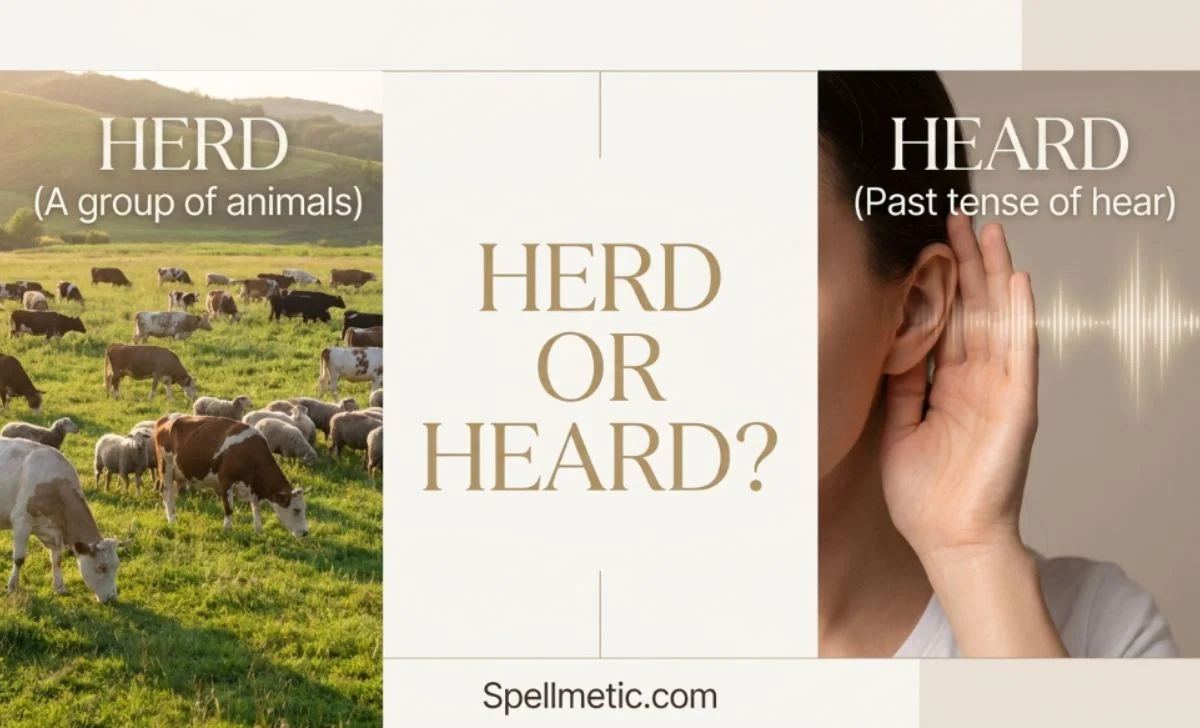
Herd or heard are two English words that sound the same but have completely different meanings.
This makes them easy to confuse, especially when writing from something you have heard in conversation.
Herd usually refers to a group of animals, such as cows, horses, sheep, or elephants. It can also be used as a verb when someone guides or moves a group.
Heard is the past tense and past participle of hear. It is used when someone listened to, noticed, or received something through hearing.
For example:
We saw a herd of cows in the field.
I heard a strange noise outside.
The pronunciation does not help much because herd and heard are homophones. The easiest way to choose the right word is to look at the meaning of the sentence.
Herd or Heard: Quick Answer
Use herd when you mean a group of animals or the act of guiding a group.
Use heard when you mean the past form of hear.
| Word | Meaning | Example |
|---|---|---|
| Herd | A group of animals; to guide a group | A herd of horses crossed the road. |
| Heard | Past form of hear | I heard a loud noise. |
So, “a herd of cows” is correct, while “a heard of cows” is incorrect when you mean a group of cows.
What Does Herd Mean?
Herd is most commonly used as a noun for a group of animals that live, feed, or move together.
You might hear it used for:
- a herd of cows
- a herd of cattle
- a herd of horses
- a herd of sheep
- a herd of goats
- a herd of elephants
For example:
A herd of cattle was grazing near the farm.
Here, herd treats the animals as one group.
Herd as a Noun
As a noun, herd identifies a group rather than one individual animal.
The farmer owns a large herd of sheep.
The word does not identify one particular sheep. It refers to the collection of animals as a group.
Herd as a Verb
Herd can also be a verb. In this form, it means to gather, drive, or guide animals or people in a particular direction.
The farmer herded the cows into the barn.
The verb changes depending on the tense:
- herd — present form
- herded — past form
- herding — -ing form
For example:
The shepherd is herding the sheep toward the gate.
This is different from heard, even though the words sound alike.
What Does Heard Mean?
Heard is the past tense and past participle of hear.
The verb hear relates to perceiving sounds or receiving information through listening.
For example:
I heard a knock at the door.
The sentence tells us that the person noticed the sound in the past.
Heard as the Past Tense of Hear
Compare these two sentences:
I hear music every morning.
I heard music yesterday.
Hear is the present form, while heard is the simple past.
Another example is:
She heard someone calling her name.
Heard as a Past Participle
Heard is also used with auxiliary verbs such as have, has, and had.
I have heard that song before.
They had heard the announcement already.
This grammatical use is one reason why heard appears frequently in everyday English.
Herd vs. Heard: Key Difference
The simplest distinction is based on context.
| Feature | Herd | Heard |
|---|---|---|
| Meaning | Group of animals; guide a group | Past form of hear |
| Word type | Noun or verb | Verb |
| Related word | Herded | Hear |
| Common context | Animals and groups | Sounds and information |
| Pronunciation | Same | Same |
| Example | A herd of cows | I heard a cow |
When the sentence describes animals moving or staying together, think herd.
When it describes something someone listened to or perceived, think heard.
Are Herd and Heard Homophones?
Yes. Herd and heard are homophones.
Homophones are words that have the same pronunciation but different spellings and meanings.
That explains why someone can say either word and you may not know which spelling they mean until you see the sentence.
For example:
I heard the sound of a herd nearby.
The two words sound alike, but their jobs are different:
- heard = perceived a sound
- herd = a group of animals
Other examples of homophones include there/their/they’re and to/too/two. Like these pairs, herd/heard must be understood from context.
Herd or Heard Pronunciation
Herd and heard have the same standard English pronunciation.
Their identical sound is the main reason learners confuse them in writing.
Since pronunciation cannot tell you which spelling to choose, focus on the meaning:
Herd → group or animals
Heard → past form of hear
For example:
We watched a herd of elephants.
We heard the elephants from a distance.
The spelling changes because the meaning changes.
Which Is Correct: “Herd” or “Heard” of Cows?
The correct expression is “a herd of cows.”
A herd of cows was standing near the fence.
Here, herd means a group of cows.
Heard would be wrong if you are trying to describe the group:
We saw a heard of cows. ❌
We saw a herd of cows. ✅
However, heard can appear near the word “cows” in a different context:
I heard the cows making noise.
In this sentence, heard is correct because it comes from the verb hear.
Is It Correct to Say “A Herd of Horses”?
Yes, a herd of horses is correct.
For example:
A herd of horses was running across the field.
You can also say:
We watched a herd of horses near the mountains.
The important point is that herd describes the group. You would use heard only when talking about something you heard.
We heard the horses from inside the house.
Here, heard is the past form of hear.
When Should You Use Heard?
Use heard when you are talking about hearing a sound, receiving information, or learning about something through communication.
Heard a Sound
I heard a loud crash downstairs.
Someone
She heard her brother calling from outside.
The News
We heard the news this morning.
About Something
Heard about means that you received information about something.
Have you heard about the new school?
Something
Heard of generally means that you know about or recognize the existence of someone or something.
Have you heard of this author?
From Someone
Heard from usually means that you received communication from someone.
I haven’t heard from my friend recently.
All these expressions use heard because they are related to hear.
Herd and Heard in Real-Life Sentences
Natural examples make the difference much easier to remember.
Examples With Herd
The farmer has a large herd of cattle.
A herd of sheep moved toward the water.
We saw a herd of elephants during the safari.
The rancher is managing a herd of horses.
Examples With Heard
I heard a strange noise last night.
She heard the announcement clearly.
We heard about the changes yesterday.
Have you heard from your manager?
Herd and Heard in the Same Sentence
You can even use both words naturally in one sentence:
We heard the horses before we saw the herd.
Another example:
I heard the cattle moving, but I couldn’t see the herd.
These examples show why the spelling depends on meaning rather than pronunciation.
Herd vs. Heard vs. Herded
Herded is another useful word to distinguish from heard.
| Word | Meaning | Example |
|---|---|---|
| Herd | A group; to guide a group | The farmer will herd the cattle. |
| Herded | Guided or moved a group | She herded the sheep into the pen. |
| Heard | Past form of hear | I heard the sheep outside. |
Compare:
The farmer herded the cows into the field.
The farmer heard the cows from the house.
In the first sentence, he moved the cows. In the second, he perceived their sound.
Common Herd or Heard Mistakes
Because these words sound identical, spelling mistakes are easy to make.
Mistake 1: Using Herd for Hearing
I herd a strange noise. ❌
I heard a strange noise. ✅
The sentence is about hearing, so heard is correct.
Mistake 2: Using Heard for a Group
We saw a heard of cows. ❌
We saw a herd of cows. ✅
The sentence refers to a group of cows, so herd is correct.
Mistake 3: Confusing Herded With Heard
The farmer heard the sheep into the barn. ❌
If the intended meaning is “guided,” the correct sentence is:
The farmer herded the sheep into the barn. ✅
These small differences can completely change the meaning of a sentence.
Easy Memory Trick for Herd and Heard
A quick memory trick can make this pair easier.
Think of herd whenever you see a group of animals:
herd of cows
Think of heard whenever the sentence involves hear:
I heard a noise.
You can also associate heard with the ear, since hearing happens through your ears.
The spelling may take practice, but the meaning provides a reliable clue.
How to Choose Herd or Heard in Seconds
Ask yourself what the sentence is actually saying.
Is it about a group of animals?
Use herd.
A herd of cattle crossed the road.
Is it about something someone heard?
Use heard.
I heard a truck outside.
Is it about guiding animals?
Use herd or herded, depending on the tense.
The farmer herded the cattle home.
This simple context test works better than trying to distinguish the words by sound.
Herd or Heard Practice Quiz
Choose herd, heard, or herded.
- We saw a ___ of cows near the river.
- I ___ a loud noise last night.
- The farmer ___ the sheep into the barn.
- Have you ___ about the new restaurant?
- A ___ of horses was running across the field.
- She has ___ that song many times.
- The shepherd ___ the goats toward the gate.
- The elephants moved together as a ___.
Answers
- herd
- heard
- herded
- heard
- herd
- heard
- herded
- herd
FAQs
1. What does herd mean?
Herd means a group of animals. It can also be a verb meaning to gather, guide, or move a group.
2. Which is correct: “herd” or “heard” of cows?
The correct phrase is “a herd of cows.” Herd means a group of animals, while heard is the past form of hear.
3. What does heard mean?
Heard is the past tense and past participle of hear. It refers to something perceived through hearing or information received by listening.
4. Is it correct to say a herd of horses?
Yes. “A herd of horses” is a correct and natural expression for a group of horses.
5. When should you use heard?
Use heard when talking about something you perceived by hearing or information you received through listening, such as “I heard a noise.”
6. What is the difference between heard and herd?
Herd means a group of animals or the act of guiding a group. Heard is the past tense and past participle of hear.
7. What is herd used for?
Herd is used for groups of animals and can also describe the action of gathering, driving, or guiding animals or people.
8. Is herd a noun or a verb?
Herd can be both a noun and a verb. As a noun, it means a group of animals. As a verb, it means to gather or guide a group.
9. Is heard the past tense of hear?
Yes. Heard is the simple past form of hear and is also used as its past participle.
10. Are herd and heard homophones?
Yes. Herd and heard are homophones because they have the same pronunciation but different spellings and meanings.
Conclusion
The difference between herd and heard becomes simple when you focus on context. Herd refers to a group of animals or the action of guiding a group, while heard is the past tense and past participle of hear.
Remember two useful examples: “a herd of cows” and “I heard a noise.” If the sentence is about animals moving together, choose herd.
If it is about hearing something, choose heard.Although these words sound the same, their meanings are completely different.
Once you connect each spelling with its purpose, you can use herd, heard, and herded confidently in everyday English.
Read More Blogs: