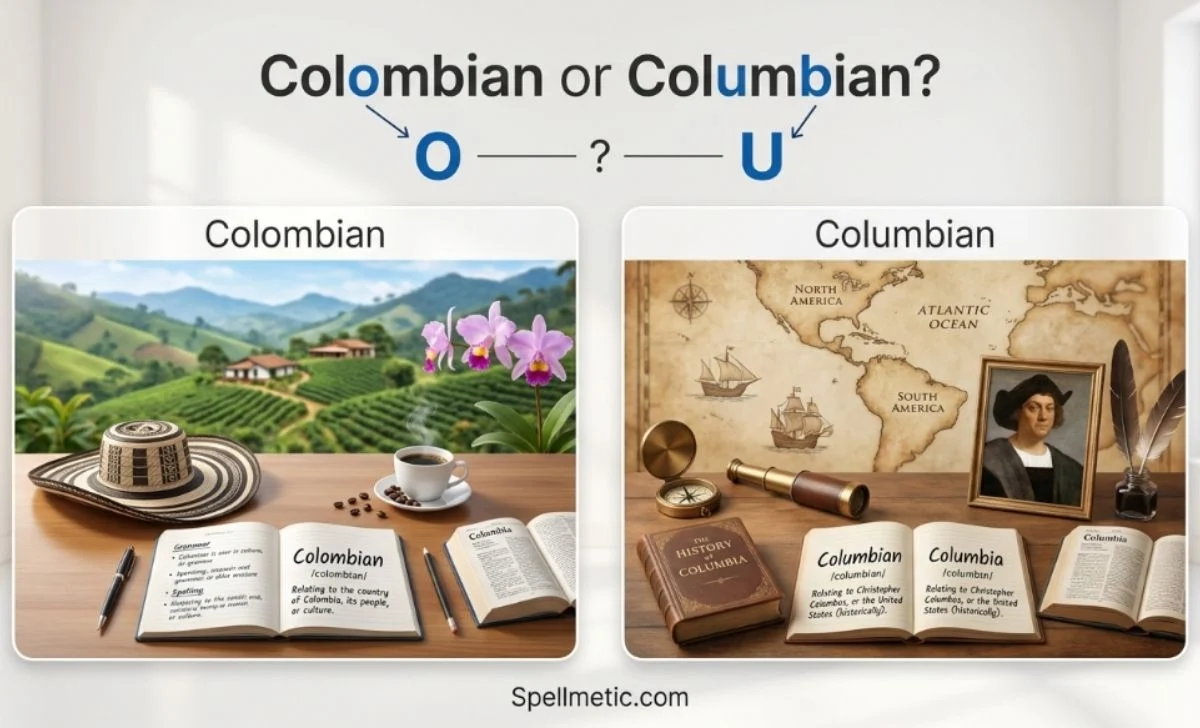
If you are talking about the country in South America, the correct word is Colombian. A person from Colombia is a Colombian, and things associated with the country are also described as Colombian.
Columbian is a real English word, but it has a different use. It can relate to Columbia, Christopher Columbus, or established historical terms such as the Columbian Exchange.
The confusion is understandable because Colombia and Columbia look and sound very similar.
The difference comes down to more than one letter, though. They refer to different names and contexts.
Colombian or Columbian: Quick Answer
Use Colombian when you mean Colombia, its people, culture, language, food, coffee, or other things connected with the country.
Use Columbian when the context relates to Columbia, Christopher Columbus, or a recognized historical expression.
| Word | Main meaning | Example |
|---|---|---|
| Colombian | Related to Colombia | Colombian coffee |
| Columbian | Related to Columbia or Columbus in certain contexts | Columbian Exchange |
Both words are legitimate English words. The important point is choosing the one that matches your intended meaning.
What Does “Colombian” Mean?
Colombian is the standard adjective and noun associated with Colombia.
As an adjective, it describes something connected with the country:
- Colombian culture
- Colombian food
- Colombian music
- Colombian Spanish
- Colombian history
- Colombian coffee
- Colombian cities
As a noun, a Colombian means a person from Colombia. The plural is Colombians.
Colombian as an Adjective
You can use Colombian before a noun:
She enjoys Colombian food.
He is studying Colombian history.
We bought Colombian coffee.
They are learning about Colombian culture.
In each example, the word refers directly to Colombia.
Colombian as a Noun
When referring to a person, use Colombian:
Maria is Colombian.
He is a Colombian who lives in Bogotá.
Many Colombians speak Spanish.
This is why Colombian is the correct nationality word for someone from Colombia.
What Does “Columbian” Mean?
Columbian is not simply a misspelling of Colombian. It is an established English word with several uses.
Depending on the context, it can relate to Columbia, Christopher Columbus, or historical terminology derived from his name.
For example:
The Columbian Exchange changed the history of the world.
Here, Columbian refers to Christopher Columbus and the historical exchange associated with his voyages, not the modern country of Colombia.
Columbian and Christopher Columbus
The connection between Columbian and Columbus explains several familiar expressions.
You may encounter:
- Columbian Exchange
- pre-Columbian civilizations
- Columbian Exposition
These terms are historical rather than references to modern Colombian nationality.
Columbian and Columbia
Columbian can also describe something associated with a place or name called Columbia.
For example, Columbia appears in names such as British Columbia, the District of Columbia, and the Columbia River.
That is why automatically changing every Columbian to Colombian can create a different meaning.
Colombian vs Columbian: The Key Difference
The easiest way to remember the distinction is:
Colombia → Colombian
Columbia/Columbus → Columbian
Consider these examples:
| Meaning | Correct word |
|---|---|
| A person from Colombia | Colombian |
| Colombia’s culture | Colombian |
| Food from Colombia | Colombian |
| Coffee from Colombia | Colombian |
| Spanish spoken in Colombia | Colombian |
| Christopher Columbus | Columbian |
| Columbian Exchange | Columbian |
| Pre-Columbian history | Columbian |
| Columbia-related context | Columbian |
The spelling changes because the underlying name changes.
Colombia vs Columbia: Why Are They Different?
This is where much of the confusion begins.
Colombia is the official name of the South American country. Its capital is Bogotá, and other well-known cities include Medellín and Cartagena.
Columbia, on the other hand, is a separate English name used in several geographic and historical contexts. It appears in names such as:
- District of Columbia
- British Columbia
- Columbia River
- Columbia, South Carolina
So, although the two words look almost identical, Colombia and Columbia are not interchangeable.
Why Do People Confuse Colombia With Columbia?
English speakers regularly encounter Columbia in American and Canadian place names. That familiarity can make the spelling Columbia feel natural when someone is trying to write Colombia.
The similarity is especially noticeable because Colombian and Columbian can sound very close in English.
But in writing, the distinction matters.
Colombia = the country
Columbia = a different name used in various places and contexts
Colombian vs Columbian Pronunciation
The pronunciation can make this spelling confusion even more understandable.
In many varieties of English, Colombian and Columbian have very similar pronunciations. The spelling difference is therefore much easier to notice on a page than in ordinary conversation.
For English learners, it helps to connect the pronunciation to the meaning rather than relying only on how the words sound.
When you hear someone talking about a person, product, language, or tradition from Colombia, the intended word is Colombian.
Is Colombian Coffee or Columbian Coffee Correct?
If you mean coffee produced in Colombia, the standard expression is Colombian coffee.
For example:
Colombian coffee is popular around the world.
She bought a bag of Colombian coffee.
Columbian coffee would normally suggest a different meaning and is not the standard way to describe coffee from Colombia.
This is a useful everyday example because it shows why the single-letter difference matters.
What Is a Person From Colombia Called?
A person from Colombia is called a Colombian.
The plural is Colombians.
Examples:
My colleague is Colombian.
Several Colombians attended the event.
Colombian communities live in many countries.
You would not normally call a person from Colombia a Columbian.
What Nationality Is Colombian?
Colombian is the nationality and demonym associated with Colombia.
A demonym is a word used to identify people from a particular place. For example:
- Colombia → Colombian
- Mexico → Mexican
- Canada → Canadian
- Brazil → Brazilian
So if someone asks, “What nationality is a Colombian?” the straightforward answer is Colombian.
What Do Colombians Call Themselves?
People from Colombia generally refer to themselves as Colombians, or colombianos in Spanish.
In Spanish, the country is Colombia, and the masculine/feminine forms are colombiano and colombiana.
English normally uses the single form Colombian:
He is Colombian.
She is Colombian.
They are Colombians.
Colombian and Columbian: Real-Life Examples
Correct Uses of Colombian
Daniel is Colombian.
We tried traditional Colombian food.
She is interested in Colombian music.
The restaurant serves Colombian coffee.
He is studying Colombian Spanish.
Bogotá is the capital of Colombia.
Correct Uses of Columbian
The Columbian Exchange had enormous historical consequences.
Archaeologists study pre-Columbian civilizations.
The museum displayed material from the Columbian Exposition.
These examples show why Columbian should not simply be labeled “wrong.” It is correct in particular contexts; it is just not the standard word for modern Colombia.
Common Mistakes With Colombian and Columbian
Mistake 1: Using Columbian for a Colombian Person
Incorrect:
She is Columbian.
Correct:
She is Colombian.
Mistake 2: Writing Columbian Coffee
Incorrect:
I prefer Columbian coffee.
Correct:
I prefer Colombian coffee.
Mistake 3: Changing Every Columbian to Colombian
This can also cause problems.
For example:
The Columbian Exchange
should not become:
The Colombian Exchange
The established historical term is Columbian Exchange.
Mistake 4: Spelling the Country “Columbia”
If you mean the South American country, write:
Colombia
not:
Columbia
A simple memory trick is to associate the country’s spelling directly with its demonym:
Colombia → Colombian
When Should You Use Colombian?
Choose Colombian when the subject is connected with modern Colombia.
This includes:
- Colombian people
- Colombian nationality
- Colombian culture
- Colombian food
- Colombian coffee
- Colombian Spanish
- Colombian music
- Colombian history
- Colombian businesses
- Colombian cities
- Colombian traditions
For example:
The company imports Colombian coffee.
She wants to visit Colombian cities such as Cartagena and Medellín.
He is learning about Colombian culture.
When Is Columbian Correct?
Use Columbian when the context specifically calls for the word associated with Columbia or Columbus.
Common examples include:
- Columbian Exchange
- pre-Columbian
- Columbian Exposition
- certain Columbia-related names and descriptions
The surrounding context should make the meaning clear.
Why Do Americans Sometimes Say “Columbia” Instead of “Colombia”?
It is more accurate to say that some English speakers confuse the two, rather than suggesting that Americans universally use Columbia for Colombia.
One reason is exposure to familiar American names containing Columbia, especially the District of Columbia and places such as Columbia, South Carolina. The spelling Columbia is therefore already familiar to many English speakers.
The similar pronunciation adds to the confusion.
However, when referring to the South American country, the standard English spelling remains Colombia.
An Easy Memory Trick
If you keep mixing up the two spellings, remember this:
Colombia → Colombian
Think of the O in Colombia carrying over into Colombian.
Columbia/Columbus → Columbian
Think of U as belonging to Columbia and the Columbus family of historical terms.
This simple connection can prevent most everyday spelling mistakes.
FAQs
1. What is the correct spelling: Colombian or Columbian?
Both are real words, but Colombian is correct when referring to Colombia, its people, culture, products, or language. Columbian has different historical and Columbia-related uses.
2. What is the difference between Colombian and Columbian?
Colombian relates to Colombia. Columbian can relate to Columbia or Christopher Columbus and appears in established historical terms.
3. What nationality is a Colombian person?
A person from Colombia is Colombian.
4. What is a person from Colombia called?
A person from Colombia is called a Colombian. More than one person are Colombians.
5. Why is Colombia spelled with an “o” instead of “u”?
Colombia is the established name of the South American country. It should not be changed to Columbia, which is a separate name used in other contexts.
6. Why do people confuse Colombia with Columbia?
The words have very similar spelling and pronunciation, while Columbia is also familiar from names such as the District of Columbia and British Columbia.
7. How do you pronounce Colombian and Columbian?
They are pronounced very similarly in many varieties of English. The spelling and meaning provide the more important distinction.
8. Is Columbian a correct word for someone from Colombia?
No. Colombian is the standard demonym for someone from Colombia. Columbian is a valid English word but does not normally mean a person from Colombia.
9. What do Colombians call themselves?
In English, they call themselves Colombians. In Spanish, colombianos can refer to Colombians generally, while colombiano and colombiana are singular forms.
10. Is Colombian coffee or Columbian coffee correct?
Colombian coffee is correct when you mean coffee from Colombia.
Final Answer
The correct choice depends on what you mean.
Use Colombian for Colombia: its people, nationality, culture, food, coffee, language, history, and products.
Use Columbian for appropriate Columbia- or Columbus-related contexts, including established terms such as Columbian Exchange and pre-Columbian.
The easiest rule is:
Colombia → Colombian
Columbia/Columbus → Columbian
Once you connect each spelling to its source word, the difference becomes much easier to remember.
Read More Blogs: