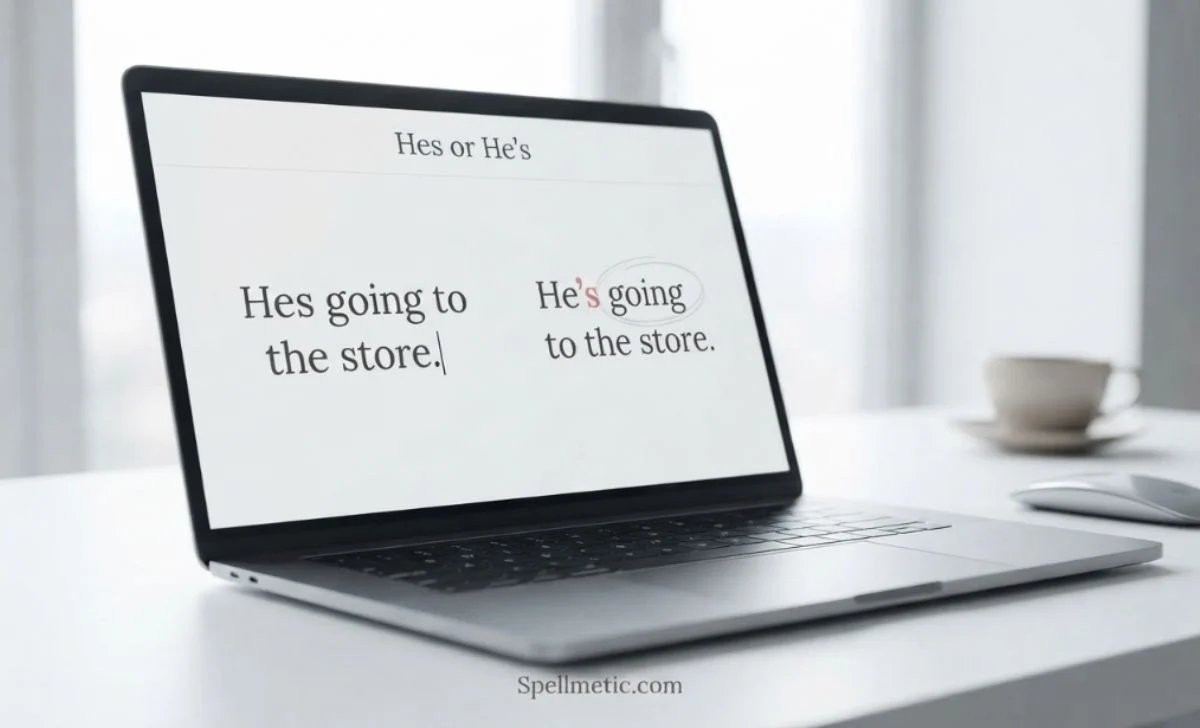
If you have ever typed hes and wondered whether it should be he’s, the answer is simple: he’s is the correct form in standard English.
The apostrophe matters because he’s is a contraction of he is or he has. Without the apostrophe, hes is not a standard English word.
This small punctuation mistake is common in texts, emails, social media posts, and other types of quick writing.
Whether you are checking the hes or he’s meaning, looking for the correct hes or he’s grammar, or trying to use the word naturally in a sentence, this guide explains the difference with clear examples.
Quick Answer
He’s is correct when you mean he is or he has.
Hes is not the standard spelling of this contraction. In ordinary English writing, it is generally a typo caused by leaving out the apostrophe.
| Form | Correct? | Meaning | Example |
|---|---|---|---|
| He’s | Yes | He is / He has | He’s waiting outside. |
| Hes | No | Not a standard English word | Hes waiting outside. |
For example:
- He’s ready for the meeting. = He is ready for the meeting.
- He’s finished the report. = He has finished the report.
A useful test is to replace he’s with he is or he has. If the sentence still makes sense, the apostrophe belongs there.
What Does “He’s” Mean?
The meaning of he’s depends on what follows it.
He’s = He Is
Use he’s as a contraction of he is.
Examples:
- He’s tired after work.
- I think he’s right.
- He’s preparing for the interview.
- He’s one of our best players.
In each example, you can expand he’s to he is:
He’s tired. → He is tired.
He’s = He Has
He’s can also be a contraction of he has.
This commonly occurs before a past participle.
Examples:
- He’s finished his homework.
- He’s already left.
- He’s forgotten his keys.
- He’s completed the application.
Here, expanding the contraction gives he has:
He’s finished. → He has finished.
So, the full form of he’s can be either he is or he has. The surrounding sentence tells you which one is intended.
Is “Hes” a Correct Word?
No, hes is not normally accepted as a standard English spelling for he’s.
The most common reason people write hes is that they leave out the apostrophe while typing. This can happen when someone is writing quickly, using a phone keyboard, or relying on voice-to-text.
For example:
- Incorrect: Hes coming to dinner.
- Correct: He’s coming to dinner.
The missing apostrophe changes the written form of the contraction. Although a reader may understand hes, it should be corrected in standard English writing.
A sequence such as HES may occur as an abbreviation, acronym, username, code, or proper name in a particular context. That does not make hes an alternative spelling of he’s.
Why Does “He’s” Need an Apostrophe?
An apostrophe is used in contractions to indicate omitted letters.
He is becomes he’s, and he has can also become he’s.
Compare:
- He is → He’s
- He has → He’s
The apostrophe signals that the shorter form comes from two words.
Without it:
- He’s → standard contraction
- Hes → not the standard contraction
This is why punctuation is important even in a very short word.
He’s vs. His: What’s the Difference?
He’s and his can sound similar in some varieties of English, but they perform different grammatical jobs.
| Word | Meaning | Example |
|---|---|---|
| He’s | He is / He has | He’s working today. |
| His | Belonging to or associated with a male person | His phone is on the desk. |
Use he’s when you can expand it to he is or he has.
Use his when you are showing possession.
Compare:
- He’s wearing his new jacket.
- He’s finished his assignment.
- His brother works nearby.
- I borrowed his laptop.
A quick substitution test makes the difference easy to remember.
How to Use “He’s” in a Sentence
If you’re searching for hes or he’s in a sentence, the correct form is he’s.
Here are several examples in everyday contexts:
- He’s waiting outside the restaurant.
- I think he’s the right person for the job.
- He’s coming home later tonight.
- Everyone knows he’s a talented musician.
- He’s already completed the project.
- If he’s available, we’ll ask him to join us.
- Sarah said he’s arriving at noon.
- He’s been working here for five years.
Notice that he’s can represent either he is or he has:
- He’s coming. → He is coming.
- He’s finished. → He has finished.
When Should You Use “He’s”?
Use he’s when a contraction of he is or he has fits naturally into the sentence.
It is common in:
- Everyday conversation
- Text messages
- Emails
- Social media
- Blog posts
- General online writing
- Informal business communication
For example:
Conversation:
“Don’t worry. He’s on his way.”
Email:
“John said he’s available tomorrow.”
Social media:
“He’s finally reached his goal.”
Blog writing:
“He’s one of the most experienced professionals in the field.”
In highly formal, academic, legal, or institutional writing, the preferred style can vary. Some organizations or style guides favor he is and he has instead of contractions. When a specific style guide applies, follow its requirements.
Hes or He’s Grammar Rule
The basic hes or he’s grammar rule is straightforward:
Use he’s when it means he is or he has.
Do not remove the apostrophe simply because the pronunciation may sound like one continuous word.
For example:
- He’s interested in the position.
- He’s already submitted the form.
- He’s going to call later.
A useful editing trick is to expand the contraction:
He’s → He is / He has
If neither full form works, check whether you intended another word, such as his.
What Is the Definition of “He’s”?
The he’s definition is a contracted form of either he is or he has.
Its grammatical meaning depends on the context.
For example:
- He’s happy. = He is happy.
- He’s gone home. = He has gone home.
The word does not have a separate meaning unrelated to those two forms in standard English.
Does “He’s” Mean a Boy or a Girl?
The search question “he’s meaning boy or girl” is really about the pronoun he.
In standard English, he is traditionally a third-person singular pronoun used for a male person. Therefore:
- He’s a doctor. = He is a doctor.
- He’s my brother. = He is my brother.
- He’s waiting outside. = He is waiting outside.
However, he’s itself does not mean “boy” or “girl.” It is simply a contraction of he is or he has.
Can “He’s” Be Replaced With “His”?
No. He’s and his are not interchangeable.
Consider:
- He’s reading a book.
- His book is on the table.
The first sentence means he is reading a book. The second shows that the book belongs to him or is associated with him.
This distinction is especially important because missing or misplaced apostrophes can change the grammatical role of a word.
Is There a Synonym for “He’s”?
There is no single synonym for he’s because the contraction can represent two different phrases.
If he’s means he is, you can sometimes rewrite the sentence using the full phrase:
- He’s happy.
- He is happy.
If he’s means he has, you can similarly use:
- He’s finished.
- He has finished.
So if you searched for hes or he’s synonym, the closest equivalent depends on which full form the contraction represents. In most cases, the useful alternative is simply he is or he has, rather than a different synonym.
Common Mistakes With He’s
The most frequent errors are simple but easy to overlook.
Writing “Hes” Instead of “He’s”
Incorrect:
- Hes coming tomorrow.
Correct:
- He’s coming tomorrow.
Confusing “He’s” With “His”
Incorrect:
- He’s car is outside.
Correct:
- His car is outside.
Here, his shows possession, so he’s would not work.
Using “He’s” When the Expansion Fails
Not every sentence containing the sound “he’s” should use he’s.
Ask whether the word means he is or he has. If neither fits, another word may be needed.
Quick Way to Remember the Difference
Use this three-step check:
- Write he’s if you mean he is or he has.
- Write his when you are showing possession.
- Do not write hes as the standard contraction.
For example:
He’s going to bring his laptop.
The first word means he is. The second shows ownership.
Hes or He’s Quiz
Test yourself with these sentences.
- ___ going to call you later.
- I think ___ already finished the work.
- ___ brother lives nearby.
- ___ one of the best players on the team.
- The teacher said ___ submitted the assignment.
Answers
- He’s
- He’s
- His
- He’s
- He’s
The key is to determine whether the word means he is, he has, or indicates possession.
FAQs
1. Is “hes” correct?
No. Hes is not the standard English spelling of the contraction he’s. It is usually a typo caused by leaving out the apostrophe.
2. What does “he’s” mean?
He’s means either he is or he has, depending on the sentence.
3. What is the full form of “he’s”?
The full form of he’s can be he is or he has.
4. Can “he’s” mean both “he is” and “he has”?
Yes. Context determines which meaning is intended.
5. What is the difference between “his” and “he’s”?
His shows possession, while he’s means he is or he has.
6. Why do people write “hes”?
Usually because they forget the apostrophe while typing or because of a keyboard, autocorrect, or voice-to-text error.
7. Is “he’s” grammatically correct?
Yes. He’s is a standard English contraction of he is or he has.
8. Is “he’s” formal or informal?
He’s is acceptable in most everyday writing. However, some formal or academic styles prefer the full forms he is and he has.
9. Can “he’s” mean a boy or a girl?
No. He’s does not itself mean “boy” or “girl.” It is a contraction containing the pronoun he, which traditionally refers to a male person.
10. What is a simple way to remember “hes or he’s”?
Replace he’s with he is or he has. If the sentence makes sense, use he’s with the apostrophe.
Final Answer
The correct form is he’s, not hes, when you mean he is or he has.
The apostrophe is necessary because it marks the contraction:
He is → he’s
He has → he’s
Remember that his is different because it shows possession:
He’s using his phone.
If you’re unsure, expand he’s in your head. If he is or he has works, you’ve found the correct form.
For schoolwork, professional emails, blog posts, and everyday English, this simple check will help you avoid the common hes or he’s mistake.
Read More Blogs:
- Channelled or Channeled? Understand the UK-US Difference
- Comma or Coma: Learn the Difference With Easy Examples