If you have ever written “I quite my job” or wondered whether something is “quite” or “quit,” you are not alone.
These two words look almost identical, but they have completely different meanings and grammatical roles.
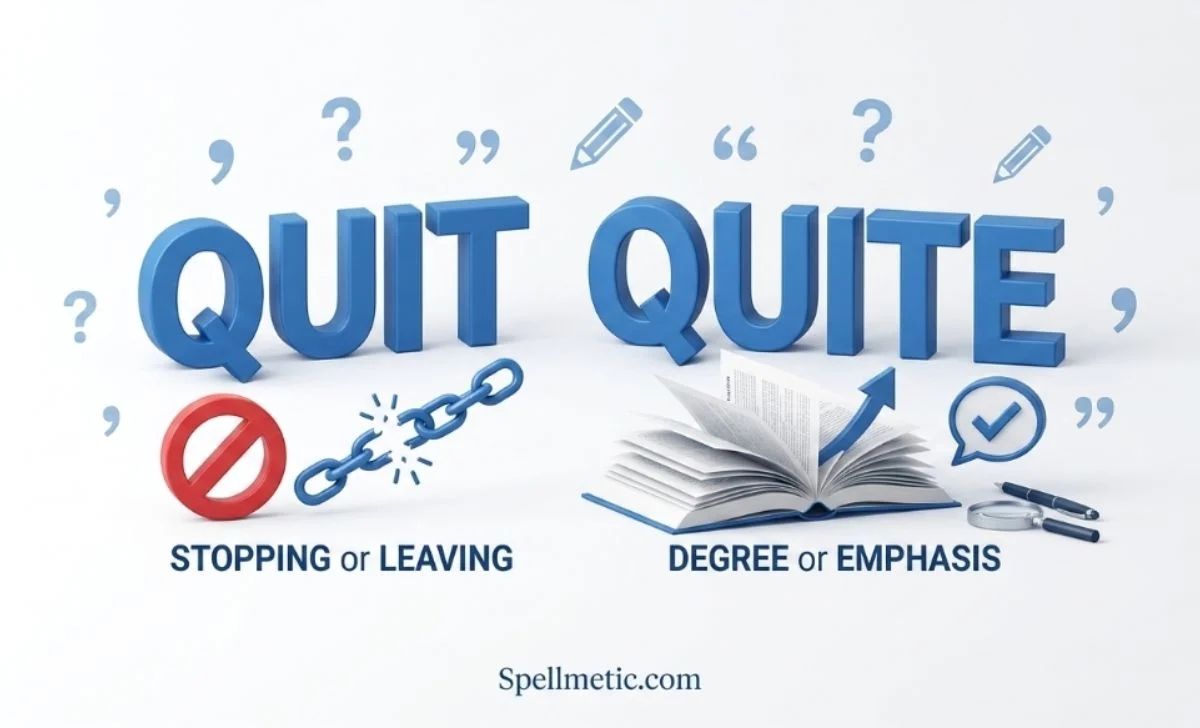
Quit is a verb that usually means to stop doing something or leave a job, place, or activity. Quite is an adverb that can mean fairly, rather, very, or completely, depending on the context.
There is also a third word worth knowing: quiet. It refers to a lack of noise and is another common source of confusion.
This guide explains the difference between quit, quite, and quiet, including their meanings, pronunciation, grammar, examples, common mistakes, and useful expressions.
Quit or Quite: Quick Answer
Quit means to stop doing something or leave something.
I decided to quit my job.
Quite is an adverb used to express degree or emphasis. Depending on the context, it can mean fairly, rather, very, or completely.
The movie was quite interesting.
The easiest way to remember them is:
Quit = stop or leave
Quite = degree or intensity
Quiet = little or no noise
Quit vs Quite at a Glance
| Feature | Quit | Quite |
|---|---|---|
| Part of speech | Verb | Adverb |
| Main meaning | Stop or leave | Fairly, very, or completely |
| Pronunciation | /kwɪt/ | /kwaɪt/ |
| Syllables | 1 | 1 |
| Common use | Quit a job, quit smoking | Quite good, quite difficult |
| Example | She quit smoking. | She is quite happy. |
The key difference is not just spelling. Quit describes an action, while quite modifies the degree or intensity of something.
What Does “Quit” Mean?
Quit is mainly a verb. It means to stop doing something, leave a job or organization, or stop taking part in an activity.
Quit Means “Stop Doing Something”
You can use quit when someone stops an activity or habit.
Examples:
- He decided to quit smoking.
- She quit playing tennis.
- I need to quit wasting time.
- They finally quit arguing.
A common grammatical pattern is:
quit + -ing verb
She quit drinking coffee.
He quit playing the game.
Quit Means “Leave a Job”
In everyday English, quit is frequently used when someone leaves their employment.
Maria quit her job last Friday.
He wants to quit his job and start a business.
In a more formal context, resign may be more appropriate:
The director resigned from his position.
However, quit is perfectly standard English and is extremely common in everyday conversation.
Quit Can Mean Leave an Activity or Place
The word can also refer to leaving a school, team, competition, or activity.
She quit the team after two seasons.
He quit school at sixteen.
I almost quit the competition, but my coach encouraged me to continue.
Is “Quit” Present or Past Tense?
One useful feature of quit is that the base form and past forms are often identical.
- Present: I quit when I lose interest.
- Past: I quit yesterday.
- Past participle: I have quit.
For the -ing form, use quitting.
She is quitting her job.
Notice the spelling change: quit → quitting, not quiting.
What Does “Quite” Mean?
Quite is an adverb. Its meaning depends heavily on the word and context around it.
This is where many learners get confused because quite does not always mean “very.”
It can express a moderate degree, or in other contexts it can express a strong degree such as very or completely.
Quite Means “Fairly” or “Rather”
With many ordinary, gradable adjectives, quite often means fairly, rather, or reasonably.
The test was quite difficult.
The restaurant is quite expensive.
She is quite happy with the results.
Here, the speaker is expressing a noticeable degree without necessarily suggesting the highest possible degree.
Quite Can Mean “Very” or “Completely”
With certain adjectives and expressions, quite can have a stronger meaning.
You are quite right.
That explanation is quite clear.
The two situations are quite different.
The exact strength of quite depends on context, the adjective being modified, and whether the adjective describes something that can vary by degree.
This is why treating quite as a simple synonym for very can lead to inaccurate explanations.
Does “Quite” Have Two Meanings?
Yes. In everyday English, quite commonly has two broad uses:
- Fairly or rather
- Very or completely
Compare these examples:
| Sentence | Likely meaning |
|---|---|
| The book is quite interesting. | Fairly/rather interesting |
| The problem is quite difficult. | Fairly/rather difficult |
| You are quite right. | Completely/very right |
| The results are quite different. | Very or completely different |
The context matters. British and American English can also differ in how strongly quite is interpreted in some situations.
Quit vs Quite vs Quiet
If you confuse quit and quite, you may also encounter quiet.
These three words are spelled similarly but have three different meanings.
| Word | Meaning | Example |
|---|---|---|
| Quit | Stop or leave | I want to quit my job. |
| Quite | Fairly, very, or completely | The lesson was quite easy. |
| Quiet | Not noisy | Please keep quiet. |
A simple memory trick:
Quit → stop
Quite → degree
Quiet → sound
How to Pronounce Quit, Quite, and Quiet
Pronunciation is another useful way to separate these words.
Quit
Quit is pronounced /kwɪt/.
It rhymes closely with words such as:
- bit
- sit
- fit
- hit
Quit your job only after thinking carefully.
Quite
Quite is pronounced /kwaɪt/.
It sounds like:
- bite
- light
- night
- right
The movie was quite good.
Quiet
Quiet is pronounced /ˈkwaɪ.ət/ and normally has two syllables.
The library is very quiet.
So:
quit → /kwɪt/
quite → /kwaɪt/
quiet → /ˈkwaɪ.ət/
The vowel sound is especially important: quit has the short /ɪ/ sound, while quite begins with the /aɪ/ sound.
How to Use “Quit” in a Sentence
Here are natural examples from different situations.
Workplace
Daniel decided to quit his job after receiving another offer.
Habits
She quit smoking two years ago.
School
He didn’t quit school; he transferred to another college.
Sports
The player refused to quit despite being injured.
Activities
I quit playing the game because it was getting late.
Technology
In computing, quit can also refer to closing a program or application.
Click the menu and select Quit.
How to Use “Quite” in a Sentence
Quite commonly appears before adjectives and adverbs.
Adjectives
The hotel was quite comfortable.
The question is quite difficult.
She looks quite tired.
Adverbs
He spoke quite clearly.
The car moved quite slowly.
Noun Phrases
A common pattern is:
quite + a/an + adjective + noun
It was quite a surprise.
She is quite an experienced teacher.
With Quantities
English also uses expressions such as:
- quite a few
- quite a lot
- quite a bit
Examples:
I have quite a few questions.
She has quite a lot of experience.
We still have quite a bit of work to do.
What Does “Not Quite” Mean?
Not quite usually means not completely or almost, but not fully.
Examples:
I’m not quite ready.
This means the person is almost ready but not ready yet.
That’s not quite what I meant.
The speaker means that the other person is close to understanding, but the interpretation is not completely correct.
The project is not quite finished.
It is nearly finished, but some work remains.
This expression is extremely common in natural English.
Can “Quite” Be Used With Verbs?
Yes. Quite can modify verbs in certain constructions.
Examples include:
I quite like this restaurant.
I quite agree with you.
I quite understand your concern.
The meaning can vary according to context and the verb being used. In these examples, quite can add a sense of degree or emphasis rather than simply meaning “very.”
Why Do People Say “Quite Literally”?
Quite literally is used to emphasize that something is literally true, rather than figuratively true.
For example:
The temperature literally dropped below freezing.
Adding quite can strengthen the speaker’s emphasis:
He was quite literally running for his life.
However, in casual speech, people sometimes use literally as an intensifier even when something is not strictly literal. That informal usage can create confusion.
In careful writing, use quite literally when the statement genuinely has a literal meaning.
Common Quit or Quite Mistakes
These errors are common because the words look and sound similar.
Mistake 1: Using “Quite” Instead of “Quit”
❌ I want to quite my job.
✅ I want to quit my job.
The sentence describes leaving a job, so quit is correct.
Mistake 2: Using “Quit” Instead of “Quite”
❌ The exam was quit difficult.
✅ The exam was quite difficult.
Here, quite modifies the adjective difficult.
Mistake 3: Confusing “Quiet” With “Quite”
❌ Please be quite.
✅ Please be quiet.
The sentence is about noise, so quiet is required.
Mistake 4: Misspelling “Quitting”
❌ She is quiting her job.
✅ She is quitting her job.
When adding -ing to quit, the final consonant is doubled.
Quit vs Resign vs Leave vs Give Up
These words are related, but they are not interchangeable in every sentence.
| Word | Typical meaning | Example |
|---|---|---|
| Quit | Stop or leave | She quit her job. |
| Resign | Formally leave a position | He resigned as manager. |
| Leave | Go away or depart | She left the office. |
| Give up | Stop trying or stop an activity | Don’t give up on your goal. |
| Cease | Stop, usually formal | The company ceased operations. |
For everyday conversation, quit and give up are common. Resign and cease can sound more formal depending on the situation.
British English vs American English
The word quit is standard in both British and American English.
The more interesting difference concerns quite.
In many British English contexts, quite can naturally mean fairly or rather:
The film was quite good.
Depending on context, an American English speaker may interpret the same phrase as stronger praise.
This does not mean that British English always uses quite weakly or American English always uses it strongly. Context, intonation, and the adjective itself matter.
So you should not assume that every occurrence of quite has exactly the same intensity.
Easy Memory Tricks
If you regularly mix up these words, remember three simple ideas:
Quit = Stop
I quit smoking.
Quite = Degree
The movie is quite good.
Quiet = No Noise
Please be quiet.
Another useful trick is to focus on the middle sound:
quIT → think of IT as stopping an activity.
quITE → rhymes with right.
quIET → sounds like a place becoming calm and silent.
Quit, Quite, and Quiet Practice
Choose the correct word: quit, quite, or quiet.
- I decided to ___ my job.
- The restaurant was ___ expensive.
- Please be ___ during the exam.
- She has ___ a few books at home.
- I’m not ___ ready.
- He wants to ___ smoking.
- The classroom became completely ___.
- The two answers are ___ different.
Answers
- quit
- quite
- quiet
- quite
- quite
- quit
- quiet
- quite
The fastest way to choose the answer is to look at the function of the word, not just its spelling.
FAQs
1. What is the difference between “quit” and “quite”?
Quit is a verb meaning to stop or leave. Quite is an adverb that can mean fairly, rather, very, or completely depending on context.
2. What does “quit” mean?
Quit means to stop doing something, leave a job or organization, or stop participating in an activity.
3. What does “quite” mean?
Quite is an adverb used to express degree. It can mean fairly, rather, very, or completely depending on the sentence.
4. Does “quite” have two meanings?
Yes. Its most common broad meanings are fairly/rather and very/completely. The intended meaning depends on context and the expression being used.
5. What is the difference between quit, quite, and quiet?
Quit means stop or leave, quite expresses degree or emphasis, and quiet means having little or no noise.
6. How do you pronounce quit, quite, and quiet?
Quit is /kwɪt/, quite is /kwaɪt/, and quiet is /ˈkwaɪ.ət/. Quit and quite have one syllable, while quiet normally has two.
7. What does “not quite” mean?
Not quite means not completely or almost but not fully.
I’m not quite ready.
8. Can “quite” mean “very”?
Yes. In some contexts, quite can express a strong degree and mean something similar to very or completely. Its exact strength depends on context.
9. Is “quit” the past tense of “quit”?
Yes. Quit can function as the present form, past tense, and past participle.
I quit.
I quit yesterday.
I have quit.
10. What is another word for “quit”?
Depending on the context, alternatives include stop, leave, resign, give up, and discontinue. The best synonym depends on what someone is quitting.
Conclusion
The difference between quit and quite becomes much easier once you focus on what each word does in a sentence.
Quit is a verb. It means to stop something, leave a job, or leave an activity.
I decided to quit my job.
Quite is an adverb. It expresses degree and can mean fairly, rather, very, or completely, depending on context.
The new job is quite challenging.
And don’t forget quiet, which describes something with little or no noise:
The office is unusually quiet today.
A simple rule can help you remember all three: quit means stop, quite shows degree, and quiet means no noise. Once you notice the word’s role in the sentence, choosing the correct spelling becomes much easier.
Read More Blogs: