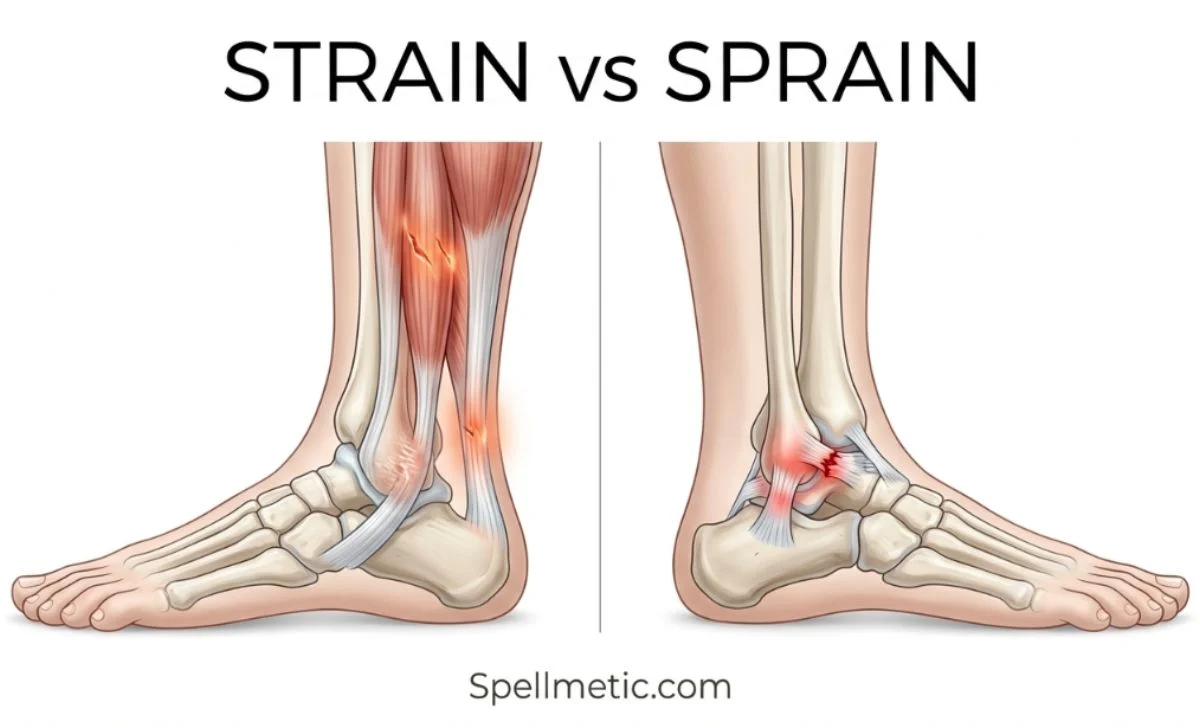
If you suddenly hurt yourself while running, lifting, playing sports, or simply twisting a joint, you may wonder: Is it a strain or sprain? The two injuries can feel very similar, but they affect different tissues.
A strain usually involves a muscle or tendon, while a sprain affects a ligament. Both can cause pain, swelling, bruising, weakness, stiffness, and difficulty moving the injured area.
The difference matters because the location and type of tissue involved can affect treatment and recovery.
This guide explains the strain vs. sprain difference, common symptoms, causes, treatment options, healing time, severity, and when professional medical care may be necessary.
Quick Answer
A strain is an injury to a muscle or tendon, while a sprain is an injury to a ligament.
| Feature | Strain | Sprain |
|---|---|---|
| Affected tissue | Muscle or tendon | Ligament |
| Common areas | Hamstring, calf, back, shoulder | Ankle, knee, wrist, thumb |
| Typical cause | Overstretching, overuse, sudden force | Twisting, falling, or joint movement beyond its normal range |
| Common symptoms | Pain, weakness, tenderness, spasms | Pain, swelling, bruising, tenderness, instability |
| Severity | Mild stretching to complete tear | Mild stretching to complete ligament tear |
The symptoms can overlap, so the way the injury happened and where the pain is located can provide useful clues.
What Is a Strain?
A strain happens when a muscle or tendon is overstretched or damaged. Tendons are strong connective tissues that connect muscles to bones.
You may hear a strain called a pulled muscle, particularly when the injury involves muscle fibers.
Common Causes of a Strain
Strains can happen because of:
- Sudden movements
- Heavy lifting
- Overstretching
- Repetitive activity
- Sports
- Poor conditioning
- Muscle fatigue
- Overuse
A strain does not always result from one dramatic movement. Repeated physical demands can gradually overload a muscle or tendon. For example, a runner increasing training too quickly may develop a calf strain.
Common Examples
Some familiar examples include:
- Hamstring strain
- Calf strain
- Back strain
- Groin strain
- Shoulder or rotator cuff strain
What Is a Sprain?
A sprain occurs when a ligament is stretched or torn. Ligaments connect bones to other bones and help keep joints stable.
A sprain commonly occurs when a joint is suddenly twisted, rolled, or forced beyond its normal range of movement.
Common Causes of a Sprain
Typical causes include:
- Rolling an ankle
- Falling
- Landing awkwardly
- Twisting a knee
- Sports injuries
- Catching yourself with your hand during a fall
For example, if you step off a curb and your ankle suddenly rolls inward, the ligaments supporting the ankle can be stretched or torn.
Common Examples
Common sprains include:
- Ankle sprain
- Knee sprain
- Wrist sprain
- Thumb sprain
- ACL sprain or tear
Strain vs. Sprain Symptoms
One reason people confuse these injuries is that strain and sprain symptoms can look very similar.
Both may cause:
- Pain
- Tenderness
- Swelling
- Bruising
- Weakness
- Stiffness
- Reduced range of motion
- Difficulty using the affected area
Muscle spasms or cramping can also occur, particularly with some strains. A sprained joint may additionally feel unstable or as though it could give way.
Symptoms More Common With a Strain
A strain may cause:
- Pain in or around a muscle
- Muscle weakness
- Tenderness
- Muscle spasms
- Pain when contracting or stretching the affected muscle
- Reduced movement
For instance, a hamstring strain may hurt when you stretch or contract the back of your thigh.
Symptoms More Common With a Sprain
A sprain may cause:
- Pain around a joint
- Swelling
- Bruising
- Tenderness over a ligament
- Reduced joint movement
- Difficulty bearing weight
- Joint instability
An ankle sprain, for example, can make walking painful and may cause the ankle to feel weak or unstable.
How Can You Tell If It’s a Strain or Sprain?
There is no reliable home test that can diagnose every injury, but a few clues can help you understand what may have happened.
Look at the location: pain centered around a muscle may suggest a strain, while pain around a joint after twisting it may suggest a sprain.
Think about the movement: lifting, sprinting, overstretching, or repetitive activity can lead to a strain. Rolling or twisting a joint is a common mechanism for a sprain.
Consider stability: a feeling that a joint might give way is more suggestive of ligament involvement.
However, these clues are not a substitute for an examination. Strains and sprains can overlap with fractures, tendon injuries, and other soft-tissue problems.
A healthcare professional may assess strength, movement, tenderness, and joint stability to determine the injury
Strain vs. Sprain: Causes and Risk Factors
Both injuries can occur during sports, work, exercise, or everyday activities.
Risk can increase with:
- Tired muscles
- Sudden increases in training
- Repetitive movements
- Poor conditioning
- Previous injuries
- Inadequate warm-up
- Activities involving jumping, pivoting, or rapid direction changes
Consider two everyday examples. Someone lifting a heavy sofa and suddenly feeling pain in the lower back may have a strain. Someone stepping awkwardly during basketball and rolling an ankle may have a sprain.
Which Is Worse: a Strain or Sprain?
Neither injury is automatically worse. The seriousness depends more on the extent of tissue damage than on whether the injury is called a strain or a sprain.
A mild strain can be less serious than a severe sprain, while a major muscle or tendon tear can be more significant than a mild ligament injury.
In general, injuries can range from simple stretching and tiny tissue damage to partial tears and complete ruptures. Severe ligament injuries can also cause joint instability.
So, if you’re searching “which is worse, strain or sprain?”, the better answer is: the severity of the injury matters more than the label.
Strain vs. Sprain Treatment
Treatment depends on the location and severity of the injury. Mild injuries can often be managed at home, while serious injuries may need medical assessment, rehabilitation, bracing, or other treatment.
What to Do Initially
For an acute injury, protection, relative rest, compression, and elevation may help manage symptoms. NHS guidance uses the PRICE approach during the first few days: Protection, Rest, Ice, Compression, and Elevation.
Ice can help with pain and swelling, but current medical guidance is more nuanced than the old idea that prolonged icing is always necessary. Yale Medicine notes that inflammation is part of the body’s healing response and recommends using ice primarily for symptom control when appropriate.
Don’t Stay Completely Inactive for Too Long
Once movement is comfortable enough, gradual and controlled activity can help prevent stiffness and restore function. The right amount of movement depends on the injury.
For more significant injuries, a healthcare professional or physical therapist can guide rehabilitation.
When Medication May Help
Over-the-counter pain medicines may help some people manage discomfort, but the best option depends on individual circumstances, other medicines, and existing health conditions.
A pharmacist or healthcare professional can help you choose an appropriate option.
Strain vs. Sprain Healing Time
There is no single recovery time for every strain or sprain.
Mild injuries may improve within days to a couple of weeks, while more significant partial tears can take weeks to months. NHS guidance says many sprains and strains feel better after about two weeks, although severe injuries can take months to return to normal.
Recovery depends on:
- Injury severity
- Location
- Tissue involved
- Age and general condition
- Previous injury
- Rehabilitation
- How quickly normal activity is resumed
Returning to intense exercise too soon can increase the risk of reinjury.
How Doctors Diagnose a Strain or Sprain
A healthcare professional usually starts with your medical history and physical examination.
They may check:
- Pain location
- Swelling
- Bruising
- Range of motion
- Muscle strength
- Joint stability
- How the injury occurred
Imaging is not necessary for every mild injury. An X-ray may be used when a fracture needs to be ruled out. Ultrasound can sometimes show soft-tissue damage, while MRI may be useful when a more serious tendon, ligament, or muscle injury is suspected.
When Should You See a Doctor?
Most mild sprains and strains improve with appropriate self-care, but some injuries need professional assessment.
Seek medical advice if:
- Pain is severe or getting worse
- Swelling or bruising is substantial
- You cannot bear weight
- You cannot use the affected area normally
- Movement is very limited
- Symptoms are not improving
- You suspect a significant tear
Get urgent medical attention if the injured body part looks deformed, becomes numb or tingling, turns blue or grey, feels unusually cold, or you heard a crack during the injury. These symptoms can indicate a fracture or another serious problem.
How to Prevent Strains and Sprains
You cannot prevent every injury, but you can lower your risk by:
- Warming up before demanding exercise
- Building strength gradually
- Increasing training loads slowly
- Taking recovery days
- Wearing suitable footwear
- Improving balance and flexibility
- Avoiding intense exercise when extremely fatigued
- Returning gradually after a previous injury
Good conditioning is particularly important for sports that involve jumping, sprinting, pivoting, or sudden changes in direction.
Strain vs. Sprain: Side-by-Side Comparison
| Factor | Strain | Sprain |
|---|---|---|
| Definition | Muscle or tendon injury | Ligament injury |
| Tissue | Muscle/tendon | Ligament |
| Typical mechanism | Overstretching, force, overuse | Twisting, rolling, falling |
| Common locations | Hamstring, calf, back | Ankle, knee, wrist |
| Pain | Often around the affected muscle/tendon | Often around the affected joint/ligament |
| Swelling | Possible | Common |
| Bruising | Possible | Common |
| Weakness | Common | Possible |
| Instability | Less typical | More typical with significant sprains |
| Treatment | Protection, symptom control, gradual rehabilitation | Protection, symptom control, support, rehabilitation |
| Recovery | Depends on severity | Depends on severity |
The key distinction is simple: muscle or tendon = strain; ligament = sprain.
FAQs
1. What is the main difference between a strain and a sprain?
A strain affects a muscle or tendon, while a sprain affects a ligament. Both can involve stretching or tearing of tissue.
2. Is a strain worse than a sprain?
Not necessarily. A severe strain can be serious, but so can a severe sprain. The extent of tissue damage and loss of function matters more than the type of injury.
3. Is a sprain worse than a strain?
Not automatically. A mild sprain may heal quickly, while a major muscle or tendon strain can require extensive rehabilitation. Severity is the more useful comparison.
4. How can you tell if you have a strain or sprain?
Consider where the pain is and how the injury happened. Muscle or tendon pain after lifting, sprinting, or overstretching may suggest a strain, while joint pain after twisting or rolling may suggest a sprain. A professional examination is needed for a reliable diagnosis.
5. Can a strain and sprain happen at the same time?
Yes. A single accident can damage more than one type of tissue. For example, a fall or sports injury can affect muscles, tendons, and ligaments at the same time.
6. How long does a strain take to heal?
A mild strain may improve within days or a couple of weeks, while a more serious partial tear can take weeks or months. Recovery depends on the injury’s severity and location.
7. How long does a sprain take to heal?
Many mild sprains improve within about two weeks, but severe sprains can take months. Rehabilitation and gradual return to activity can be important for more significant injuries.
8. What is the best treatment for a strain or sprain?
Treatment depends on the injury. Early protection, symptom management, compression and elevation may help, followed by appropriate movement and rehabilitation. More serious injuries may require a brace, physical therapy, imaging, or specialist care.
9. When should you see a doctor for a strain or sprain?
Get medical advice when pain is severe, symptoms are worsening, swelling is significant, you cannot bear weight, or the injury is not improving. Urgent care is appropriate for deformity, numbness, unusual color or coldness, or a crack heard during the injury.
10. Can you prevent strains and sprains?
You cannot eliminate the risk, but warming up, building strength gradually, managing training loads, using appropriate footwear, and allowing adequate recovery can reduce the likelihood of injury.
Conclusion
When comparing strain or sprain, the most important distinction is the tissue involved. A strain affects a muscle or tendon, whereas a sprain affects a ligament.
Their symptoms can look remarkably similar, which is why the terms are often confused.
A sudden twist or rolled joint is more commonly associated with a sprain, while lifting, sprinting, overstretching, or repetitive activity can contribute to a strain. Still, symptoms alone cannot always identify the exact injury.
Neither is automatically worse. A mild strain may be far less serious than a severe sprain, and a major tendon or muscle tear can require more treatment than a minor ligament injury.
Recovery likewise varies from days or weeks to several months depending on severity.
If pain is severe, the injured area is deformed or numb, you cannot bear weight, or symptoms are getting worse, professional medical assessment is the safer choice.
For uncomplicated injuries, gradual recovery and appropriate rehabilitation can help you return to normal activity while reducing the risk of reinjury.