If you have ever written “plyers” instead of “pliers,” you are not alone. The two spellings look similar, sound almost identical in ordinary speech, and are easy to mix up.
However, when you mean the hand tool used for gripping, bending, cutting, or holding objects, pliers is the standard spelling.
Plyers is generally treated as a misspelling of pliers in modern standard English.
If you are writing an email, school assignment, product description, instruction manual, or professional document, pliers is the spelling you should use.
The confusion is understandable because English has many words where the letters “y” and “i” can appear in similar positions.
In this case, though, remembering the correct form is straightforward: the tool is spelled pliers, with “i” after the l.
Quick Answer: Plyers or Pliers?
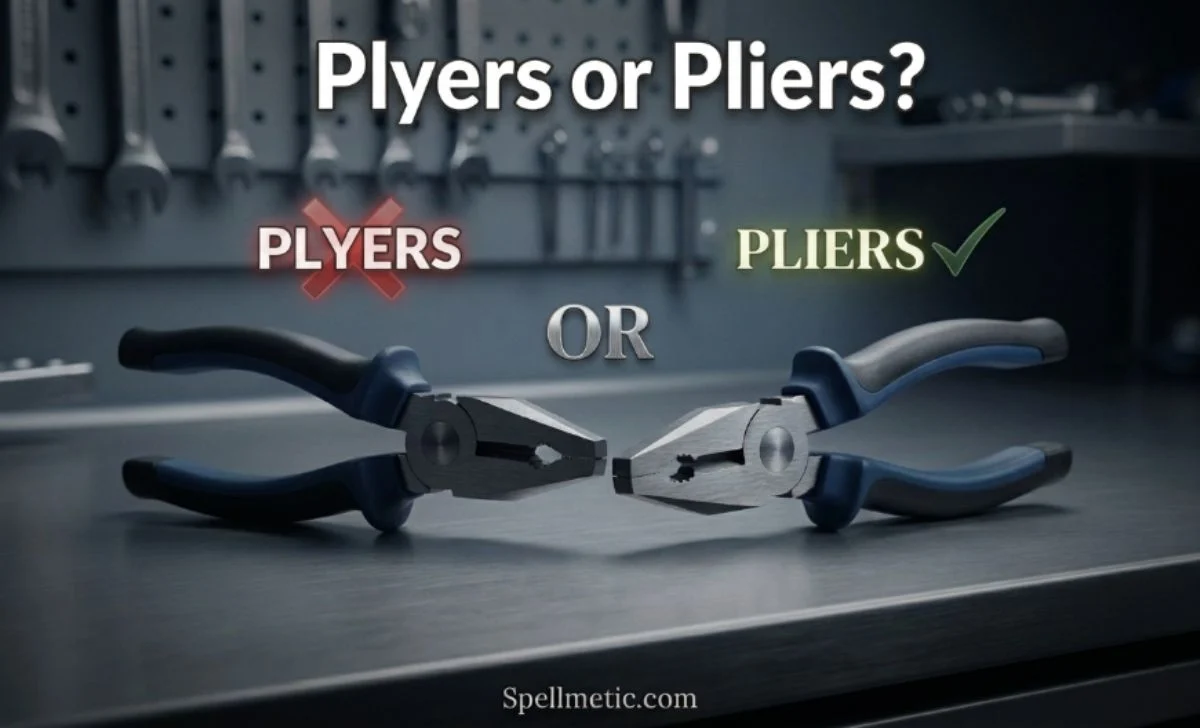
Pliers is the correct standard spelling.
- Pliers = the standard English spelling for the hand tool.
- Plyers = generally a misspelling of pliers.
Correct Example
I need a pair of pliers to remove this wire.
Incorrect Example
I need a pair of plyers to remove this wire.
If you are referring to the familiar hand tool, always choose pliers in standard English.
What Does Pliers Mean?
Pliers are a hand tool consisting of two joined levers with jaws at one end and handles at the other.
They are commonly used to:
- grip objects
- bend wire
- hold small parts
- cut certain types of wire
- pull or twist materials
- perform repair and maintenance work
For example:
She used a pair of pliers to bend the wire into shape.
The word can refer to many types of tools, including needle-nose pliers, slip-joint pliers, locking pliers, and cutting pliers.
Is Plyers a Correct Word?
For the tool, plyers is not the standard spelling.
People may write “plyers” because the word is pronounced in a way that does not clearly reveal its spelling.
Search engines and spell-checkers may also encounter the misspelling because people frequently type words according to how they sound.
If you are writing about tools, hardware, construction, electrical work, automotive repair, or DIY projects, use pliers.
Why Do People Spell It Plyers?
The most likely reason is pronunciation.
When someone hears “pliers,” the word can sound roughly like “ply-ers.” A writer who relies on sound rather than memory may naturally type plyers.
This is a common type of spelling mistake: the incorrect version looks reasonable because it reflects the way the word sounds.
Plyers vs. Pliers
| Word | Status | Meaning | Example |
|---|---|---|---|
| pliers | Correct | A hand tool with jaws and handles | He grabbed the pliers. |
| plyers | Misspelling | Intended to mean pliers | He grabbed the plyers. |
The difference is only one letter, but that letter matters in standard written English.
Why Is Pliers Spelled With an “I”?
The spelling pliers is connected to the older word ply, meaning to work with or use something, and the historical development of the tool’s name.
Modern English has settled on pliers as the standard spelling for the tool.
This is one reason it is better to memorize the conventional spelling rather than trying to spell the word purely from pronunciation.
A useful memory trick is:
Pliers = tool with “I”
Think of the I as the little metal joint or pivot connecting the two sides of the tool.
How Do You Use Pliers in a Sentence?
Here are some natural examples:
- He used a pair of pliers to pull out the nail.
- The mechanic reached for the pliers.
- Use needle-nose pliers to hold the small wire.
- She kept a pair of pliers in her toolbox.
- These pliers are useful for bending metal wire.
Notice that pliers normally refers to the tool itself.
Why Do We Say “A Pair of Pliers”?
One of the most common grammar questions about this word is why we say “a pair of pliers” instead of simply “a plier.”
Pliers are made of two connected sides that work together, so the noun is normally treated as a plural-form tool noun.
We commonly say:
I bought a pair of pliers.
We can also say:
I need two pairs of pliers.
Not:
I need two pliers.
The same pattern appears with other tools and objects that have two joined parts, such as scissors and tongs.
Pliers or Plyers in American and British English
There is no major American-versus-British spelling difference here.
Both American English and British English use pliers as the standard spelling for the tool.
| English Variety | Standard Spelling |
|---|---|
| American English | pliers |
| British English | pliers |
| Canadian English | pliers |
| Australian English | pliers |
So changing from American to British English does not make plyers correct.
Common Mistakes With Pliers
Mistake 1: Writing Plyers
I bought new plyers.
Correct:
I bought new pliers.
Mistake 2: Using “Plyer” for One Tool
Because pliers looks plural, some learners try to create the singular form “plyer.”
For normal everyday English, the usual expression is:
a pair of pliers
Mistake 3: Confusing Pliers With Players
The word players is completely different.
- pliers = a hand tool
- players = people who play a game or sport
For example:
The players picked up the pliers.
Both words can appear in the same sentence, but they have entirely different meanings.
Types of Pliers
Understanding the different types can also make the correct spelling easier to remember.
Needle-Nose Pliers
These have long, narrow jaws and are useful for reaching small or difficult spaces.
The electrician used needle-nose pliers to position the wire.
Slip-Joint Pliers
These have an adjustable pivot, allowing the jaws to open to different widths.
Use slip-joint pliers for a larger grip.
Locking Pliers
These can lock onto an object and maintain their grip.
The mechanic used locking pliers to hold the damaged part.
Cutting Pliers
These are designed specifically for cutting wire and similar materials.
He used cutting pliers to trim the cable.
These names all use the same standard spelling: pliers.
Pliers in Real-Life Situations
You will see the word pliers in many practical settings.
At Home
A homeowner might use pliers to grip a stubborn nut, bend wire, or make a small repair.
In Electrical Work
Electricians commonly use specialized pliers for gripping, cutting, and manipulating wires.
In Automotive Repair
Mechanics use different types of pliers when working with clips, wires, hoses, and small components.
In DIY Projects
People often keep pliers in a basic toolbox alongside screwdrivers, wrenches, and hammers.
For example:
Before starting the repair, make sure you have a screwdriver, wrench, and pair of pliers.
Pliers or Plyers: Which One Should You Use?
If you are writing about the hand tool, choose pliers.
Use it in:
- schoolwork
- professional writing
- product descriptions
- technical instructions
- DIY guides
- emails
- workplace documents
- everyday messages
Avoid plyers unless you are intentionally discussing the misspelling itself.
The safest rule is simple:
Pliers = correct
Plyers = misspelling
How to Remember the Correct Spelling
A quick memory trick can help:
Think “I” for “instrument”
PL + I + ERS = PLIERS
The word contains I, not Y.
You can also associate the spelling with the tool:
Pliers have an I.
Whenever you hesitate between plyers or pliers, remember that the standard tool name is pliers.
FAQs
1. Is it plyers or pliers?
Pliers is the correct standard spelling for the hand tool. Plyers is generally a misspelling.
2. What does pliers mean?
Pliers are a hand tool with two joined handles and jaws used for gripping, bending, holding, twisting, or cutting certain materials.
3. Is plyers a real word?
“Plyers” may appear in user-generated writing or as a spelling mistake, but it is not the standard spelling for the hand tool. Use pliers in formal and everyday English.
4. Do you say a plier or a pair of pliers?
The usual expression is “a pair of pliers.” The noun normally appears in its plural form because the tool has two connected sides.
5. Is pliers singular or plural?
Pliers has a plural form, and we normally say “a pair of pliers” when referring to one tool.
6. Is pliers spelled differently in British English?
No. Pliers is the standard spelling in both British and American English.
7. Why do people spell pliers as plyers?
The pronunciation can make plyers seem logical. People sometimes spell unfamiliar words according to how they sound, which can lead to this common misspelling.
8. What is the correct plural of pliers?
The usual form is pliers. For more than one set, say “two pairs of pliers.”
9. What is the difference between pliers and players?
Pliers are a hand tool, while players are people who participate in a game or sport. They are completely different words.
10. What are the most common types of pliers?
Common types include needle-nose pliers, slip-joint pliers, locking pliers, and cutting pliers. Each type is designed for different repair or gripping tasks.
Conclusion
When choosing between plyers or pliers, the correct spelling for the hand tool is pliers. The spelling plyers is generally a mistake caused by writing the word according to its pronunciation.
Remember that pliers can be used for gripping, bending, holding, twisting, and cutting certain materials. Because the tool has two connected sides, English normally uses the expression “a pair of pliers.”
There is also no meaningful American-versus-British spelling difference: both varieties use pliers.
So the next time you are writing a toolbox list, product description, repair guide, or sentence about hand tools, choose the simple standard form:
Pliers, not plyers.