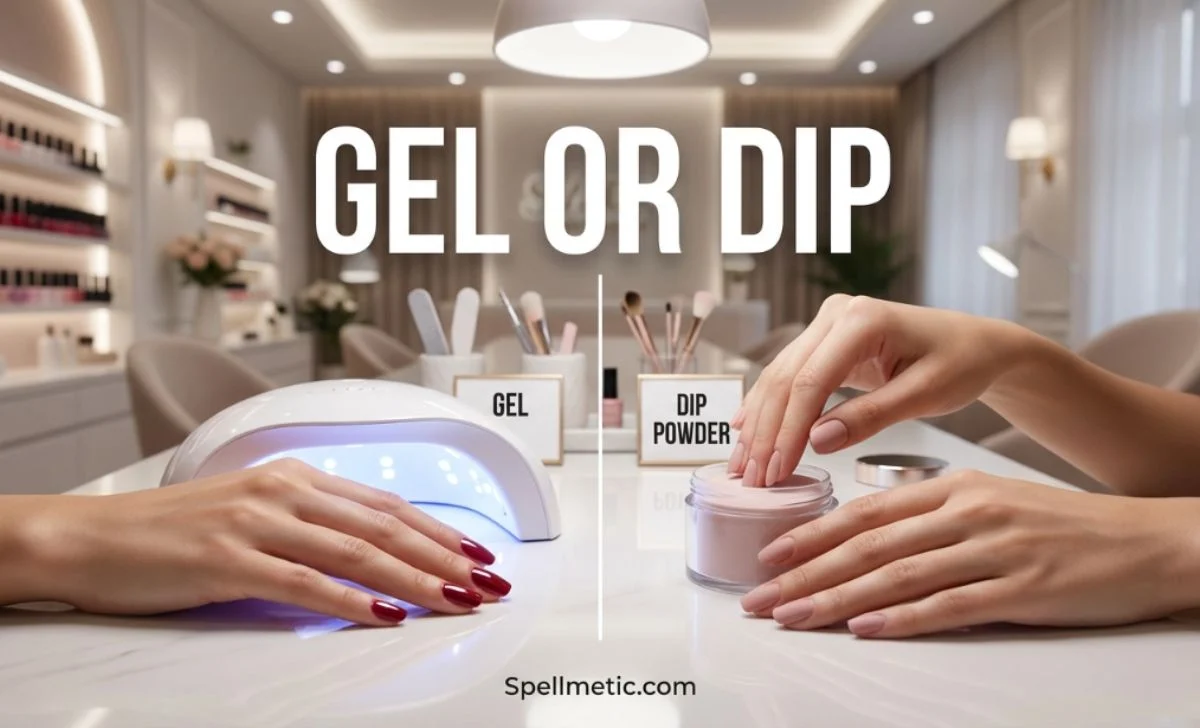
Choosing between gel or dip can be surprisingly difficult. Both can give you glossy, long-lasting nails, but they are not the same manicure.
Gel polish is cured under a UV or LED lamp, while dip powder uses an adhesive system and colored acrylic powder that hardens without a curing lamp.
So, which one is better?
There is no single winner for everyone. Gel is usually the more flexible choice for a thin, glossy finish and detailed nail art, while dip powder is known for durability and does not require a UV or LED curing lamp.
Your natural nail condition, preferred look, maintenance routine, and removal method all matter.If you have thin or brittle nails, the safest choice is not simply about picking gel or dip.
How the nails are prepared, how the product is removed, salon hygiene, and how frequently you get manicures can make a major difference.
Quick Answer
Gel is usually better for a thin, flexible, natural-looking finish and detailed nail art, while dip powder is often better for durability and longer wear without a UV or LED curing lamp.
Neither option is automatically healthier for your nails.Proper preparation, salon hygiene, gentle application, and especially careful removal matter more for nail health.
- Best for thin-looking, flexible nails: Gel
- Best for durability: Dip
- Best for detailed nail art: Gel
- Best for avoiding a curing lamp: Dip
- Best for short natural nails: Either, depending on nail condition
- Best for nail health: Neither has a universal advantage
- Typical wear: Gel often lasts around 2–3 weeks; dip can last up to about 4 weeks
- Most important factor: Proper application and removal
Bottom line: Choose gel for flexibility and versatility; choose dip for strength and longer wear.
If your natural nails are already damaged, irritated, or unusually thin, consider giving them a break instead of covering the problem.
Gel or Dip: What’s the Difference?
The biggest difference is how each system is applied and hardened.
Gel manicure: Gel polish is brushed onto the nail in layers and cured under a UV or LED lamp. It usually creates a smooth, glossy and relatively thin finish.
Dip powder manicure: A base or adhesive is applied to the nail, followed by pigmented acrylic powder. An activator is then used to harden the product, followed by shaping and a top coat.
Dip powder does not require a curing lamp. Cleveland Clinic describes dip powder as a durable system that can last up to about four weeks.
It is also important not to confuse every type of gel with the same product. Gel polish, builder gel and Gel-X are different systems, with different purposes and application methods.
Gel vs Dip Nails at a Glance
| Feature | Gel | Dip Powder |
|---|---|---|
| Application | Gel polish in layers | Adhesive + acrylic powder |
| Curing | UV or LED lamp | Activator; no lamp required |
| Finish | Thin, smooth and glossy | Usually thicker and more structured |
| Flexibility | More flexible | More rigid and durable |
| Wear | Often around 2–3 weeks | Can last up to about 4 weeks |
| Nail art | Excellent for detailed designs | Good, especially for solid colors |
| Removal | Usually soak-off | Usually requires soaking and filing |
| UV exposure | Yes, during curing | No curing lamp |
| Best feature | Finish and versatility | Durability |
These are general comparisons rather than guarantees. Application quality and your individual nails can change the result.
Which Lasts Longer: Gel or Dip?
If your main priority is wear time, dip powder generally has the advantage.
The American Academy of Dermatology notes that dip powder manicures can provide chip-free nails for up to four weeks. Gel manicures can also last for several weeks, but growth at the cuticle and normal wear eventually make a new manicure necessary.
Think about a person who works in a kitchen, types all day, cleans frequently or uses their hands heavily. A more durable dip manicure may be appealing because it can tolerate everyday wear well.
However, longer-lasting does not automatically mean healthier. A manicure that stays intact for four weeks can still cause problems if the nails underneath are becoming thin, irritated or discolored.
Is Dip or Gel Better for Thin Nails?
This is one of the most common questions, and the answer depends on why the nails are thin and how the manicure is applied.
Neither gel nor dip should be treated as a cure for weak nails.
Dip powder can provide a firm protective layer, but the preparation process may involve buffing and filing. Cleveland Clinic notes that extensive filing and buffing can weaken the nail base over time.
Gel is more flexible than some harder artificial systems, and the American Academy of Dermatology recommends soak-off gel options when choosing artificial nails because flexibility may reduce the likelihood of cracking compared with harder systems.
If your nails are already peeling, severely brittle, painful or unusually thin, adding another enhancement may not be the best first step. Let the natural nail recover and consider getting professional advice if the problem continues.
Is Gel or Dip Worse for Your Nails?
Neither option is automatically “bad,” but both can cause problems when used incorrectly or removed aggressively.
Problems Associated With Gel
Repeated gel manicures can contribute to:
- Nail brittleness
- Peeling
- Cracking
- Dryness
- Temporary weakening
- Skin irritation or allergic reactions
The American Academy of Dermatology notes that gel manicures can contribute to brittleness, peeling and cracking.
The removal process also matters. Picking or peeling gel from the nail can take away layers of the natural nail plate.
Problems Associated With Dip Powder
Dip powder can also create issues, particularly when nails are aggressively prepared or the product is removed improperly.
Potential concerns include:
- Excessive filing
- Nail thinning
- Acetone exposure during removal
- Adhesive-related allergic reactions
- Poor salon hygiene
- Nail or surrounding-skin irritation
The AAD also warns against putting fingers directly into a shared dip powder container because germs can potentially be transferred between clients. A salon should instead sprinkle the powder onto the nail or use a disposable container for each client.
So, when asking “Is gel or dip worse for your nails?”, the better question is often: How is the manicure being applied and removed?
Gel vs Dip for Nail Health: What Actually Matters?
The product is only one part of the equation.
Nail Preparation
Aggressive buffing can remove part of the nail surface. Good preparation should improve adhesion without unnecessarily thinning the natural nail.
Removal
Never peel, scrape or forcibly pull off a manicure. Removal should be controlled and appropriate for the product.
Salon Hygiene
Tools should be properly cleaned and disinfected, and shared powder practices should be avoided.
Cuticle Care
Cuticles help protect the area around the nail. The AAD advises against cutting or aggressively pushing them because this can increase the risk of infection.
Recovery Time
If your nails become thin, brittle, discolored or damaged, continuing to cover the problem may make it harder to notice. The AAD recommends checking the natural nails between manicures and taking a break when changes appear.
Which Looks More Natural: Gel or Dip?
For someone who wants a natural-looking manicure, gel often has an advantage because it can create a thinner, smoother appearance.
Gel is particularly popular for:
- Nude manicures
- French tips
- Sheer colors
- Minimal designs
- Short natural nails
- Glossy everyday looks
Dip powder tends to create a more substantial coating. That can be useful if you want additional structure, but very thin nails may feel different under a thicker product.
The final appearance, however, depends heavily on the nail technician’s technique.
Gel or Dip for Short Nails
Both can work well on short nails.
Gel may be the better choice if you want your natural nails to look neat, thin and polished without adding much structure.
Dip may be attractive if your short nails are prone to breaking and you prefer a stronger-feeling manicure.
But there is an important distinction: dip powder does not magically make damaged nails healthy. If short nails are constantly splitting, find out why instead of simply covering the problem.
For example, someone who has short nails because they type all day may prefer gel for its flexible feel. Someone whose short nails repeatedly chip during physical work may prefer the extra durability of dip.
Gel or Dip for Nail Art?
For detailed nail art, gel is usually more versatile.
Gel products work particularly well for:
- French manicures
- Chrome effects
- Cat-eye designs
- Ombre
- Fine lines
- Layered artwork
- Detailed patterns
Dip powder is excellent for clean, solid-color manicures and can also be used creatively, but gel gives a nail technician more flexibility for intricate designs.
If your main goal is a simple long-lasting color, dip can make sense. If you want your nails to be part of the outfit, gel offers more creative freedom.
Which Is More Expensive: Gel or Dip?
There is no universal winner because salon prices vary by location, technician, product, nail length and whether removal is included.
Instead of comparing only the first appointment, consider the total maintenance cost.
A cheaper manicure is not necessarily better value if it requires frequent repairs or if poor removal damages the natural nail.
Ask the salon:
- Is removal included?
- Is a new set charged separately?
- How much is a fill or maintenance appointment?
- Is nail art extra?
- Does the salon charge for removing another product?
- What products and lamps are used?
This gives you a more realistic comparison than looking at the headline price alone.
Is Gel or Dip Faster?
Dip powder can be convenient because it does not need a UV or LED curing step.
Gel, however, cures quickly under a lamp, so the overall appointment can still be efficient.
The real difference often comes down to the technician, nail preparation, design and removal.
A simple gel manicure can be quicker than an elaborate dip application, while a basic dip manicure may save time by avoiding lamp curing. So “which is faster?” depends on the exact service, not just the product.
Gel vs Dip Removal: Which Is Easier?
Removal is one of the most overlooked parts of the decision.
Gel polish is generally designed to be soaked off when it is a soak-off formulation. Dip powder can also require acetone soaking, often combined with filing to reduce the product before soaking.
The biggest mistake is trying to speed up the process by peeling or scraping.
Acetone can dry the surrounding skin, and repeated or prolonged removal can contribute to nail thinning. The AAD specifically notes that acetone used to remove dip manicures can damage nails and surrounding skin.
If you regularly switch between gel and dip, ask your nail technician to remove the previous product carefully rather than aggressively filing the natural nail.
Gel vs Dip and UV Exposure
One major difference is the curing process.
Gel requires UV exposure from a curing lamp, while dip powder does not require a UV or LED curing lamp.
This does not mean that every gel manicure creates a major health risk. Current research on UV nail lamps is still limited, and the evidence does not support exaggerated claims that ordinary gel manicures automatically cause skin cancer.
A 2024 systematic review found that the available evidence on skin-cancer risk from UV nail lamps was limited and of weak quality, although prolonged and repeated exposure may carry a low potential risk. A later review likewise found insufficient compelling evidence to establish a carcinogenic effect from UV nail-dryer lamps.
If UV exposure concerns you, practical precautions include reducing unnecessary exposure and following reputable dermatology advice. The AAD recommends choosing an LED curing light rather than a traditional UV curing light because it emits lower levels of UV radiation and cures more quickly.
Gel or Dip: Which One Should You Choose?
There is no need to choose based on hype. Match the manicure to what you actually need.
Choose Gel If You Want:
- A thin, glossy finish
- A more flexible feel
- Detailed nail art
- A natural-looking manicure
- Short natural nails
- More styling flexibility
Choose Dip If You Want:
- Strong durability
- Longer wear
- A structured finish
- No curing lamp
- A manicure suited to heavy hand use
Consider Taking a Break From Both If:
- Your nails are visibly thinning
- Nails are peeling or cracking
- The surrounding skin is swollen or irritated
- You notice discoloration
- You have a suspected allergic reaction
- Your nails hurt after removal
If you develop persistent nail or skin changes, a dermatologist can help determine whether the problem is from the manicure or an underlying nail condition.
Gel vs Dip vs Acrylic vs Builder Gel
These terms are often mixed together, but they are not interchangeable.
| Type | Best known for |
|---|---|
| Gel polish | Glossy color and flexible finish |
| Dip powder | Durability without a curing lamp |
| Acrylic | Structure and added length |
| Builder gel | Added structure with a gel-based system |
| Gel-X | Full-cover gel extensions |
This distinction matters because saying “gel is better” is incomplete. A thin gel polish manicure and a structured builder-gel enhancement can behave very differently.
How to Protect Your Nails With Either Option
You can reduce many common manicure problems by focusing on the basics:
- Choose a reputable nail salon.
- Make sure reusable tools are properly cleaned and disinfected.
- Avoid aggressive cuticle cutting.
- Never peel off gel or dip powder.
- Ask how dip powder is applied between clients.
- Avoid excessive filing of the natural nail.
- Moisturize your hands and cuticles.
- Check your bare nails between manicures.
- Give damaged nails time to recover.
- Stop using a product if you develop irritation or an allergic reaction.
If a nail becomes discolored, swollen, lifted, unusually thick or painful, don’t simply cover it with another manicure. The AAD recommends leaving the nails bare and seeking dermatological evaluation when nail changes persist.
FAQs
1. Is dip or gel better for thin nails?
Neither is automatically best for every thin nail. Gel can offer a more flexible finish, while dip provides more structure. If nails are already damaged, focusing on recovery and gentle removal may be more important than choosing between the two.
2. Is gel or dip better for nail health?
There is no universal winner. Nail preparation, product application, salon hygiene, removal and manicure frequency can have a greater practical impact on nail health than the label on the bottle.
3. Is gel or dip worse for your nails?
Both can contribute to nail problems when used or removed improperly. Gel can cause brittleness, peeling and cracking, while dip may involve extensive filing, acetone removal and adhesive-related reactions.
4. Which lasts longer, gel or dip?
Dip powder can last longer in many cases. The AAD says dip manicures can remain chip-free for up to four weeks, although actual wear depends on nail growth, application and lifestyle.
5. Is gel or dip more expensive?
Prices vary by salon and location. Compare the complete cost, including removal, maintenance, nail art and future appointments rather than judging by the initial price alone.
6. Is gel or dip better for short nails?
Both can work well. Gel is a good choice for a thin, natural-looking finish, while dip may suit someone who wants additional durability on short nails.
7. Does dip powder damage natural nails?
Dip powder itself is not guaranteed to damage every person’s nails, but aggressive preparation, filing and acetone-based removal can contribute to thinning or dryness.
8. Does gel damage nails?
Gel manicures can contribute to brittleness, peeling and cracking, especially with repeated use or improper removal. Careful application and soak-off removal can help reduce unnecessary damage.
9. Does dip powder need a UV light?
No. Dip powder hardens through its adhesive and activator system, so it does not require a UV or LED curing lamp.
10. Can you switch between gel and dip?
Yes, but the previous product should be removed carefully. Avoid stacking new products over damaged nails or aggressively filing the natural nail during the switch.
Final Verdict
Gel or dip is not really a question of which manicure is universally better. It is a question of which one fits your nails and priorities.
Choose gel when you want flexibility, a thinner glossy finish, natural-looking short nails or detailed nail art. Choose dip when durability and avoiding a curing lamp are higher priorities.
For nail health, however, the most important factor may be what happens before and after the manicure.
Gentle preparation, clean tools, proper removal, careful cuticle care and paying attention to changes in your natural nails can make a bigger difference than simply choosing gel over dip.
If your nails are already thin, peeling or irritated, don’t use another manicure to hide the problem. Give them time to recover and seek professional advice if the changes persist.
Read More Blogs: